

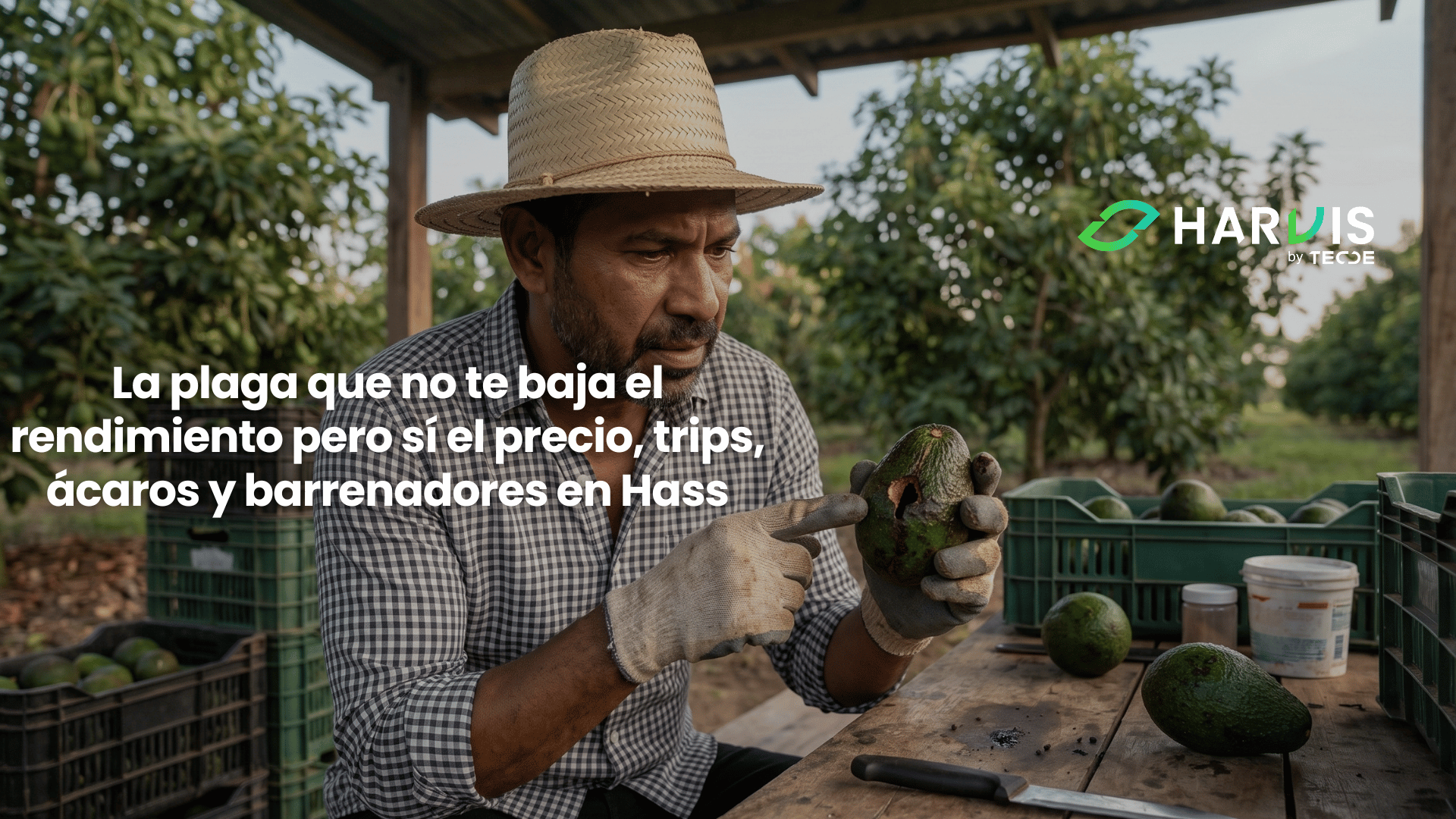
A study that gathered records from 136 productive Colombian lots with monitoring of at least five years quantified the losses due to rejection of Hass fruit at 5.78 percent on the farm and 5.68 percent at the packing plant, equivalent to $80.29 per ton produced. That money does not appear in any yield record because the fruit was produced, harvested, and weighed; it simply did not reach the market that would pay better. And when looking at the list of causes for rejection in pre-harvest and harvest, low calibers, damage to the epidermis by insects of the subfamily Melolonthidae, thrips, mites, the bug Monalonion, overripe fruit, and sunburn top the list.
The previous two blogs of this season focused on pests that reduce what you harvest. The economic threshold framework and sampling from the first, and its application to a pest that lives hidden inside the fruit in the second, share an assumption that no longer holds here: that damage translates into less product. In Hass, much of the relevant damage does not reduce tons; it reduces commercial category, and that forces a re-evaluation of the threshold with another variable.
It is worth entering knowing where the real difficulty lies. These pests are not difficult to recognize or to control chemically; they are difficult to manage well because their damage windows are short, their distribution in the lot is uneven, and late applications clash directly with the demands of the market you were targeting.
The Damage That Doesn't Weigh but Costs
The first correction that needs to be made to the framework of the first blog of this season is the variable used to calculate the threshold. When the pest reduces yield, the threshold is calculated based on the value of the fruit you will not have. When the pest only damages appearance, the fruit does exist, and the threshold is calculated based on the price differential between the category it was supposed to go to and the category it will end up in.
This difference changes the entire calculation. An aesthetic damage affecting ten percent of the fruit in a lot does not cost you ten percent of the income; it costs you ten percent multiplied by the gap between the export price and the national price, which is usually much greater than zero and much less than the full price. In farm terms, this means that the threshold for thrips or mites is more sensitive to the market than to the insect, and that a year with a wide price gap justifies interventions that a year with a narrow gap does not.
The same study leaves a second methodological lesson. The information was built by crossing the characterization of damages made in the laboratory, in the field, and at the packing plant, that is, looking at the same problem from the three places where it leaves a trace. Almost no farm makes that cross-reference, and without it, it is impossible to know which of your lots is generating the rejection you are paying for.
Thrips: Damage Decided in Three Weeks and Charged Eight Months Later
Of all the pests on the list, thrips best illustrate the problem of the window. Damage occurs when the fruit is very small; practically all the scraping that leaves a scar occurs while the fruit measures between five and fifteen millimeters long. Although the fruit remains susceptible to feeding for a longer time, thrips rarely cause scars on fruits larger than about nineteen millimeters, and the economic damage concentrates in the two or three weeks following fruit set.
This window has two operational consequences that are worth separating. The first is that the calendar for applications against thrips is not defined by date or climate but by fruit size, and therefore a lot with uneven flowering has several staggered windows instead of one. The second is that useful monitoring is not the one that counts thrips in traps; it is the one that measures fruit. Sticky traps placed within the canopy detect the presence and population dynamics and are a good trigger for vigilance, but the decision to apply is made by counting thrips on marked small fruits, which is where the damage is occurring.
There is also a population movement that explains many attacks that seem to appear out of nowhere. The abundance of thrips spikes when the vegetative flow hardens its leaves, at which point the insects move from the foliage to the young fruits. In other words, the risk rises just when the shoot stops being tender, and that is an event you can observe without any equipment. Keep that fruit size data in mind because it comes back later when we talk about residues and the export window.
Those That Do Enter the Fruit, and Why Their Distribution Changes Your Path
Borers are a problem of another nature. Stenoma catenifer and Heilipus lauri do not damage the skin; they enter the fruit, and their importance is not only economic but also quarantine-related, meaning that their detection can halt an entire commercial flow instead of punishing a lot.
A study conducted in four commercial Hass orchards during 2019 and 2020 determined the spatial distribution of damage from both species on previously geopositioned trees, using Taylor's power law and Ripley's K function. The result is what matters for the design of sampling because the Taylor aggregation coefficient was 1.47 for H. lauri and 1.22 for S. catenifer, values that confirm an aggregated pattern in both cases.
The implication is direct regarding what we discussed in the first blog of the season. With a pest of aggregated distribution, the zigzag path that follows the comfortable route has a high probability of completely missing the focus, and the result of the sampling will be reassuring just when it should not be. An aggregated pest requires more observation points, distributed thoughtfully throughout the lot and deliberately including uncomfortable sectors, exactly the opposite of what the usual path does.
For S. catenifer, there is also a well-characterized detection tool. The field optimization of its sex pheromone showed that gray rubber septa are the most effective dispenser, that hanging height did not significantly affect captures, and that it is advisable to place wing traps within the canopy at 1.75 meters, a comfortable height for checking. Mark-recapture studies indicated that males fly an average of 67 meters in one night, and trap density trials found that three traps per hectare yielded the highest number of moths captured per trap.
These three data points together allow for the design of a sensible detection system instead of copying a recommendation. An average flight of 67 meters per night tells you the approximate radius covered by each trap, a density of three per hectare tells you how many you need, and a height of 1.75 meters within the canopy tells you where to place them so that someone can check them all weekly without a ladder. The function of these traps, it is worth emphasizing, is to detect and time, not to control.
Knowing Which Lot Is Generating the Rejection
Do you know today which lots the fruit that was rejected in the last week of packing came from, and why it was rejected? In almost all operations, the packing report arrives consolidated, without discriminating origin or reason, so the producer receives a percentage of loss that cannot be converted into any field decision. Harvis helps you return that information to the lot by crossing your harvest records by lot with the causes of rejection, your historical monitoring of thrips, mites, and borers, and the applications you made with their date and product, so that at the end of the campaign you can see which lots concentrate the problem and which practice moved it. Write to us, and we will set up that cross-reference with the information you are already generating.

Mites: How Broad-Spectrum Acaricides Create the Problem They Came to Solve
This is the uncomfortable section of the blog because it describes a mechanism by which a well-intentioned application worsens the situation measurably.
Phytophagous mites of avocado are usually under natural biological control exercised by predatory mites of the family Phytoseiidae, which live in the same foliage and feed on them. These predators are generally more sensitive to broad-spectrum products than the pests they control. When a product of that type is applied against thrips or any other foliar pest, the population of phytoseiids falls first and deeper than that of phytophagous mites, and a few weeks later, an explosion of mites that did not exist before the application appears. The producer interprets that spike as proof that there was a serious mite problem and applies again, reinforcing the cycle.
The integrated management literature addresses this point with fairly concrete recommendations. Biological control programs for Oligonychus perseae with commercial phytoseiids establish that releases should be made when around fifty percent of the leaves show one or more active pest mites, which is an action threshold in the exact sense we discussed in the first blog of this season, with the particularity that it triggers a release instead of a spray. The history of managing this pest in areas where it became invasive documents in detail how the dependence on acaricides ended up aggravating the problem before programs were reoriented towards the conservation of predators, and recent work continues to expand the list of phytoseiids with potential as control agents in avocado.
The operational rule that emerges is simple to state and difficult to maintain. Before applying any broad-spectrum product against a foliar pest in Hass, it is worth asking what is currently controlling the mites in that lot because if the answer is that there are phytoseiids working for free, that application has a deferred cost that does not appear in the quote.
What the Export Window Does to Your Application Calendar
Here closes the trap that this blog has been setting. The fruit you are protecting from aesthetic damage is worth more because it is going for export, and export imposes conditions on what you can apply and until when.
The first condition is the registration and traceability of the farm with the health authority, with the phytosanitary requirements agreed upon with the destination country and the monitoring of quarantine-important pests within the farm and its surrounding area. The second is chemical and is the one that is underestimated. Each molecule has a withholding period, and each destination market has its own maximum residue limits, which do not always coincide with each other, so a product acceptable for the national market can close off an export destination.
The arithmetic is what causes damage. Thrips cause their damage on fruits from five to fifteen millimeters, which places the intervention window far from harvest and makes the conflict with residues manageable at that point. Mites and some skin damages, on the other hand, tempt applications when the fruit is already developed, which is precisely when the withholding period begins to clash with the harvest date. Applying late against aesthetic damage to protect the export category and losing that category due to residues is a result seen every year.
As we already addressed in our blog LMR, Maximum Residue Limits, which you can read here, the limits that apply to your fruit are defined by the destination market and not by the product supplier, and the record of each application with its date and dose is what allows you to demonstrate compliance when someone requests it; in the case of Hass, that record-keeping discipline stops being an administrative requirement and becomes part of the agronomic calculation because it determines what you can apply in the last weeks and, therefore, against which pests you have available tools and against which you no longer do.

One Lot, Four Traps, and the Packing Sheet
The exercise to test all this costs little and can be done in one campaign.
Choose a lot of at least one hectare with a history of rejection. Install three or four pheromone traps for S. catenifer with gray rubber septa, hung within the canopy at 1.75 meters, and set a day of the week to check them and record captures, always the same person and always the same criteria. That series will show you when there is flight and when there is not, which is the information you currently do not have.
In parallel, mark and geoposition twenty trees distributed throughout the lot, deliberately including sectors where no one walks, because we already know that these pests are distributed in an aggregated manner. From fruit set, check small fruits on those trees weekly and record the size of the fruit along with the presence of thrips to have your own susceptibility window recorded instead of a theoretical window.
The third component is the one that is hardest to obtain and yields the most. Ask your packing plant for the rejection report discriminated by lot of origin and cause, and if it does not deliver it that way today, negotiate at least to separate the shipments by lot during the test campaign. Without that data, all field monitoring remains unverified because you will never know if what you counted on the tree turned into rejected fruit or not.
At the end of the campaign, you will have three things that do not currently exist on your farm: a flight curve of the borer, a susceptibility window to thrips measured on your own fruits, and the rejection percentage of the lot with its causes. With that, you can calculate for the first time a real threshold because you will have both ends of the account: what you observed in the field and what it cost at the packing plant.
The Skin of the Fruit Is Where Management Is Charged
In Hass, it is easy to manage the crop by looking at tons because tons are what is weighed and what is discussed. However, the money is largely defined by a range of damages that weigh nothing, that occur in short windows, and that are charged months later in a place where the producer is not present. A sanitary program for export that does not incorporate that asymmetry will continue to spend well against visible problems while losing margin on those that are not.
What you can do starting Monday fits into five decisions. Calculate the threshold of pests causing aesthetic damage based on the price differential between categories and not on the total value of the fruit because those are two different accounts, and the second will lead you to overapply. Set the management window for thrips by fruit size, between five and fifteen millimeters, and not by calendar date, accepting that uneven flowering will give you several windows. Redesign the sampling route with more points distributed throughout the lot because borers are distributed in an aggregated manner, and the usual path does not find them. Before applying a broad-spectrum product, check what is currently controlling the mites in that lot since phytoseiids are more sensitive than the pest, and the spike arrives a few weeks later. And obtain the rejection report from the packing plant discriminated by lot and cause because it is the only way to know if your sanitary management is working where it counts. The producer who reaches the end of the campaign knowing which of his lots generated the rejection and for what reason has a plan for the coming year; the one who only receives the consolidated percentage will repeat the same program expecting a different result.
Do you want to return the packing information to the lot and set up monitoring for thrips and borers with date records? Write to us via WhatsApp or schedule a demo, and we will show you how Harvis organizes your monitoring, your applications, and your harvest results so that the comparison is made at the end of the campaign.
Consulted References
- Henao-Rojas, J. C., et al. (2019). Causes of Hass Avocado Fruit Rejection in Preharvest, Harvest, and Packinghouse, Economic Losses and Associated Variables. Agronomy, MDPI. https://doi.org/10.3390/agronomy10010008
- UC Statewide IPM Program, University of California. Avocado Thrips, Pest Management Guidelines. https://ipm.ucanr.edu/agriculture/avocado/avocado-thrips/
- Spatial distribution of damage by Heilipus lauri (Coleoptera, Curculionidae) and Stenoma catenifer (Lepidoptera, Elachistidae) on avocado Persea americana cv. Hass. (2025). Acta Agronómica, SciELO Colombia. http://www.scielo.org.co/scielo.php?script=sci_arttext&pid=S0120-04882025000100001
- Field optimization of the sex pheromone of Stenoma catenifer (Lepidoptera, Elachistidae), evaluation of lure types, trap height, male flight distances, and number of traps needed per avocado orchard for detection. Bulletin of Entomological Research, Cambridge University Press. https://www.cambridge.org/core/journals/bulletin-of-entomological-research/article/abs/field-optimization-of-the-sex-pheromone-of-stenoma-catenifer-lepidoptera-elachistidae-evaluation-of-lure-types-trap-height-male-flight-distances-and-number-of-traps-needed-per-avocado-orchard-for-detection/F4BC6A820DCD03FF182AB1F6FFE70956
- Captures of Stenoma catenifer (Lepidoptera, Depressariidae) are Influenced by Pheromone Trap Density in Hass Avocado Orchards. Florida Entomologist, BioOne. https://doi.org/10.1653/024.105.0401
- UC Statewide IPM Program, University of California. Persea Mite, Pest Management Guidelines. https://ipm.ucanr.edu/agriculture/avocado/persea-mite/
- Oligonychus perseae (Tetranychidae) Invasion in the Canary Islands, History, Management and Current Situation. (2024). Agronomy, MDPI. https://doi.org/10.3390/agronomy14050920
- Predatory mites Amblydromalus limonicus and Amblyseius herbicolus (Acari, Phytoseiidae) as potential biocontrol agents of Eotetranychus sexmaculatus in avocado. (2025). PMC. https://pmc.ncbi.nlm.nih.gov/articles/PMC12167854/
- Instituto Colombiano Agropecuario, ICA, y USDA APHIS. Plan de trabajo para la exportación de aguacate Hass. https://www.ica.gov.co/getattachment/3b81a462-7da4-4886-b82c-abfe50c969f0/Aguacate-Hass.aspx
- FAO. Reconocimiento de las principales limitantes fitosanitarias que afectan la calidad comercial del aguacate Hass. https://www.fao.org/family-farming/detail/en/c/1710959/
- FAO. Spatial distribution of damage by Heilipus lauri and Stenoma catenifer on avocado Persea americana cv. Hass. https://www.fao.org/family-farming/detail/en/c/1755168/
- Ministerio de Agricultura y Desarrollo Rural, Corporación Colombia Internacional. Manejo integrado de plagas y enfermedades en aguacate. https://sioc.minagricultura.gov.co/Aguacate/Normatividad/Mipe%20Aguacate%20CCI.pdf
- Effectiveness of the Sex Pheromone for Monitoring Stenoma catenifer (Lepidoptera, Elachistidae) in Avocado Orchards. Neotropical Entomology, Springer. https://link.springer.com/article/10.1007/s13744-019-00749-7
- Pest categorisation of Oligonychus perseae. EFSA Journal / PMC. https://www.ncbi.nlm.nih.gov/pmc/articles/PMC9171685/
- Universidad de California, Riverside, Applied Biological Control Research. Avocado Seed Moth. https://biocontrol.ucr.edu/avocado-seed-moth