

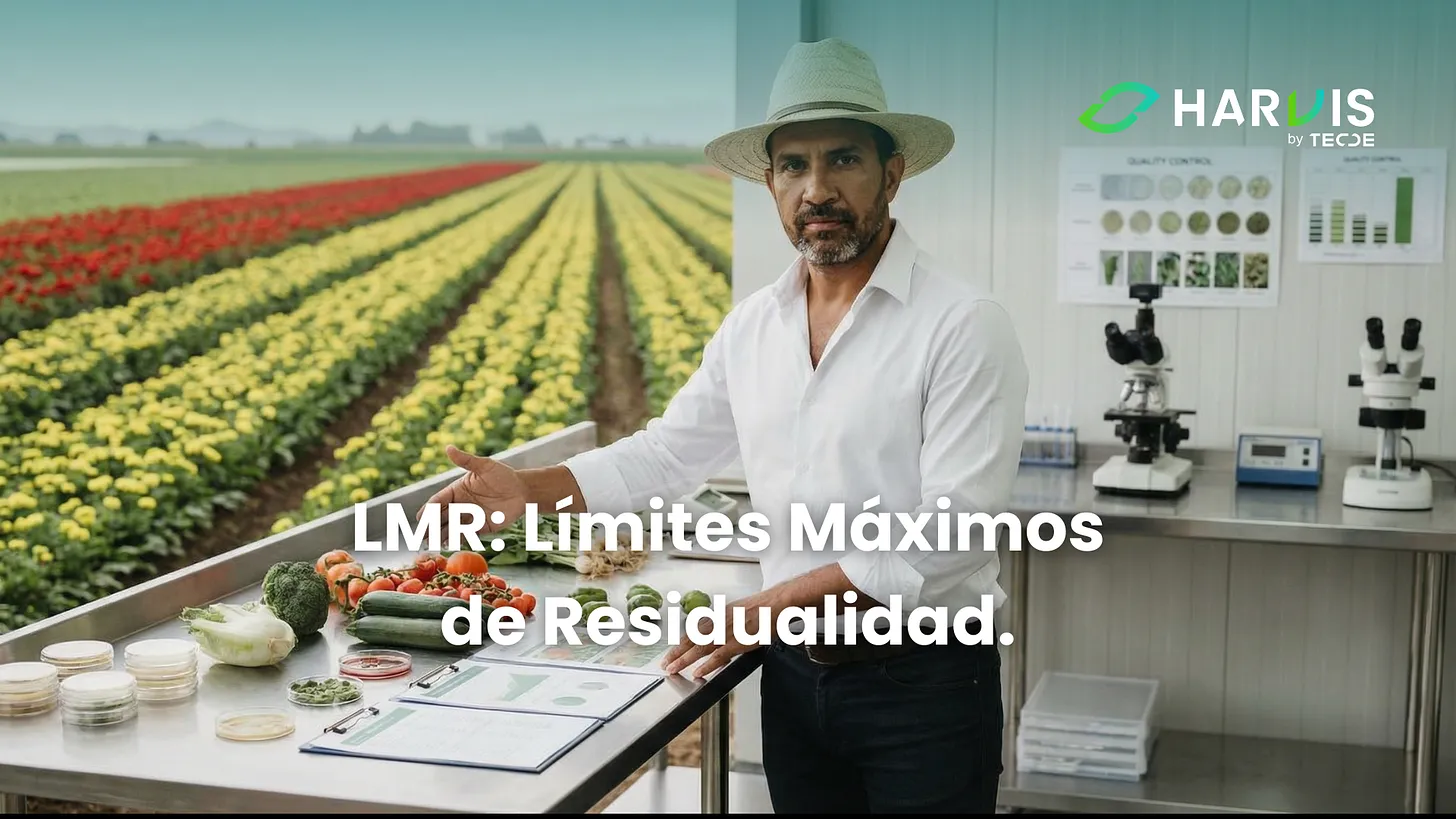
In our previous editions, we have analyzed key certifications for Colombian exports such as ICA, GlobalG.A.P., Rainforest Alliance, USDA Organic, EU Organic, SMETA, and others, so we consider it important to advance to an aspect directly related to food safety and access to international markets: Maximum Residue Limits (LMR). These parameters, defined by each country and recognized in certification standards, establish the maximum allowable concentrations of pesticides and other chemicals in food. Thus, high-demand markets such as the European Union, United States, Canada, Japan, and China, among others, apply strict regulations that require producers to align their agricultural practices with these tolerances. Similarly, certifications such as GlobalG.A.P. and USDA Organic require strict compliance with these limits as an essential condition for certification, making this article a great complement to these regulations and for the stakeholders involved in them.
More than just numbers in a table, LMR are the difference between export success and rejection at the border. A single product that exceeds the allowed limits can result in the loss of entire containers, reputational damage, and a temporary ban on exporting to key markets.
For the producer aiming to conquer international markets, mastering LMR is not optional: it is fundamental.

🧪What are Maximum Residue Limits (LMR)?
It is the maximum concentration of pesticide residues (expressed in mg/kg) defined by the traces left on agricultural products after the application of pesticides, which includes the original active ingredient and its metabolites measured on the surface as well as inside the product legally permitted in food and feed. LMR are based on data from good agricultural practices (GAP), and food obtained from products that meet the respective LMR are intended to be toxicologically acceptable.
📏How are LMR expressed?
⚖️In mg/kg or ppm (Parts per million): ppm and mg/kg are equivalent units in the context of residues in food.
1 ppm equals 1 part of a substance in a million parts of another. In other words, 1 ppm = 1 mg of substance in 1 kg of food.
📜Who defines LMR?
At both national and international levels, there are various authorities that establish LMR where each market may have different standards:
✅Codex Alimentarius (FAO/WHO): Global reference.
✅European Union (EU): Regulates with stricter criteria than Codex.
✅EPA (United States): Manages its own standards.
✅ICA (Colombia): Establishes and monitors LMR at the national level. (This means that a product that meets LMR in Colombia may not be accepted in the EU or the US if the standards are stricter)
📊Importance of LMR in export
✔️Access to international markets: Importers review compliance with LMR before approving shipments.
✔️Consumer health protection: Ensure that food is safe.
✔️Prevention of rejections and economic losses: A lot that exceeds the LMR can be returned, destroyed, or banned.
✔️Compliance with certifications: Standards such as GLOBALG.A.P. and Rainforest Alliance require strict monitoring of residues.
❌ Factors affecting LMR in crops
✅Type and dose of pesticide used.
✅Frequency and timing of application.
✅Pre-harvest interval (days between last application and harvest).
✅Weather conditions (rain, sun, humidity).
✅Good agricultural practices and field records.
🌐 Main markets and their regulations for LMR
🌍European Union - Regulation (EC) No. 396/2005
📋 Characteristics:
✔︎Legal basis: Regulation 396/2005 and its amendments.
✔︎Update: Regular updates - last amendment of 2024 for deltamethrin, metalaxyl, thiabendazole, and trifloxystrobin, effective from December 2024.
✔︎Default limit: 0.01 mg/kg (when no specific LMR is established)
✔︎Coverage: 27 countries + Norway, Iceland, United Kingdom (with variations post-Brexit or the UK's exit from the EU)
🎯 Particularities:
✔︎Evaluation based on the American diet.
✔︎More flexible tolerance system than the EU.
✔︎Considers economic benefits in regulatory decisions.
✔︎Faster import procedures for known products.
🍁Canada - Health Canada PMRA
📋 Characteristics:
✔︎Authority: Pest Management Regulatory Agency (PMRA).
✔︎Default limit: 0.1 mg/kg.
✔︎Harmonization: Frequent coordination with the US EPA.
✔︎Reviews: Every 15 years for registered pesticides.
🪷Japan - Ministry of Health, Labour and Welfare
📋Characteristics:
✔︎System: Positive List since 2006.
✔︎Default limit: 0.01 mg/kg (one of the strictest worldwide).
✔︎Particularity: Requires specific LMR for each pesticide and crop.
✔︎Controls: Extremely rigorous at entry ports.
🗺️ Codex Alimentarius - International Standard
📋 Characteristics:
✔︎Authority: FAO-WHO.
✔︎Function: International reference for countries without national LMR.
✔︎Database updated until November 2024 in its 47th session.
✔︎Adoption: Many developing countries adopt Codex LMR.
🫐Most sensitive products and markets.
🥝 Fresh fruits (kiwi, grape, blueberry, avocado, banana).
🥬 Leafy vegetables (spinach, lettuce, arugula).
🌶️ Export products destined for the EU and the UK, where LMR requirements are lower than Codex.
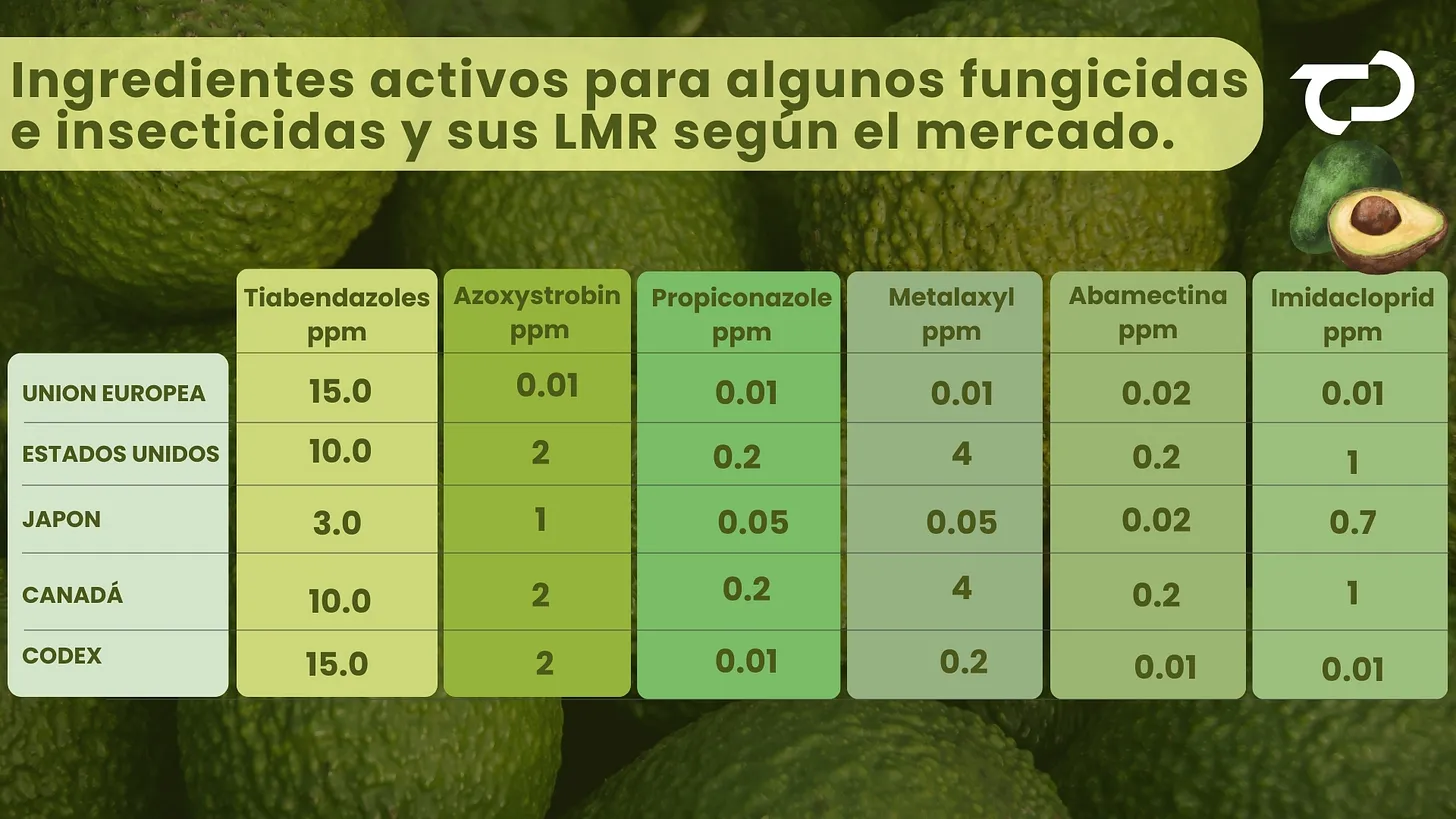
Considering the above, and due to the increase in exports, we share the following infographic on the cultivation of Avocado:
🥑The avocado, as one of the most important export products from Latin America, faces specific LMR challenges due to the phytosanitary treatments required to control pests and diseases.
Below, a comparison of different active ingredients fungicides and insecticides and their LMR according to the market will be made:
📊 LMR Management Strategy by Destination Market
🎯 European Market
📋 Application plan:
1. Selection of active ingredients
✔︎Prioritize products with LMR ≥ 0.5 mg/kg.
✔︎Avoid molecules with default limit (0.01 mg/kg).
✔︎Check the list of unapproved substances.
2. Application times
✔︎Last application: at least 30-45 days before harvest.
✔︎Strictly respect pre-harvest intervals (PHI).
✔︎Document all applications.
3. Monitoring and analysis
✔︎Mandatory residual analysis before shipment.
✔︎ISO/IEC 17025 accredited laboratories.
✔︎Detection limit ≤ 0.01 mg/kg.
🌎US Market
📋 Application plan:
1. Taking advantage of tolerances
✔︎Use active ingredients with established tolerances.
✔︎Optimize dose and frequency of application.
✔︎Consider authorized post-harvest treatments.
2. FSMA compliance
✔︎Detailed records of applications.
✔︎Training of application personnel.
✔︎Complete traceability from field to packaging.
🪷Japanese Market
📋 Application plan:
1. Strict positive list
✔︎Only use pesticides with established specific LMR.
✔︎Avoid any unlisted molecules.
✔︎Extended pre-harvest intervals.
2. Multiple analyses
✔︎Analysis at origin and destination.
✔︎Laboratories recognized by Japanese authorities.
✔︎Analysis certificates in Japanese.
⚡ Factors affecting residues
🌡️ Agronomic factors
🌱 Type of crop
✔︎Woody crops (avocado): higher retention in the skin.
✔︎Leafy vegetables: higher foliar absorption.
✔︎Tubers: concentration in skin vs pulp.
💧 Application Method
✔︎Foliar spraying: higher surface deposit.
✔︎Soil application: systemic absorption.
✔︎Seed treatment: internal distribution.
🌤️ Environmental Conditions
✔︎Temperature: accelerates degradation.
✔︎Humidity: may increase absorption.
✔︎UV radiation: photodegradation of residues.
✔︎Wind: affects drift and coverage.
⏰ Temporal Factors
📅 Pre-harvest interval (PHI)
✔︎Time between last application and harvest.
✔︎Specific for each pesticide-crop.
✔︎Critical: Never harvest before PHI.
🔄 Natural Degradation
✔︎Half-life: time to reduce residue by 50%.
✔︎Factors: temperature, pH, microorganisms.
✔︎Variability: among active ingredients.
🧪 Formulation Factors
💊 Type of formulation
✔︎Emulsifiable concentrate (EC): rapid absorption.
✔︎Wettable powder (WP): surface residues.
✔︎Granules (GR): slow release.
🔬 Adjuvants
✔︎Penetrants: increase systemic absorption.
✔︎Adherents: prolong surface retention.
✔︎pH: affects the stability of the active ingredient.
🛡️ Risk Prevention and Management Strategies
📋 Integrated Management Plan
Phase 1: Pre-sowing Planning
1. Target market analysis
✔︎Specific LMR by crop/pesticide/country.
✔︎Updated import regulations.
✔︎Complementary certification requirements.
2. Selection of phytosanitary program
✔︎Authorized active ingredients.
✔︎Compatibility with more restrictive LMR.
✔︎Rotation plan for resistance management.
Phase 2: Field Implementation
✔︎Detailed record of applications
☑️Exact date and time.
☑️Commercial product and concentration.
☑️Dose per hectare applied.
☑️Weather conditions.
☑️Equipment used and calibration.
☑️Responsible personnel.
✔︎Monitoring of pre-harvest intervals
☑️Application calendar vs harvest.
☑️Alerts prior to PHI expiration.
☑️Verification before each harvest.
Phase 3: Pre-harvest Monitoring
1. Residue analysis
✅When?: 7-15 days before planned harvest.
✅Sampling: Representative according to international standards.
✅Laboratory: ISO/IEC 17025 accredited.
✅Methods: LC-MS/MS or GC-MS/MS with LCQ ≤ 0.01 mg/kg.
2. Interpretation of results
✅Comparison with the LMR of the most restrictive market.
✅Recommended safety margin of 20-30%.
✅Decision to harvest or wait longer.
🔬 Recommended laboratory network
🌎 Latin America:
✔︎Colombia: CIAT, External Laboratories.
✔︎Mexico: SENASICA, ABC Laboratories.
✔︎Peru: SENASA, SGS Peru.
✔︎Chile: INIA, SGS Chile.
🌍 International (Reference):
✔︎Europe: Eurofins, SGS Europe.
✔︎United States: A&L Labs, Midwest Labs.
✔︎Certification: All must have ISO/IEC 17025 accreditation.
📰Statistics on rejections due to LMR
By region (2024):
✔︎European Union: 12% of rejections due to excessive residues.
<✔︎United States: 8% of rejections due to LMR.
✔︎Japan: 15% of rejections (stricter)
✔︎Canada: 6% of rejections.
Trends:
✔︎Increase: Detection of multiple residues.
✔︎Reduction: Extremely high individual residues.
✔︎Emerging: Metabolites not previously considered.
⚗️ LMR are not technical barriers, they are opportunities for differentiation. Each clean analysis is an open passport to international markets. Each avoided rejection is preserved profitability and an impact on reputation.
Below we share the updated LMR consultation links for the EU, US, JAPAN, and CODEX, where you can find the corresponding information for your crop and the active ingredients you use on your farm:
🔵EU:
https://ec.europa.eu/food/plant/pesticides/eu-pesticides-database/start/screen/products
⚪US:
https://bcglobal.bryantchristie.com/db#/pesticides/query
🔴JAPAN:
https://db.ffcr.or.jp/front/foodgroupcomp
🟠CODEX:
https://www.fao.org/fao-who-codexalimentarius/codex-texts/dbs/pestres/pesticides/es/
In our next edition, we will talk in depth about pesticides, mechanisms, modes of action, and the importance of rotating active ingredients to avoid resistant genetic complexes.