

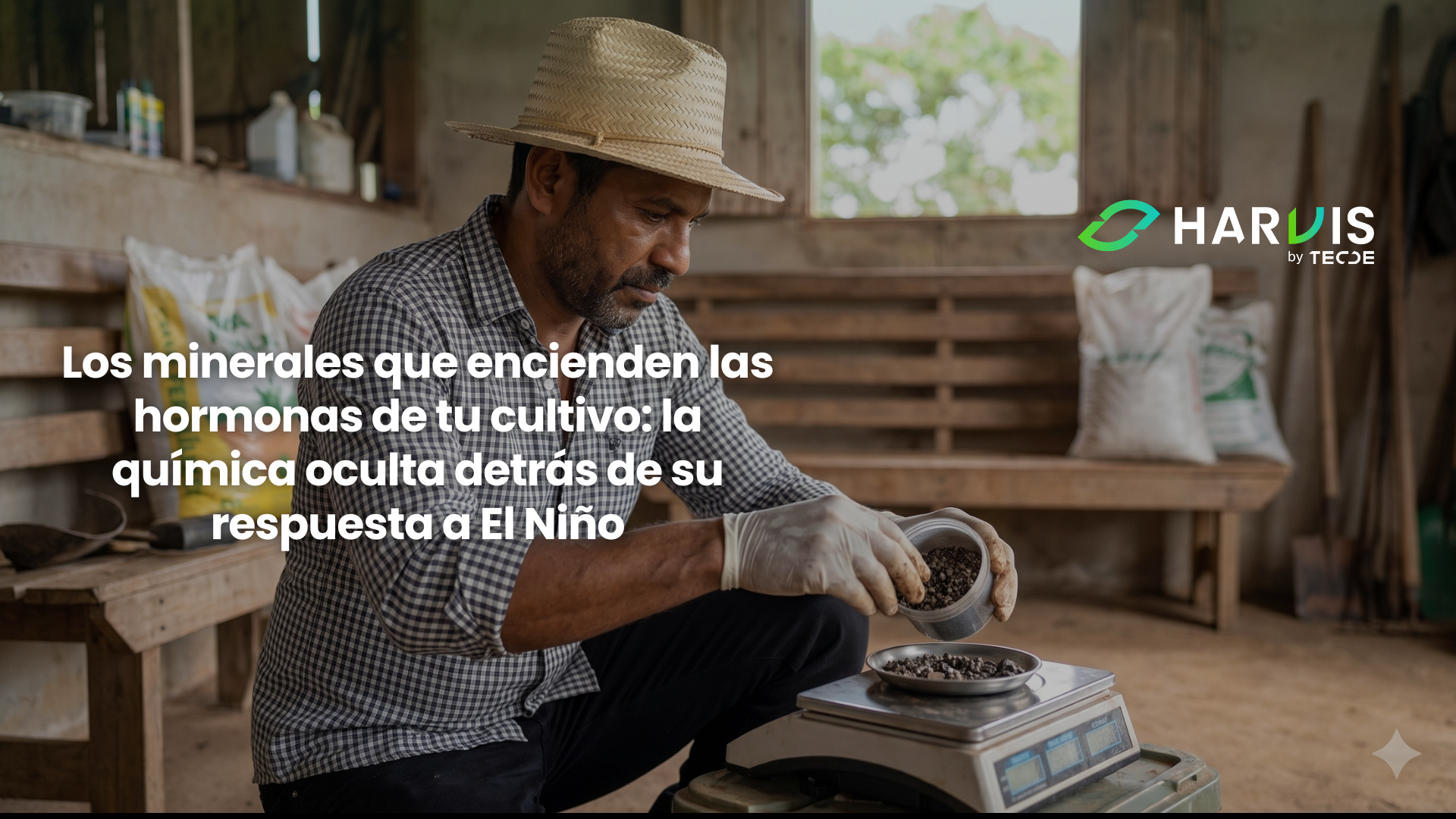
In the previous blog, we concluded with an idea worth revisiting: a plant deficient in molybdenum cannot properly close its stomata when drought arrives because it lacks the mineral that activates the hormone responsible for that command, and today we will develop this idea in depth.
Plant hormones are not absorbed from the soil nor do they come in a bag; the plant manufactures them through internal chemical reactions, and like all chemical reactions, these manufacturing pathways require enzymes to catalyze them. Many of these enzymes are metalloenzymes, which only function if they have a specific mineral embedded in their active center. If the mineral is removed, the enzyme shuts down, and if the enzyme shuts down, the hormone is not produced. Without the hormone, the plant cannot give the corresponding command.
This explains something that confuses many producers: why can an element that the plant needs in tiny amounts, grams per hectare or even less, have a disproportionate effect on the entire harvest? It is not about the quantity; it is because that mineral is a key that, when present or absent, turns on or off an entire pathway of decisions. In this blog, we will see what those keys are, what science says about how they work, and what is most practical in light of the El Niño event, specifically when to apply them so that the effect is available just when the crop needs it.
Molybdenum and Abscisic Acid: The Switch for Stomatal Closure
Let’s start with the most decisive link regarding the drought that El Niño will bring; we have already seen that abscisic acid (ABA) is the hormone that orders the stomata to close to conserve water. So, how does the plant produce that hormone?
The synthesis of ABA is a multi-step chain, and the final step, which produces the active molecule, is catalyzed by an enzyme called aldehyde oxidase; being the key, this enzyme cannot function without a molybdenum cofactor. Molybdenum is embedded in the enzyme (through a special form called molybdenum cofactor), and without it, aldehyde oxidase simply does not complete the reaction. In practical terms, without sufficient molybdenum, the plant cannot properly manufacture the ABA it needs to close its stomata.
And this is not just laboratory theory. An experiment demonstrated that enhancing the gene that produces the molybdenum cofactor (the gene for the sulfurase enzyme that activates aldehyde oxidase) in corn increased the plants' synthesis of ABA and their drought tolerance. This is a direct demonstration; more capacity to activate that molybdenum cofactor translated into a better response to water deficit. The entire chain is straightforward: molybdenum activates aldehyde oxidase, that enzyme produces ABA, ABA orders the stomatal closure, and that closure is what sustains drought tolerance, a sequence supported by decades of biochemical research.
Pause to consider what this means for your farm in light of El Niño. Stomatal closure is the first line of defense for a crop against drought — in coffee, it is the central component of its response to water deficit [16]; in avocado, the plant overexpresses ABA genes under stress. If your crop reaches the peak of drought with a hidden deficiency of molybdenum, its ability to produce ABA will be limited, and its defense response will be weak or late. No matter how much survival instinct the plant has, if it lacks the mineral that ignites the hormone, the command to turn off the water supply will not be executed in time. Molybdenum is literally the switch for your crop's emergency water system.
Zinc and Boron: The Minerals Behind Auxins and Growth
Let’s move on to auxins, the hormones of growth and direction. Here we have two minerals that work at different times in the life of this hormone: zinc, which helps to produce it, and boron, which helps to transport and protect it.
Zinc is at the origin. Auxins (mainly indole-3-acetic acid, IAA) are produced from an amino acid called tryptophan. And the enzyme that produces tryptophan — tryptophan synthase — needs zinc to function. The chain is direct: without zinc, less tryptophan is produced; with less tryptophan, less auxin is manufactured. This explains why the classic symptoms of zinc deficiency are slow growth and small leaves — what you are essentially seeing is a crop with insufficient auxin, unable to properly expand its cells and tissues. Studies in citrus confirm this relationship; the application of zinc stimulates tryptophan synthesis and, with it, IAA production and growth [7]. In light of drought, this link has additional value; auxin directs root growth, and a good root system is precisely what allows the plant to explore the soil in search of scarce water.
Boron acts at another point in the story. It does not manufacture auxin, but it regulates its transport and distribution within the plant. Research shows that boron deficiency early on alters the movement of auxins; in experiments with citrus, the lack of boron reduced IAA content in root tips in just 3 hours and disorganized the expression of the genes responsible for synthesizing and transporting auxin. In other words, without boron, auxin does not reach where it needs to go. Boron is also crucial in reproductive processes — pollen viability, flowering, and fruit set, because these processes depend on precise hormonal signaling and the integrity of the cell walls that boron helps to build.
An imbalance of boron and auxins, combined with stress, can disrupt the signaling that keeps fruits attached to the plant. Remember that under severe stress, the crop tends to drop flowers and fruits, that painful drop of small fruit. A good status of boron and auxins helps to sustain fruit set and prevents the plant from abandoning its load at the first sign of difficulty. Zinc to build growth and roots that seek water; boron to sustain flowering and fruit, both are pieces of the hormonal scaffolding that decides how much of your harvest survives stress.
Copper and Ethylene: The Mineral That Regulates Ripening and Drop
For a plant to respond to ethylene, it first has to detect it. This detection is done by specific receptors (the ETR1 family and their relatives), and here is the point: those receptors need a copper ion embedded in their structure to perceive ethylene. Copper is what gives the receptor the ability to “grab” the ethylene molecule accurately. A study published in 2025 even details how the plant transports copper, through chaperone proteins, to place it exactly at the receptor site. And the most compelling evidence is this: plants with mutations that prevent copper from binding to the receptor become completely insensitive to ethylene. Without copper, the plant is effectively “deaf” to this hormone.
Why does this matter during El Niño? Because ethylene is a double-edged sword under stress. On one hand, it is part of the plant's adaptive response; on the other, unbalanced hormonal management can lead to accelerated senescence and premature fruit drop when thermal and water stress intensifies. The correct perception of ethylene, which depends on copper, is part of how the plant regulates that response in an orderly manner rather than chaotically. A crop with an adequate copper status manages maturity and stress signals better, which translates into more balanced decisions about which fruits to hold and which to drop.
It is worth adding one more mineral to this map, even though it is not a microelement: potassium. We have already dedicated a complete blog to its role in fruit quality, but it also has a key hormonal and physiological dimension for drought. On one hand, potassium deficiency reduces auxin levels in the roots; in some crops, the drop exceeds 50%, affecting root growth. On the other hand, potassium is the ion that physically opens and closes the stomata; when ABA gives the command to close, it is the movement of potassium in and out of the cells that executes that closure. In other words, ABA is the command, but potassium is the muscle that carries it out. Without sufficient potassium, even a good ABA signal loses effectiveness. Molybdenum, zinc, boron, copper, and potassium — five pieces of the same decision-making machinery.
Do your fields have the minerals that ignite the defense hormones, or will they reach drought with the system turned off? That difference is not visible until stress reveals it. Harvis analyzes the status of microelements in each field to anticipate it. Talk to our team →

Balance and Timing: Apply Before Stress Arrives
Knowing which minerals ignite hormones is half the equation. The other half — and the most practical — is when to apply them so that the effect is available at the right moment. Here are three principles to keep clear.
First, balance is key, and more is not better. These minerals function as cofactors, not as fuel; the plant needs a sufficient amount to ignite its enzymes, but overdoing it does not turn on the hormone “more,” and in several cases, it is frankly dangerous. Boron is the most delicate example; the window between deficiency and toxicity is narrow, and excess burns the edges of the leaves and damages the crop. Copper is also toxic in excess. And as we saw in previous blogs, these elements compete with each other and with other nutrients — an excess of one can block another. The goal is not to “load” the crop with microelements but to ensure that each one is at its appropriate level. With these minerals, precision matters more than quantity.
Second, each mineral has its phenological window. The crop does not demand these elements uniformly throughout the year; rather, it needs them in peaks, linked to specific stages. Field evidence shows a clear pattern: zinc is best utilized during vegetative growth and leaf expansion stages, when the plant is building tissue and needs auxin; boron is critical during flowering and fruit set, when it supports pollen and fruit. Studies in fruit trees that compared different stages of foliar application found that hitting the phenological window allows achieving the same effect with fewer applications and lower doses, more efficiency, less expense. Applying the correct mineral at the wrong stage is wasting it.
Third, and crucial for El Niño, the application must be preventive. Here is the point that many producers overlook. Most of these microelements — zinc, copper, boron, iron, manganese — are not very mobile within the plant; once they reach a tissue, they do not redistribute easily to where they are needed later. This means they must be present before the peak demand arrives, not during. If you wait to see the symptoms of stress to apply, you are already late; the plant needed those minerals in its system before stress triggered the hormonal demand. That is why the strategy against El Niño is to load the system in advance — ensuring adequate levels of these minerals in the window prior to the event — so that when drought arrives, the hormonal machinery has everything it needs to start immediately. Foliar application is a useful tool in this logic because it delivers the element quickly and directly, bypassing soil blockages and allowing timely corrections before the critical window.
In summary, the correct amount of the right mineral at the right stage, and above all, before stress, not during. That is the difference between a crop that arrives at El Niño with its defense system charged and ready, and one that arrives with the switch turned off.
Crossing Mineral, Hormone, and Timing
Coordinating all this manually is practically impossible because it requires integrating variables that change by field and by week: the status of each microelement in the soil, the phenological stage of the crop, the window prior to climatic stress, and the interactions between nutrients that may be blocking others. This is where technology does what intuition cannot.
Harvis crosses the status of microelements in each field with the phenological stage of the crop and the El Niño forecast to indicate not only which mineral is lacking but also when to apply it so that its hormonal effect is available at the critical moment. It is not the same for one field to lack zinc during foliar expansion as for another to lack boron entering flowering; these are different deficiencies, with different hormones, in different windows, and each requires a specific action at a specific moment. Applying the correct mineral at the wrong time wastes the effect.
The pattern that only emerges by crossing many fields is this: the fields that best withstand stress are not the ones that received the most microelements, but the ones that received them at the right moment and in balance. A field overloaded with boron can be as compromised as one deficient in it. A field with sufficient zinc but applied late did not build the roots it needed. Distinguishing — field by field — which mineral is lacking, in what proportion, and in what window to apply it to ignite the correct hormone in time is what turns nutrition into a real preparation tool against El Niño, rather than a blind application.
As we have already addressed in our blog Between Rain and Drought: How to Prepare Your Crop for Climate Extremes, which you can read here, the key to dealing with climate variability is to anticipate. This season adds a concrete layer to that anticipation; it is not enough to manage water; we must ensure that the minerals that ignite the defense hormones are in the crop, in balance, and on time, before stress puts them to the test.
Ensure the mineral switches of your crop's defense system before drought arrives. Write to us on WhatsApp and receive technical assistance to define which microelements to apply in each field and when. Talk to an expert, talk to Harvis →
Consulted References
- Schroeder, J. I., et al. (2022). Plant hormone regulation of abiotic stress responses. Nature Reviews Molecular Cell Biology, 23. https://www.nature.com/articles/s41580-022-00479-6
- Finkelstein, R. (2013). Abscisic Acid Synthesis and Response. The Arabidopsis Book, 11. https://pmc.ncbi.nlm.nih.gov/articles/PMC3833200/
- Lu, Y., Li, Y., Zhang, J., Xiao, Y., Yue, Y., Duan, L., Zhang, M., and Li, Z. (2013). Overexpression of Arabidopsis Molybdenum Cofactor Sulfurase Gene Confers Drought Tolerance in Maize (Zea mays L.). PLoS ONE / PMC. https://www.ncbi.nlm.nih.gov/pmc/articles/PMC3542365/
- Mendel, R. R. (2024). The Final Step in Molybdenum Cofactor Biosynthesis—A Historical View. Molecules / PMC. https://www.ncbi.nlm.nih.gov/pmc/articles/PMC11434336/
- Castillo-González, J., Ojeda-Barrios, D., Hernández-Rodríguez, A., González-Franco, A. C., Robles-Hernández, L., and López-Ochoa, G. R. (2018). Zinc metalloenzymes in plants. Idesia / Redalyc. https://www.redalyc.org/journal/339/33957240004/html/
- Yan, L., Pei, Y., Li, P., and Zhang, J. (2020). Interaction of zinc and IAA alleviate aluminum-induced damage on photosystems in alfalfa. Plant Physiology and Biochemistry / PMC. https://www.ncbi.nlm.nih.gov/pmc/articles/PMC7501636/
- Abd El-Moniem, E. A., and Abd-Allah, A. S. E. (2008). Effect of zinc, tryptophan and indole acetic acid on growth, yield and chemical composition of Valencia orange trees. ResearchGate. https://www.researchgate.net/publication/287466965
- Dong, X., Wang, Y., Sun, X., and Wang, X. (2016). Boron deficiency alters root growth and development and interacts with auxin metabolism by influencing the expression of auxin synthesis and transport genes. Biotechnology & Biotechnological Equipment. https://www.tandfonline.com/doi/full/10.1080/13102818.2016.1166985
- Li, C. J., Bangerth, F., and Romheld, V. (2005). Involvement of auxin and cytokinins in boron deficiency induced changes in apical dominance of pea plants. Journal of Plant Physiology / ScienceDirect. https://www.sciencedirect.com/science/article/abs/pii/S0176161705003639
- Riaz, M., Yan, L., Wu, X., and Jiang, C. (2024). Molecular mechanisms affected by boron deficiency in root and shoot meristems of plants. International Journal of Molecular Sciences / PMC. https://www.ncbi.nlm.nih.gov/pmc/articles/PMC12066120/
- Dluhosch, D., Kersten, L. S., Minges, A., Schott-Verdugo, S., Gohlke, H., and Groth, G. (2025). Molecular mechanism and structural models of protein-mediated copper transfer to the Arabidopsis thaliana ethylene receptor ETR1. Scientific Reports, Nature. https://www.nature.com/articles/s41598-025-19915-6
- Bleecker, A. B., and Kende, H. (2000). Ethylene signaling in plants. Journal of Biological Chemistry / ScienceDirect. https://www.sciencedirect.com/science/article/pii/S0021925817494610
- Printz, B., Lutts, S., Hausman, J. F., and Sergeant, K. (2024). Molecular Mechanisms of Plant Responses to Copper: From Deficiency to Excess. International Journal of Molecular Sciences (MDPI). https://doi.org/10.3390/IJMS25136993
- Wang, Y., Lu, G., Ding, Y., and Shi, H. (2023). The Role of IAA in Regulating Root Architecture of Sweetpotato in Response to Potassium Deficiency Stress. PMC. https://www.ncbi.nlm.nih.gov/pmc/articles/PMC10181447/
- Meriño-Gergichevich, C., Ondrasek, G., Zúñiga-Zúñiga, C., and Reyes-Díaz, M. (2021). Combined Spraying of Boron and Zinc During Fruit Set and Premature Stage Improves Yield and Fruit Quality of European Hazelnut. Frontiers in Plant Science. https://www.ncbi.nlm.nih.gov/pmc/articles/PMC8201987/
- Silva, P. C. da, Ribeiro Junior, W. Q., Ramos, M. L. G., Rocha, O. C., Veiga, A. D., et al. (2022). Physiological Changes of Arabica Coffee under Different Intensities and Durations of Water Stress in the Brazilian Cerrado. Plants / PMC. https://pmc.ncbi.nlm.nih.gov/articles/PMC9460576/
- Moreno-Ortega, G., Zumaquero, A., Matas, A., and Olivier, N. A. (2021). Physiological and Molecular Responses of ‘Dusa’ Avocado Rootstock to Water Stress. Plants / MDPI. https://www.ncbi.nlm.nih.gov/pmc/articles/PMC8537572/
- IFRC / Cruz Roja. (2026). “El Niño” 2026: How do we prepare for its effects in Latin America and the Caribbean?. https://www.ifrc.org/es/articulo/el-nino-2026-como-nos-preparamos-para-sus-efectos-en-america-latina-y-el-caribe