


Complementing the topic we've been discussing about soil, if you've been working on your farm for years, you can probably distinguish your plots just by stepping on them. There's one where the crop almost always performs better, and another that, no matter what you do, falls behind. The reasons mentioned in the last blog, such as slope, drainage, management history, and texture, are essential elements in this difference. But behind those contrasts, there is often a factor that weighs more than we imagine and that we rarely talk about when planning our tasks, and that is organic matter.
First of all, it is important to clarify that soil organic matter is the set of plant and animal residues in various stages of decomposition, along with the microorganisms that live in the soil and the stable humic substances that remain at the end of the process. This essential component directly influences soil structure, its ability to retain and exchange nutrients, water availability, and the activity of organisms that transform what we apply into something that the plant can actually absorb. It is not an exaggeration to say that almost all the properties that make a soil "good" depend, in one way or another, on how much organic matter it has.
The effects it has on production, while imperceptible directly, can be observed in crop yields at the end. Let's think about water; in a situation of the El Niño phenomenon that we are going to face, it is pure gold. Research from the University of Minnesota has documented that in a loamy soil, increasing organic matter from 3% to 4% can allow a crop like corn to withstand several more days before needing rain. That sounds modest until one remembers that water stress during the formation of the corn ear can reduce grain yield by between 3% and 8% for each day of stress. Let's do the math. Those extra days of "buffer" that organic matter provides can literally be the difference between a harvest that meets expectations and one that frustrates, without you having spent an extra penny on irrigation or inputs. The water that your soil manages to retain is water that you didn't have to apply, and production that you didn't lose. It is worth clarifying that this figure corresponds to a specific type of soil; the magnitude of the effect changes according to the texture and conditions of each plot, but the direction of the benefit holds true in any soil.
Water is just one part. Organic matter improves soil structure because it promotes the formation of stable aggregates, those clumps that make the soil porous and allow water and air to circulate. This means better aeration, roots that penetrate deeper, less waterlogging, and, very importantly, much less erosion. The FAO has estimated that management practices that protect the soil and conserve its organic matter can reduce erosion by up to 70%, and reducing erosion is exactly the same as conserving the most fertile layer of your farm, the first one that washes away when it rains heavily on bare soil.
Then there is the issue that most closely touches the wallet, as organic matter acts like a sponge that retains nutrients and releases them gradually. In a soil poor in organic matter, a good part of the fertilizer you apply is lost through leaching, washed away before the plant can take advantage of it. In a rich soil, that same application yields much more because the soil retains and manages it.
Not All Organic Matter is the Same
It is commonly thought that organic matter is a single entity, but it has very different fractions. Research from the Institute of Geology at UNAM has delved into the real composition of soil organic matter, showing that it is made up of compounds of very different nature and stability, and that understanding this composition is key to knowing how it behaves and how it can be conserved. In other words, for the farm, there is a fraction that decomposes quickly and feeds microorganisms and plants immediately, and another much more stable fraction that gives structure and permanence to the soil over the years. Both are important, and good management seeks to feed both.
The interesting thing is that the type of management you give to the farm determines how much biologically active organic matter you conserve. The Rodale Institute, in long-term studies comparing organic and conventional management, found that systems that return residues to the soil, use cover crops, and reduce tillage accumulate greater reserves of biologically active organic matter than intensive conventional systems. It is not an ideological matter; the soil responds to what you return to it. If you only extract and never replenish, the account will eventually run dry.
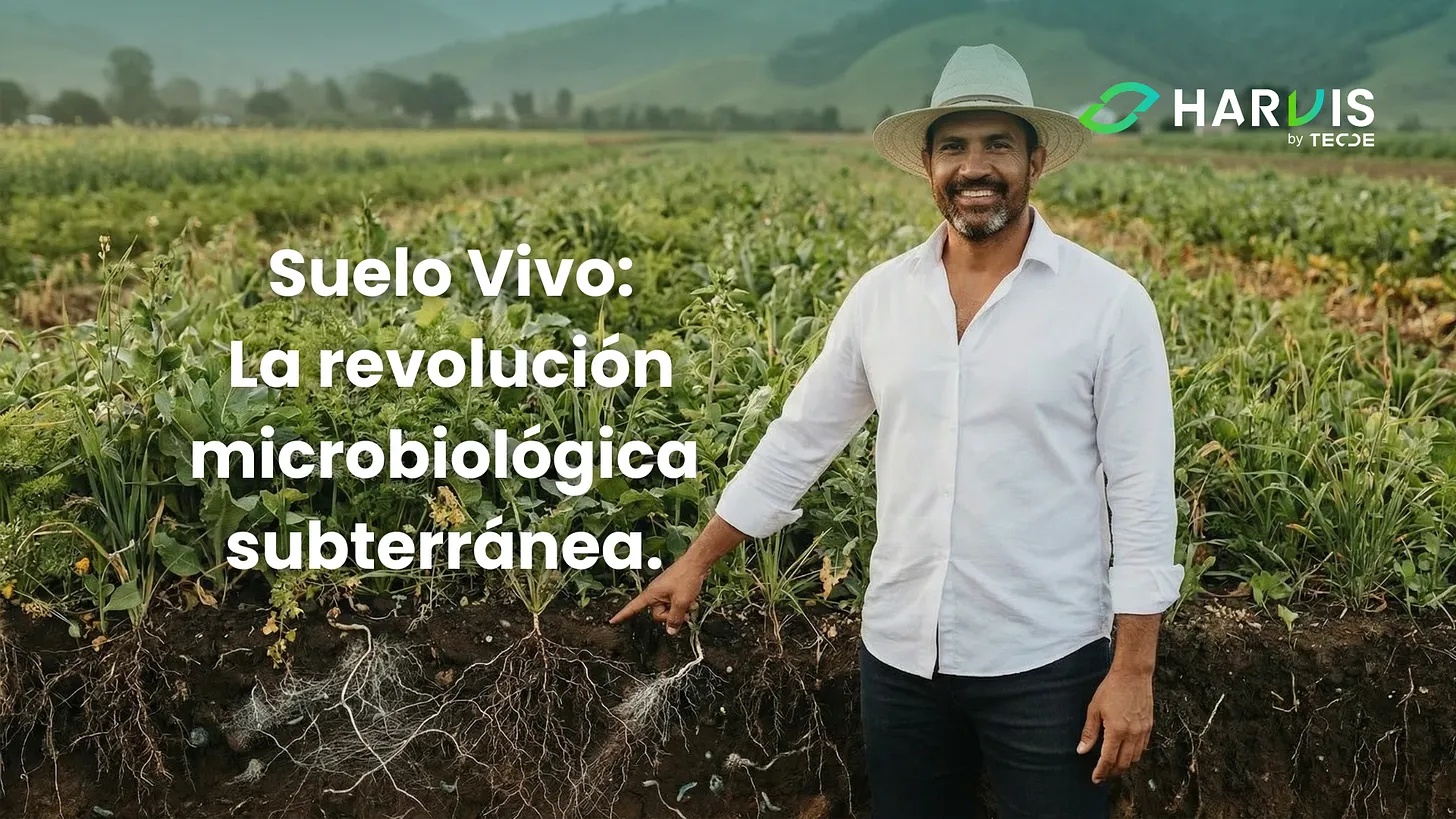
Organic matter is, in the end, the fuel for all the life that inhabits the soil, and that life does the heavy lifting of nourishing your plants. As we explained in our blog Living Soil: The Microbiological Revolution Happening Under Your Feet, soil is not a dead substrate that supports roots, but an ecosystem with a huge number of organisms in every handful of dirt; you can read it by clicking the following link. Organic matter is what keeps that population alive, and without it, no fertilization plan, no matter how sophisticated, reaches its potential.
How Do We Manage Organic Matter?
When I accompany a farm over time, it is something that needs to be paid attention to with records in hand, as organic matter moves slowly, and that is why it is so easy not to notice that you are losing it. A plot does not go from 4% to 1% in one season; it does so over the years, a fraction at a time, so slowly that the producer gets used to increasingly lower yields, believing that "that's just how that plot is."
One of the most costly mistakes in the nutrition of perennial crops is calculating the fertilization plan without considering organic matter as an active source of nitrogen. In tropical soils, organic matter contains approximately 5.8% nitrogen in its structure, which is gradually released through microbial mineralization at an annual rate of around 1.5% of the total present. What this means in productive terms is that a soil with 1% organic matter contributes only 17.4 kg of nitrogen per hectare, while one with 4% can contribute up to 69.6 kg/ha. That difference of three percentage points in organic matter equates to more than 50 kg/ha of nitrogen that chemical fertilizer would have to replace, at a cost that the producer assumes without knowing it exists.
In Colombia, the most systematic research on this relationship comes from the National Coffee Research Center (Cenicafé). The extraction numbers in coffee are demanding. For every 1,000 kg of coffee beans harvested, 31 kg/ha of nitrogen are removed from the soil, so in coffee plantations with full sun exposure and frequent productions of 4,000 kg/ha/year, extraction can exceed 120 kg/ha/year of N. In a soil with 2% organic matter, the fraction that can cover that requirement is minimal: approximately 34.8 kg N/ha/year released by mineralization. The remaining 74% must be covered with external fertilization.
In a soil with 5% organic matter, mineralization can contribute up to 87 kg N/ha/year, reducing the fertilization gap by more than 50% and directly lowering production costs. When nitrogen is completely excluded from the fertilization plan in coffee, yield can be reduced by up to 80%, a figure that does not speak of degraded soils but of any plot where organic matter is not enough to compensate for that omission.
Avocado, unlike coffee, has a shallow root system and lacks functional absorbent hairs. It depends on mycorrhizal fungi to capture nutrients, and those fungi require active organic matter to establish and proliferate. It has been documented that this mechanism describes how in tropical soils, organic matter constitutes the energy substrate for beneficial microbiota, whose density directly determines root absorption efficiency. If you want to know how I can help you manage the organic matter of your crop better, I invite you to schedule a demo at the following link.

The avocado crop requires soils with an organic matter content between 2.5% and 5%, as this range guarantees sufficient aeration, drainage, and structure for a root system that is very sensitive to suffocation. Below that threshold, the tree does not die; it simply does not express its productive potential.
Yield data by source of nutrition illustrate the impact clearly. In Hass avocado crops, organic fertilization generated 4.2 times more yield than the control without fertilization, 2.8 times more than the combined management, and 2.2 times more than exclusively mineral fertilization. The highest yield under organic management was directly attributed to the contribution of organic matter to the soil.
This difference is not exclusive to laboratory data. In commercial orchards in Nayarit, Mexico, soils had organic matter contents between 0.3% and 3.4% and low concentrations of N, P, Ca, and Mg, which corresponds to the profile of many avocado plots in expanding areas in Colombia, where the crop advances over soils that have not been prepared to sustain the root demand of the species. Additionally, applying mineral fertilization on soil with less than 2% organic matter in avocado does not correct the underlying problem since the nutrients are there, but the tree does not have the biological conditions to take them up efficiently.
On the other hand, for livestock, another reality must be considered: cold climate soils tend to accumulate organic matter because they cannot mineralize it. We have already discussed the concept, but to be more specific, the mineralization of organic matter, that is, its transformation into nutrients available for grass, is a biological process. It is carried out by bacteria, fungi, and soil microorganisms that, like any living organism, depend on temperature to function. In Colombian high Andean soils, the high net productivity of plants combined with the low rate of organic matter mineralization, due to low temperatures, high humidity, and reduced microbial activity, favors the accumulation of soil organic carbon.
When all these numbers come together, the nitrogen that your soil mineralizes, what your crop extracts, and the climate that accelerates or slows that process, something that no isolated analysis shows appears: organic matter is not a fixed data point on a laboratory sheet; it is a bank that pays you interest in the form of nutrients, and the rate of that interest changes completely depending on the crop and the thermal floor. A 3% organic matter does not mean the same in a coffee plantation of temperate soil that extracts more than 120 kg of nitrogen per hectare, as in a high Andean pasture where cold slows mineralization and carbon accumulates, or in an avocado plot where what matters is not only the released nitrogen but the microbial life that supports the mycorrhizae. That is why the real value is not in knowing your organic matter percentage just once, but in crossing it, plot by plot, with what you sow, what you extract, and what you apply. When we put those pieces together over the cycles, what emerges is a map of how much nitrogen your own soil is giving you in each plot and how much you are overpaying to replace something you already had. That account, which is almost never made, is often the difference between a fertilization plan that copies a formula and one that starts from what your land really contributes. Caring for organic matter, then, is not just another good environmental practice: it is managing the asset that, silently, is paying part of your fertilization every year.
Consulted References
- FAO. (2005). Organic Agriculture and Abiotic Resources. Conservation of Natural Resources for Sustainable Agriculture. Food and Agriculture Organization of the United Nations, Rome. https://www.fao.org/4/Y4137S/y4137s05.htm
- Osorio, N. W. (2014). Nutrient Management in Tropical Soils (416 pp.). Editorial L. Vieco S.A.S., Colombia.
- University of Minnesota Extension. Soil Organic Matter in Crop Systems: Water Retention and Effect on Corn Yield. https://es.extension.umn.edu/manejo-y-salud-del-suelo/sistemas-de-cultivo-de-materia-org%C3%A1nica-del-suelo
- Chávez Vergara, B. (2020). Investigating the Composition of Soil Organic Matter. Gaceta UNAM, Institute of Geology, National Autonomous University of Mexico. https://www.gaceta.unam.mx/indagan-la-composicion-de-la-materia-organica-del-suelo/
- Rodale Institute. (2020). Effects of Organic and Conventional Management on Biologically Active Soil Organic Matter Pools. https://rodaleinstitute.org/es/science/articles/organic-and-conventional-management-effects-on-biologically-active-soil-organic-matter-pools/
- Cenicafé Magazine / SciELO Colombia. (2011). Mineralization of Nitrogen from Organic Matter in Tropical Soils. http://www.scielo.org.co/scielo.php?script=sci_arttext&pid=S0304-28472011000100004
- Cenicafé — National Coffee Research Center. Nutrient Extraction and Requirements in Coffee Cultivation: Nitrogen and Yield Response. https://biblioteca.cenicafe.org/jspui/bitstream/10778/1107/3/avt0424.pdf
- Tarazona Agrosolutions. Avocado Nutrition and Soil Management Considerations: Optimal Organic Matter Content. https://tarazonaagrosolutions.com/blog/guias-de-cultivos/nutricion-del-aguacate-y-consideraciones-para-el-manejo-de-los-suelos/
- Mexican Journal of Agricultural Sciences / SciELO Mexico. (2025). Response of Hass Avocado to Organic, Mineral, and Combined Fertilization. https://www.scielo.org.mx/scielo.php?script=sci_arttext&pid=S2007-09342025000500115&lng=en&nrm=iso
- Mexican Journal of Agricultural Sciences / SciELO Mexico. (2021). Characterization of Soils in Commercial Avocado Orchards in Nayarit, Mexico. https://www.scielo.org.mx/scielo.php?script=sci_arttext&pid=S2007-09342021000200205
- Redagrícola. Strategy for Adequate Optimization of Mineral Nutrition in Hass Avocado. https://redagricola.com/estrategia-para-una-adecuada-optimizacion-de-la-nutricion-mineral-en-aguacate-hass/
- Ecosystems Journal. Accumulation of Organic Carbon in High Andean Soils: Mineralization, Temperature, and Microbial Activity. https://revistaecosistemas.net/index.php/ecosistemas/article/download/1855/1264/0
- Docampo, R. (2010). The Importance of Soil Organic Matter and Its Management in Fruit Production. INIA Series of Dissemination Activities No. 687. INIA Las Brujas, Uruguay. http://www.inia.uy/Publicaciones/Documentos%20compartidos/111219220807102521.pdf
- Harvis. Living Soil: The Microbiological Revolution Happening Under Your Feet. https://harvis.app/blog/suelo-vivo
- Harvis. (2026). Agricultural Management and Productive Analytics Platform. https://harvis.app/