

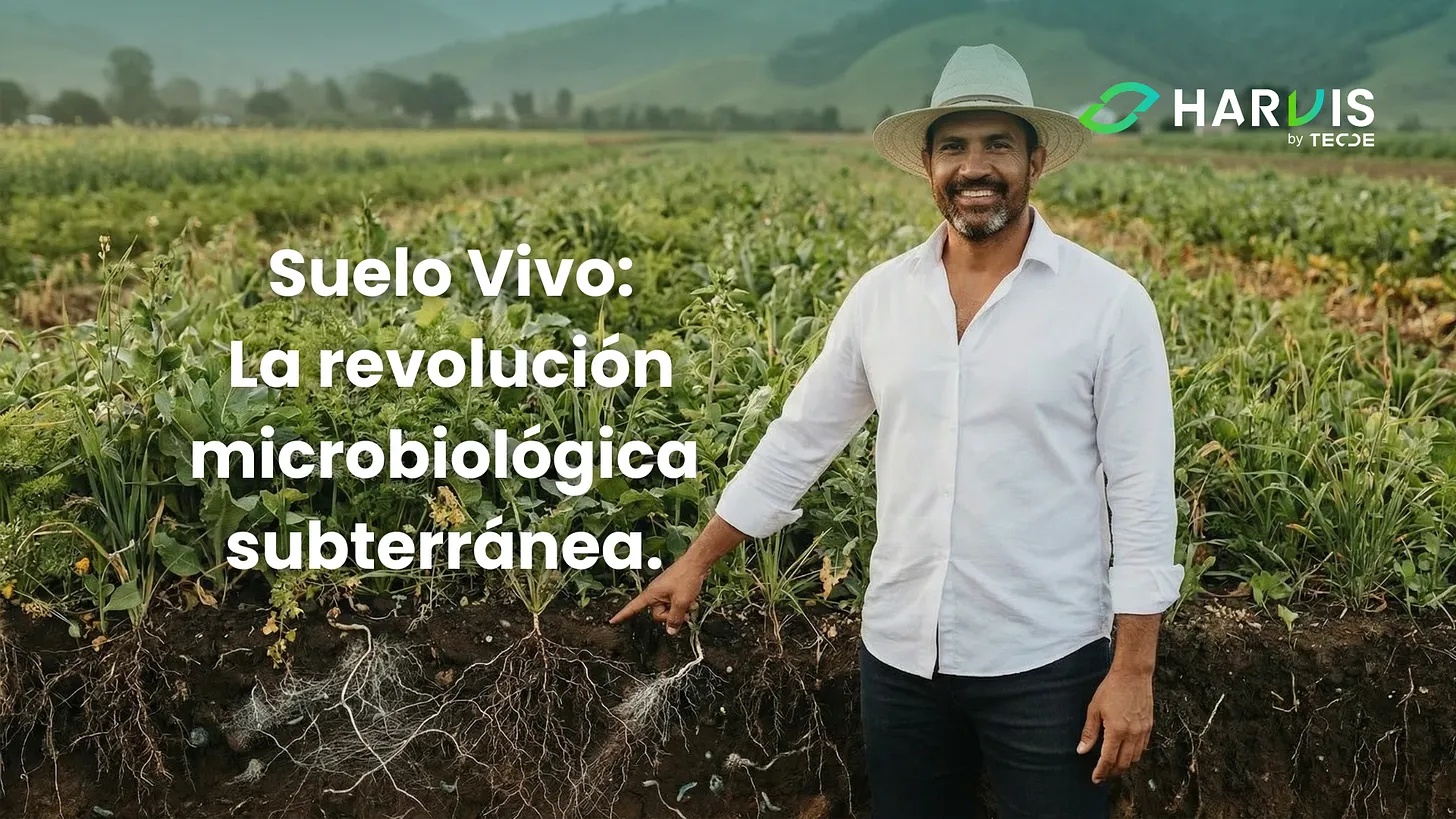
Under every productive hectare lies a biological universe more complex than a city: tons of living organisms working 24 hours a day in a network of chemical exchange that surpasses the sophistication of any industrial system. From the worms we can see building aeration tunnels to the microscopic fungi weaving networks of nutritional exchange, every soil organism is an active builder of fertility. However, decades of intensive agriculture have destroyed 60% of this underground biodiversity, turning living soils into inert substrates that require constant chemical fertilization to sustain the productivity of our crops.
In our previous editions, we explored everything from the water revolution to regenerative biotechnologies for integrated pest management. Each concept has led us to a fundamental understanding: 21st-century agriculture is not about feeding plants, but about nourishing ecosystems. Today we delve into the foundation of all sustainable agricultural productivity: living soil and its network of microbiological interactions.
Today we want to talk about a concept that transcends the purest technical sense of "soil fertility" for a more holistic one: ecosystemic bioactivation: a scientific revolution that uses microbial communities, fungal networks, molecular biochemistry, and microbiome engineering to create self-regulating soil systems, where each microorganism contributes to nutritional cycles that maximize nutrient availability and plant health.
New agriculture faces a revolutionary challenge: transforming degraded soils into vibrant microbiological ecosystems that generate continuous nutritional availability, capture atmospheric carbon, improve soil physical structure, and establish productive symbioses that reduce such a strong dependence on synthetic fertilizers that environmentally imply a great cost to ecosystems.
The microbiological management of soil transcends traditional chemical fertilization approaches to become a regenerative science that combines: functional microbiome design, activation of mycorrhizal networks, enzymatic bio-stimulation, biological nitrogen fixation, microbial phosphorus solubilization, micronutrient mobilization, soil carbon capture, and biotechnologies that not only nourish crops but actively regenerate the productive capacity and health of the agroecosystem.

21st-century agriculture has developed a revolutionary paradigm: the integral bioactivation of soil, which optimizes six fundamental dimensions: microbial diversity, fungal connectivity, nutritional availability, physical structure, exchange capacity, and ecosystem resilience. This approach is based on the principle of microbiological synergy, where each soil organism contributes to multiple processes that mutually enhance each other.
The concept of ecosystemic bioactivation defines fundamental components such as:
🦠 Functional microbiological network: Specialized bacterial communities that transform complex organic compounds into forms available and usable by plants, establishing continuous nutritional cycles.
🍄 Mycorrhizal connectivity: Fungal networks that connect individual plants in networks analogous to internet networks but at the underground level, facilitating the exchange of nutrients, water, and chemical information.
⚡ Molecular enzymatic systems: Enzymatic systems that catalyze specific biochemical reactions to release nutrients from unavailable mineral forms, multiplying nutritional efficiency.
🔄 Biogeochemical cycling:* Integrated processes where the decomposition of organic matter simultaneously feeds the production of humus, the release of nutrients, and the formation of stable aggregates.
📡 Chemical communication: Molecular signaling systems between plants, fungi, and bacteria that coordinate nutritional, defensive, and growth responses collectively.
In this sense, and considering the importance of soil bioactivation, science has evolved towards methodologies and technological practices that drive this process:
Microbiomes designed for specific functions:
🧬 Next-generation nitrogen-fixing bacteria:
genetically modified bacteria and/or strains with greater efficacy and specificity for nitrogen fixation, such as the varieties of Methylobacterium symbioticum or those strains of Azospirillum and Bradyrhizobium that are more efficient or have greater specificity for non-leguminous crops, but the "next-generation" strains refer more to biotechnological use and optimization than to specific taxonomic groups.
🔋 Advanced phosphorus solubilizers:
Biofertilizers based on microorganisms (bacteria and fungi) that convert phosphorus in the soil from insoluble forms to soluble ones so that plants can absorb it, or to chemical technologies or controlled release that improve the efficiency and availability of phosphorus over time. Some of them are:
- Bacillus megaterium specialized: Produces organic acids that release phosphorus from calcium phosphates.
- Pseudomonas fluorescens modified: Secretes highly active phosphatase enzymes.
- Penicillium bilaiae optimized: Fungi that solubilize complex forms of organic phosphorus.
- Burkholderia cepacia functional: Bacteria that mobilize phosphorus in alkaline soils.
🍄 Intelligent mycorrhizal networks:
Mycorrhizae are symbiotic fungi that form mutualistic associations with plant roots. They act as an extension of the root system, multiplying the capacity to absorb nutrients and water.
🕸️ Functioning of the mycorrhizal network:
Symbiotic exchange:
- The plant provides: Sugars (20-30% of its photosynthetic production).
- The fungus provides: Mineral nutrients, water, protection against pathogens.
Underground communication network:
- A single mycorrhizal network can connect hundreds of plants.
- Exchange of nutrients between plants with different needs.
- Transfer of chemical information about threats and opportunities.
- Distribution of resources from "donor" plants to "receiver" plants.
Next-generation mycorrhizae:
Glomus intraradices optimized:
- Root colonization of 85-95%.
- Increases phosphorus absorption by 300-500%.
- Improves drought tolerance by 40-60%.
- Increases resistance to root diseases.
Rhizophagus irregularis functional:
- Specialized in soils with extreme pH.
- Mobilizes micronutrients (Zn, Fe, Mn, Cu).
- Produces glomalin (a protein that improves soil structure).
- Establishes carbon-nutrient exchange networks.
Gigaspora margarita extended:
- Forms resistant spores for adverse conditions.
- Active at extreme temperatures (5-45°C).
- Connects plants from different botanical families.
- Accelerates the establishment of ground cover.
📊 Quantified benefits of mycorrhizal networks:
- 60-150% increase in nutrient absorption.
- 30-50% reduction in irrigation needs.
- 25-40% improvement in soil structure.
- 35-80% increase in root biomass.
Directional enzymatic bio-stimulation:
Enzymatic bio-stimulants are revolutionary preparations that contain specific enzymes or enzyme-producing microorganisms, designed to catalyze key biochemical reactions in plant nutrition. These biotechnologies transform nutrients trapped in complex forms into elements immediately available to plants.
Alkaline phosphatases represent one of the most valuable enzymes in this system, releasing phosphorus from complex organic compounds through the specialized action of microorganisms such as Bacillus subtilis and Aspergillus niger. These enzymes act as molecular catalysts that break the chemical bonds between phosphorus and organic molecules, generating increases of 40 to 80% in phosphorus available to plants.
Cellulases and hemicellulases, produced mainly by Trichoderma reesei and Cellulommonas sp, decompose plant residues, transforming them into readily available nutrients. These enzymes process cellulose and hemicellulose from the cell walls of dead plant material, accelerating composting processes by 60 to 70% while simultaneously releasing nitrogen, phosphorus, and potassium previously immobilized in plant tissues.
A particularly interesting group are chitinases and glucanases, produced by Bacillus thuringiensis and species of Streptomyces, which fulfill a fascinating dual function: they degrade the cell walls of fungal pathogens eliminating them as a threat while simultaneously transforming these degraded materials into nutrients available for plants, combining biological control with nutritional release in a single process.
Artificial nitrogenases represent perhaps the most revolutionary advance in this area, constituting synthetic enzymatic systems capable of converting atmospheric nitrogen into ammonia available for plants. Unlike natural nitrogenases that require strict anaerobic conditions, these artificial systems function under normal soil conditions, fixing between 20 and 40 additional kilograms of nitrogen per hectare without requiring significant external energy inputs.
🌍 Smart soil diagnostic technologies
The revolution in soil diagnostics has transformed soil evaluation from a laborious process of weeks into instant analyses that reveal the complete state of the underground ecosystem. Field kits for microbial evaluation allow for viable microorganism counts using specific culture plates for bacteria, fungi, and actinomycetes, providing results in 24 to 48 hours that include the quantification of critical functional groups such as nitrogen fixers and phosphorus solubilizers, in addition to generating precise indices of microbial diversity. Simultaneously, instant enzymatic activity tests evaluate key indicators such as dehydrogenase to measure overall microbial activity, β-glucosidase to assess carbon cycling, phosphatase to determine phosphorus availability, and urease to analyze nitrogen mineralization.
Microbiome sequencing using Oxford Nanopore's MinION Mk1D technology has completely revolutionized our diagnostic capabilities, allowing for the identification of all microbial species present in a soil sample through an integrated process of DNA extraction, amplification, sequencing, and bioinformatics analysis that is completed in just 4 to 6 hours. This technology provides species and strain-level identification with extraordinary precision, determining the specific metabolic capabilities of each microorganism present, evaluating total microbial diversity, quantifying the relative abundance of each functional group, detecting specific pathogens, assessing the soil's ability to cycle particular nutrients, and comparing results with global databases of highly productive soils.
Continuous fertility biosensors have established a new paradigm for real-time monitoring of soil health through integrated systems that include soil respiration sensors that measure the CO₂ produced by microbial activity as a direct indicator of ecosystem vitality, correlating this data with organic carbon availability and generating automatic alerts in the face of significant changes in biological activity. Redox potential electrodes continuously evaluate the oxidation-reduction conditions of the soil, predicting the availability of variable nutrients such as iron, manganese, and sulfur, detecting harmful anaerobic conditions, and optimizing the precise timing for microbial applications. Complementing this system, root exudate sensors detect the specific compounds that plants release through their roots, providing instant information about nutritional status and plant stress levels, predicting specific nutrient needs, and optimizing the applications of beneficial microorganisms according to the actual demands of each crop.

Emerging Biotechnologies in Soil Regeneration
Activated microbial biochar represents a revolutionary convergence between carbon capture and soil bioactivation, where charcoal produced by controlled pyrolysis of organic biomass is transformed into a long-lasting biological reservoir through inoculation with specific microorganisms. The microbial activation process begins with the production of biochar through controlled pyrolysis at temperatures between 400 and 600 degrees Celsius, followed by directed inoculation that impregnates the material with specific microbial consortia including nitrogen-fixing bacteria such as Azotobacter and Rhizobium species, mycorrhizal fungi such as Glomus and Gigaspora, solubilizers like Bacillus and Pseudomonas, and biocontrol agents like Trichoderma and Bacillus subtilis. After a stabilization or "curing" process of 2 to 4 weeks, the activated biochar is incorporated into the soil as a permanent inoculant that generates increases of 200 to 400% in nutrient retention, provides permanent refuge for beneficial microorganisms, improves soil structure for decades, captures between 2 and 4 tons of CO₂ per hectare annually, and reduces nutrient leaching by 60 to 80%.
Directed molecular compost uses specific microbial inoculants to accelerate and optimize the decomposition of organic matter, producing compost with nutritional and biological properties precisely designed for specific needs. The accelerated composting technology operates in three controlled phases: the thermophilic phase optimized between 50 and 65 degrees Celsius uses Bacillus stearothermophilus to decompose complex proteins, Thermus thermophilus to degrade resistant celluloses, and Geobacillus sp to mineralize lignocellulosic compounds. The functional mesophilic phase between 25 and 45 degrees Celsius incorporates Trichoderma harzianum to produce cellulolytic enzymes, Aspergillus niger to solubilize organic phosphates, and Penicillium sp to release chelated micronutrients. Finally, the directed maturation phase between 20 and 30 degrees Celsius uses actinomycetes to form stable humic complexes, lactic acid bacteria to improve compost preservation, and Pseudomonas to synthesize natural phytohormones. The results of molecular compost include composting times of only 45 to 60 days compared to the 6 to 12 months of the traditional process, humus contents of 15 to 25% versus the conventional 5 to 10%, enzymatic activity 300 to 500% higher, and microorganism survival exceeding 10⁸ colony-forming units per gram for more than two years.
Soil Aggregate Engineering:
Soil aggregates consist of groups of mineral particles (sand, silt, and clay) bound together by organic and mineral substances whose formation fundamentally determines soil structure, porosity, infiltration, and nutrient retention capacity of the ecosystem. Soil structure bioengineering uses natural microbial polymers such as extracellular polysaccharides produced by Rhizobium and Azotobacter, fungal glomalins secreted by mycorrhizal fungi, bacterial biofilms that act as protective matrices binding particles, and algal exopolymers that function as surface stabilizers. The aggregate formation process operates through four integrated stages: nucleation where mineral particles combine with organic matter and microorganisms, cementation where microbial polymers act as natural "biological glue", stabilization where fungal hyphal networks structurally reinforce the formation, and maturation where wet/dry cycles definitively consolidate aggregation.
🌱 Ecosystemic Benefits
The implementation of living soil technologies generates an industrial-scale carbon sink where conventional systems capture only 0.1 to 0.3 tons of CO₂ per hectare annually, while bioactivated soils achieve captures of 2 to 8 tons of CO₂ per hectare annually, and comprehensive regenerative systems achieve extraordinary sequestrations of 5 to 15 tons of CO₂ per hectare each year. The sequestration mechanisms operate simultaneously through microbial biomass that stores between 0.5 and 2 tons of carbon per hectare in living tissues, root exudates that contribute 1 to 4 tons of carbon per hectare annually to the soil, the formation of stable humus that creates carbon reservoirs for decades, and microbial biochar that provides permanent capture of 2 to 6 tons of carbon per hectare.
Living soils radically transform water management through quantified improvements that include increases of 50% in field capacity, reductions of 30 to 60% in irrigation needs, improvements in infiltration during heavy rains, and decreases of 70% in surface runoff. The mechanisms of water efficiency operate through stable aggregates that create specific porous spaces for water retention, the increase of organic matter where each additional 1% retains 20,000 liters per hectare, microbial mucilages that form gels specialized in moisture retention, and mycorrhizal networks that actively transport water from wet areas to dry areas of the soil profile.
🌏 State of the Art
The living soil revolution transcends any traditional improvement in fertility to constitute a paradigmatic transformation that fundamentally redefines our understanding of agricultural productivity, where every introduced microorganism, every established mycorrhizal network, and every gram of sequestered carbon contributes to a regeneration that surpasses the merely agricultural to become planetary ecosystem restoration. Regenerative agriculture generates direct economic value through quantifiable environmental services that include carbon capture valued between 10 and 50 US dollars per ton of CO₂ sequestered, water conservation that provides between 200 and 800 dollars per hectare annually in hydrological services, biodiversity that generates between 100 and 400 dollars per hectare annually in pollination services, and regenerative fertility that produces savings of 300 to 1,200 dollars per hectare annually in reduced external inputs.
Emerging technologies include artificial intelligence systems for microbiomes that develop algorithms capable of designing customized microbial consortia for each specific type of soil, predicting optimal symbiotic interactions through advanced computational modeling, automatically optimizing seasonal inoculations according to changing environmental conditions, and modeling the evolution of microbial communities to anticipate future changes and needs. At the same time, the genetic editing of soil microorganisms applies CRISPR technology to soil bacteria to develop enhanced specific functions, designs multifunctional hybrid microorganisms that combine multiple beneficial capabilities, metabolically programs the production of targeted nutrients according to specific crop needs, and develops molecular biosafety systems in controlled release organisms to ensure long-term environmental safety.
Today's producer faces the most transformative opportunity since the invention of agriculture: to lead the transition to productive systems that not only generate food but actively regenerate the planet while continuously improving their productivity and profitability.
Living soil technologies are proven, the benefits are quantified, premium markets are emerging. All that remains is the conscious decision to invest in the underground microbiological revolution that will sustain agriculture for the next millennia.
Every hectare converted to biological soil management, every microbiological analysis performed, every inoculant applied, every ton of carbon sequestered builds the foundation of an agriculture that not only feeds humanity but heals ecosystems while generating shared prosperity.
"The future of global food security is being written in every soil microorganism, in every established mycorrhizal network, in every gram of carbon we transform from atmospheric threat into regenerative soil fertility."
In our next edition, we will explore Carbon farming: carbon capture in agricultural systems and its valuation in carbon credit markets.
📚 SOURCES CONSULTED
- https://link.springer.com/article/10.1007/s44279-025-00208-5
- https://www.tandfonline.com/doi/full/10.1080/23311932.2025.2519811
- https://www.marketdataforecast.com/market-reports/mycorrhiza-based-biofertilizer-market
- https://www.databridgemarketresearch.com/reports/global-mycorrhizae-based-biofertilizers-market
- https://www.nature.com/articles/s44296-025-00066-8