

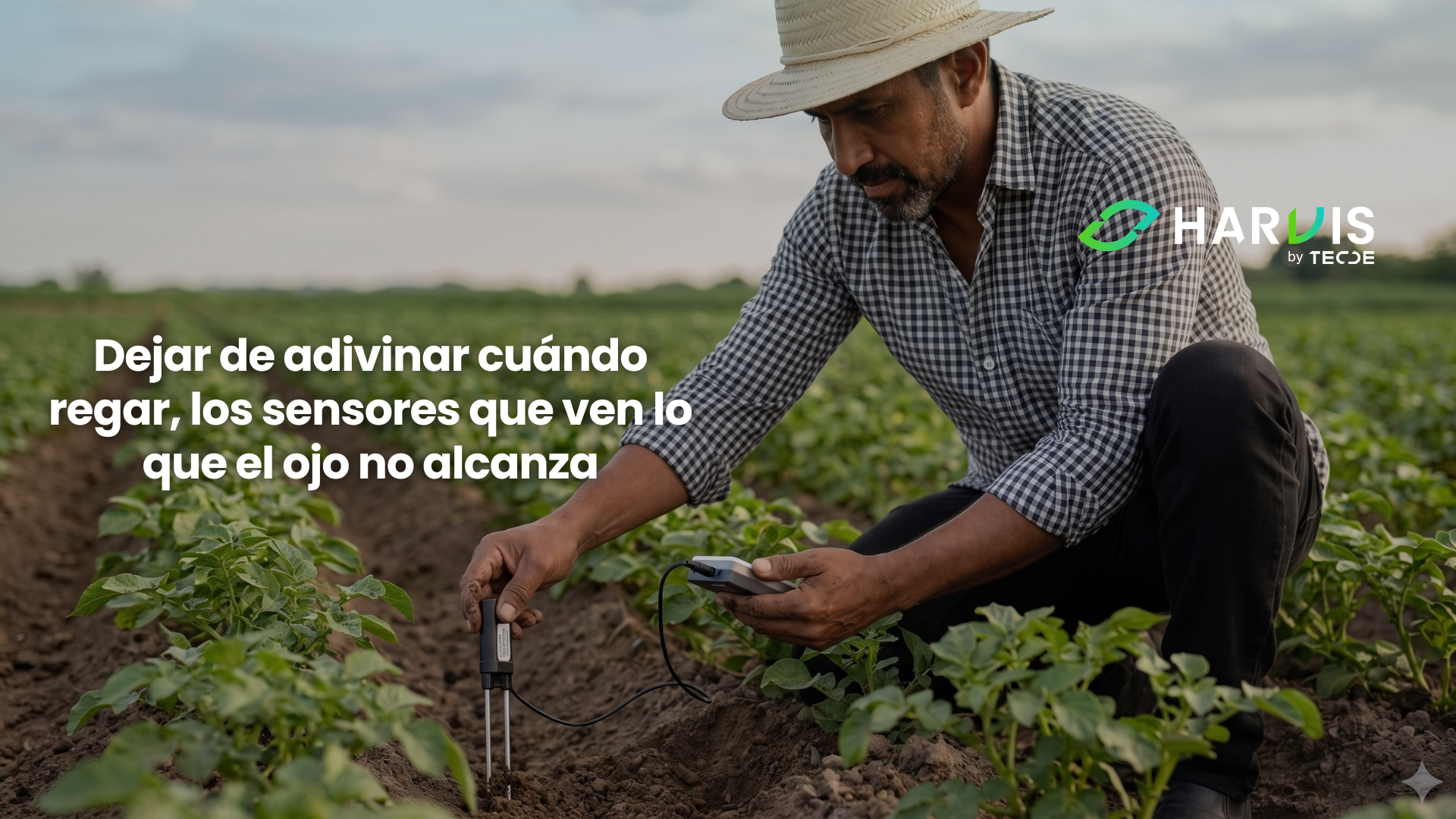
When a leaf looks wilted, the physiological damage caused by that wilting has already occurred, and the yield that was compromised along the way is already at risk. This is the silent trap of observation-guided irrigation, because visible symptoms are late indicators of a process that started underground several days earlier, when the available water in the root zone crossed a threshold that no one was monitoring. The producer who irrigates based on what they see is almost always late; the one who irrigates by calendar is early sometimes and late others, with the added complication of not knowing which of the two happened.
This season has built three pieces that fit together. First, we quantified the water demand of the crop, then we reviewed what fraction of that water actually reaches the root according to the application method, and finally, we saw that there are windows in the cycle where deliberately restricting water improves profitability. The three pieces share a dependency that we had not yet resolved, which is that none of them works if you do not know, today, what your soil has and how your plant is doing. The FAO itself points this out as a condition for controlled deficit irrigation, warning that the technique requires high management capacity with close monitoring of soil water content. Without that layer of measurement, the calculation is an estimate, the infrastructure is an assumption, and the deficit strategy is a risk.
From Calculated Number to Measured Number: Why the Water Balance Gets Out of Sync
The water balance calculated with reference evapotranspiration and crop coefficient is an excellent tool and remains the reference framework for irrigation agronomy. Its limit is not in the formula but in the accumulation of small errors over time. The rain you record is not all the rain that infiltrated, because part of it ran off and another part evaporated from the surface before entering. The amount you applied is not all that remained in the root zone, because your system has real efficiency and uniformity that almost never match the design specifications. The storage capacity of your soil changes between fields and between depths within the same field.
Each of those deviations is small in an individual irrigation, and none is noticeable in a week. Added up over a month, they produce a discrepancy between the water that your spreadsheet says is in the soil and the water that is actually there. The sensor serves to correct that drift, functioning as the control point that brings the model back to reality. It does not replace the calculation; it anchors it.
Comparative data helps to dimension how valuable that anchoring is. A 2025 study comparing moisture sensor-based scheduling against climate-based scheduling in a drip-irrigated crop with low-cost capacitive sensors connected via the Internet of Things found reductions of nearly 28.8 percent in water use and 16.2 percent in pumping hours, while maintaining crop performance. Think of it in terms of the farm, because those pumping hours are diesel or billed energy, and that savings did not come from producing less but from stopping unnecessary irrigations that the soil did not need. Recent systematic reviews on IoT-enabled irrigation systems report savings ranging from nearly ten percent to nearly thirty percent depending on the crop, the system, and the baseline against which it is compared, a wide range that should be interpreted carefully, because the savings are greater when the previous practice was more imprecise.
How Much Water Is There and How Much Does It Cost to Extract It: Two Questions That Are Not the Same
Here appears a distinction that determines which equipment is suitable for you and that many catalogs do not explain. There are two families of soil sensors that answer different questions.
The first family measures volumetric water content, that is, what percentage of the soil volume is occupied by water. This includes capacitive sensors and frequency domain reflectometry, time domain reflectometry, and in the more traditional realm, neutron probes and the gravimetric laboratory method. Its reading is intuitive because it tells you how many millimeters of water you have stored in each layer, and it connects directly with the water balance you already know how to calculate.
The second family measures matric potential, that is, the tension with which the soil retains water and, therefore, the effort it costs the root to extract it. This includes tensiometers and granular matrix sensors. Its reading is less intuitive because it is expressed in suction units, but it has an important conceptual advantage, as it answers the question that the plant actually faces. A sandy soil with twelve percent volumetric moisture can have water perfectly available, while a clayey soil with the same twelve percent may be retaining it so strongly that the root cannot reach it. The content is the same; the availability is not.
The practical choice depends on your soil and your way of working. In medium and heavy-textured soils, where the retention curve is steep, tension provides information that volumetric content does not deliver with the same clarity. In operations that already have water balance by field, volumetric content integrates better with existing records. The comparative study mentioned above also found that capacitive sensors outperformed tensiometers in operational simplicity and irrigation efficiency, although their performance remained slightly below the method based on optimized evapotranspiration, suggesting that the best configuration is not to choose between sensor and calculation but to operate them together.
Calibration: The Step That Decides Whether Your Sensor Measures or Just Gives an Opinion
This is the point where most investments in monitoring are lost without the producer realizing it. A capacitive sensor does not measure water directly; it measures an electrical property of the medium and converts it into moisture through an equation. That equation comes factory-calibrated in a reference soil that is not yours, with a texture, organic matter content, and salinity that probably do not match those of your field. The result is a number that looks precise, graphs nicely, and may be systematically off.
Recent research on the calibration of low-cost capacitive sensors addresses exactly this problem, evaluating the performance of these devices in specific soils and proposing adjusted equations for irrigation management applications. Studies from 2025 on capacitance sensors for precision irrigation scheduling reach a converging conclusion: site-specific calibration substantially improves the agronomic utility of the reading. Developments from 2026 on low-cost sensors for real-time scheduling insist on the same requirement before trusting the data for automation.
The good news is that field calibration does not require a laboratory. The procedure consists of taking soil samples next to the sensor at different times, from saturated soil after irrigation to dry soil before the next one, determining the actual moisture of those samples by dry weight, and comparing each value with the reading that the sensor provided at that moment. With five or six pairs of data covering the range of moisture you manage, you have a local relationship that corrects the factory reading. It is an afternoon's work per soil type and is the difference between having an instrument and having a decoration with an internet connection.
There is a second calibration, more agronomic than technical, which is to define your thresholds. The sensor tells you how much water there is, but it does not tell you when to water, because that threshold depends on the crop, the phenological stage, and the strategy you have chosen. An expanding citrus lot and that same lot changing color require different thresholds, and that is where monitoring stops being an instrument and becomes a decision-making tool.
Measure Before Opening the Valve
Do you know right now how much available water is in the root zone of your most critical field, or are you deducing it from the last time it rained? That difference separates managed irrigation from improvised irrigation, and it does not depend on buying the most expensive equipment but on having the data and knowing what to compare it against. Harvis helps you keep track of your irrigations and rainfall by field, cross-referencing it with the calculated demand of the crop and turning your sensor readings into a concrete decision about when to open the valve and for how long. Write to us on WhatsApp and let's talk about how your monitoring is today.
Where You Bury the Sensor Matters More Than the Brand You Bought
There is a widespread belief that the quality of monitoring depends on the equipment, and the evidence points in another direction. A mid-range sensor well placed delivers better decisions than a high-end sensor placed in the wrong location, because the location error cannot be corrected with instrument precision.
The first decision is depth. University extension guides recommend installing sensors in pairs, typically at one-third and two-thirds of the effective root depth, monitoring at least two or three layers to capture how water is distributed in the profile. The logic is simple and worth understanding, because the surface sensor tells you if the irrigation you applied reached the area where the highest root density is, while the deep sensor alerts you if you overwatered and the water is percolating below, taking nutrients with it. That pair of readings together answers the two important questions: whether you watered enough and whether you overwatered. It is also worth noting that nearly seventy percent of the water that the plant extracts comes from the upper half of the root zone, so the surface layer weighs more in the daily decision.
The second decision is horizontal position, and in localized irrigation, it is critical. The water from a dripper does not wet the field; it wets a bulb, and a sensor placed outside that bulb measures dry soil permanently while the plant is perfectly supplied. Placing it close to the emitter has the opposite problem, as it measures a saturated area that does not represent the average of the active root. Specific research on sensor placement in drip systems addresses this trade-off and concludes that the position should be defined within the wet bulb, at an intermediate distance between the emitter and the edge of the bulb, and at the depth where the active root is concentrated.
The third decision is how many points to install. Extension recommendations suggest a minimum of two monitoring locations per management zone and warn that fields with greater variability in texture, slope, or irrigation uniformity require more points. Studies on optimizing sensor positioning in the field confirm that representative location matters more than the absolute number, and that installing in high points, depressions, or atypical areas introduces bias instead of information. The practical rule that emerges is to install in the area that represents the majority of the field, and if you have a consistently drier or heavier sector, treat it as a separate management zone with its own measurement point.
Ask the Plant, Not Just the Soil
The soil tells you how much water is available, but the plant decides how much it uses and how much transpiration it sacrifices to protect itself. This distinction opened a second generation of instruments that directly measure the water status of the crop, and they are especially relevant in perennial fruit trees like avocado and citrus, where the response to deficit is precisely what you want to control.
Dendrometers measure micrometric variations in trunk diameter throughout the day. During hours of highest atmospheric demand, the trunk contracts because transpiration extracts water from the tissues, and during the night it recovers when the plant replenishes. When the tree enters stress, the maximum daily contraction increases and the trunk growth rate decreases or becomes negative, two signals that appear before any visible symptoms in the foliage. Extension sources specialized in irrigation report strong correlations between the maximum daily contraction measured by dendrometer and the stem water potential measured with a pressure chamber, with a coefficient of determination of about 0.85, which in practical terms means that an automatic and continuous instrument can largely replace a manual measurement that requires trained personnel and strict time windows.
Sap flow sensors estimate how much water is moving through the trunk at any moment, providing a direct reading of actual transpiration versus potential transpiration. More recent trunk microtensiometers continuously measure the stem water potential, and recent research has worked to relate that reading to sap flow, canopy temperature, and variations in trunk and fruit diameter. A 2025 model combined trunk diameter variation with vapor pressure deficit to reproduce the stem water potential, and studies from the same year applied dendrometers to directly automate irrigation in orchards. Research in high-density orchards has evaluated the combined use of sap flow and maximum daily contraction as a scheduling system, with results supporting the combination of both signals.
These devices are more expensive and more demanding than a soil sensor, and they are not the starting point for a farm that is just beginning to measure. Their natural place is in high-value orchards where soil monitoring already exists, where a controlled deficit strategy is applied, and where the margin between restricting well and restricting poorly justifies the instrument.
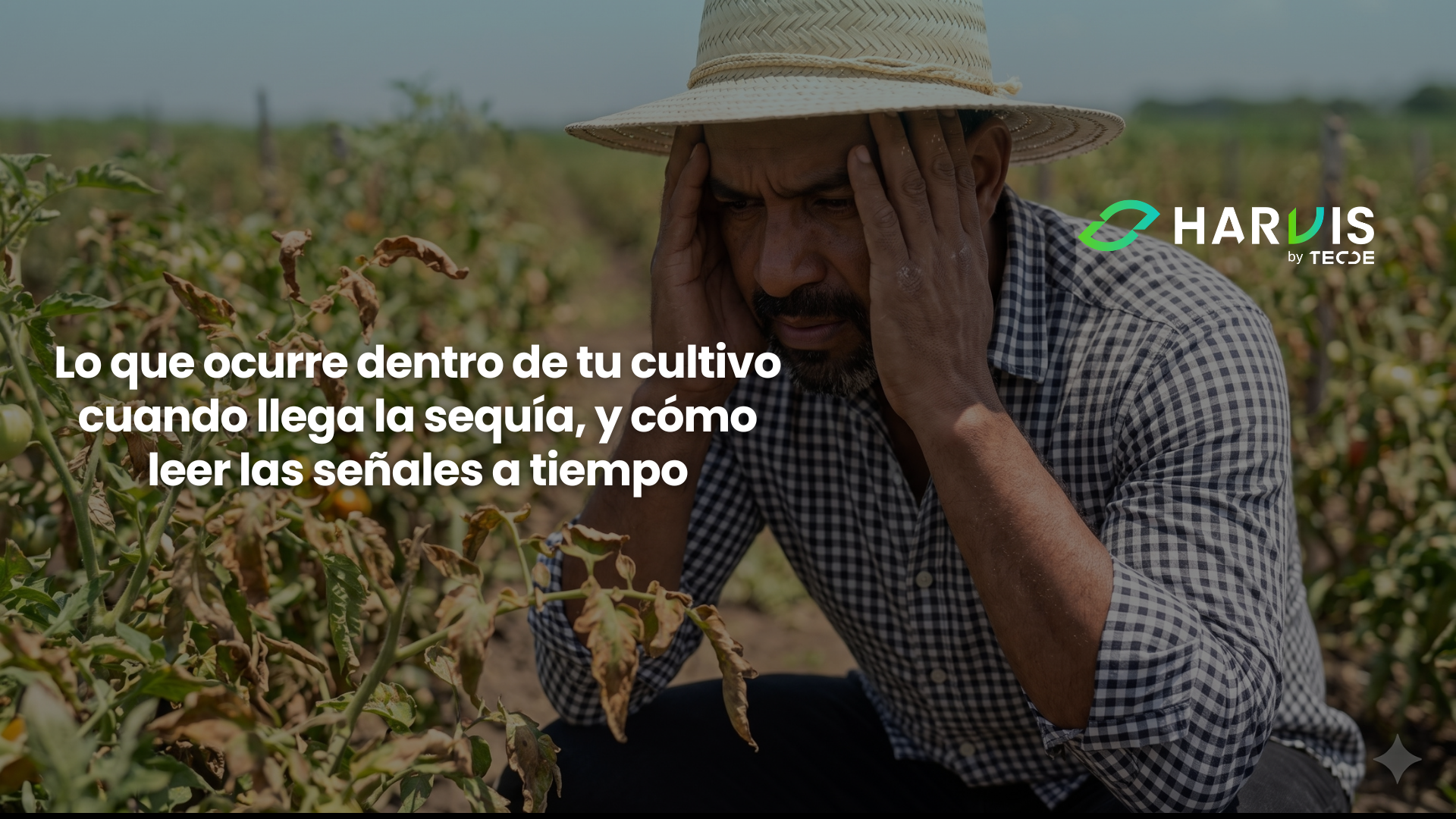
As we already addressed in our blog What Happens Inside Your Crop When Drought Arrives, and How to Read the Signals in Time, which you can read here, the plant keeps an internal record of its own stress long before that record becomes visible in the leaf or fruit; plant sensors are, at their core, the way to read that record while there is still something that can be done about it.
What a Sensor Will Not Solve for You
It would be easy to close this journey by suggesting that installing sensors solves water management, and that is not true. It is worth stating clearly where the limits are, because the producer who knows them makes better purchasing decisions.
A poorly installed or uncalibrated sensor produces data that looks reliable but is not, and that is a worse scenario than having no data, because it generates confidence where there should be doubt. Equipment drifts over time, especially lower-cost ones, and requires periodic verification against direct sampling at least once per season. Rural connectivity remains a real constraint, and a system that relies on continuous transmission to function inherits the fragility of the available signal, which is why it is advisable to prioritize equipment that stores data locally and transmits when possible. Batteries, cables, and connectors live outdoors and in the presence of fieldwork, and the physical failure rate of a poorly protected system is high.
There is a deeper limit. The sensor measures a point, and your field is not a point. No matter how well placed it is, extrapolating its reading to an entire management unit assumes a homogeneity that rarely exists, and that is one of the reasons why reviews on soil moisture forecasting insist on combining sensors with climate information and models, rather than replacing one with the other. Point measurement and the balance model correct each other, and neither is sufficient alone.
Finally, automating based on unverified data multiplies the error instead of correcting it. A system that automatically opens valves based on a poorly defined threshold will make mistakes with perfect consistency, every day, without anyone questioning it. The responsible sequence is to measure, verify against the reality of the field for at least one season, adjust the thresholds with what you learned, and only then automate.
Measuring Costs Less Than Making Mistakes
The cost of a basic moisture monitoring system for a management unit is today a fraction of the value of the harvest it protects, and an even smaller fraction of the cost of an undetected stress event in the wrong window of the cycle. That arithmetic has changed in recent years, as equipment prices have dropped while the value of water has risen.
What a monitoring system does, at its core, is shorten the distance between what is happening in your soil and what you know is happening. Everything we built this season, the calculation of demand, the efficiency of the application system, and the ability to restrict water judiciously in certain windows, depends on that distance being short. Calibrate the sensor against your own soil, place it where the active root is within the wet bulb, give it a couple of depths, define your thresholds by phenological stage, and verify at least once per season that the instrument continues to tell the truth. With that, you stop watering based on what you see and start watering based on what you know.
Consulted References
- Food and Agriculture Organization of the United Nations (FAO). (n.d.). Regulated deficit irrigation and partial rootzone drying as irrigation management techniques. https://www.fao.org/4/y3655e/y3655e11.htm
- Allen, R. G., Pereira, L. S., Raes, D., & Smith, M. (1998). Crop evapotranspiration, guidelines for computing crop water requirements. FAO Irrigation and Drainage Paper 56. https://www.fao.org/4/x0490e/x0490e00.htm
- Comparative Analysis of Soil Moisture- and Weather-Based Irrigation Scheduling for Drip-Irrigated Lettuce Using Low-Cost Internet of Things Capacitive Sensors. (2025). PMC. https://pmc.ncbi.nlm.nih.gov/articles/PMC11902337/
- IoT Sensing for Advanced Irrigation Management, a Systematic Review of Trends, Challenges, and Future Prospects. (2025). PMC. https://pmc.ncbi.nlm.nih.gov/articles/PMC11991392/
- Internet of Things-enabled smart irrigation systems for precision water management, a systematic review. (n.d.). Agricultural Water Management / ScienceDirect. https://www.sciencedirect.com/science/article/pii/S0378377426004968
- Soil moisture monitoring technologies in smart agriculture, a comprehensive review. (n.d.). ScienceDirect. https://www.sciencedirect.com/science/article/pii/S294991192500053X
- Calibration of Low-Cost Capacitive Soil Moisture Sensors for Irrigation Management Applications. (2025). PMC. https://pmc.ncbi.nlm.nih.gov/articles/PMC11768944/
- Assessing capacitance soil moisture sensors for precision irrigation scheduling in wheat crop. (2025). CABI Agriculture and Bioscience. https://www.cabidigitallibrary.org/doi/10.1079/ab.2025.0025
- Development and Testing of a Low-Cost Soil Moisture Sensor for Real-Time Irrigation Scheduling. (2026). Irrigation and Drainage, Wiley. https://onlinelibrary.wiley.com/doi/10.1002/ird.70026
- University of Minnesota Extension. (n.d.). Soil moisture sensors for irrigation scheduling. https://extension.umn.edu/irrigation/soil-moisture-sensors-irrigation-scheduling
- An attempt to find a suitable place for soil moisture sensor in a drip irrigation system. (n.d.). ScienceDirect. https://www.sciencedirect.com/science/article/pii/S2214317321000342
- Oregon State University Extension Service. (n.d.). EM 9868, Soil moisture monitoring to support irrigation scheduling. https://extension.oregonstate.edu/catalog/em-9868-soil-moisture-monitoring-support-irrigation-scheduling
- Optimizing the Positioning of Soil Moisture Monitoring Sensors in Winter Wheat Fields. (n.d.). Water, MDPI. https://www.mdpi.com/2073-4441/10/12/1707
- Extension Australia, Irrigating Agriculture. (n.d.). Plant based sensors for irrigation scheduling. https://extensionaus.com.au/irrigatingag/plant-based-sensors-for-irrigation-scheduling/
- Using stem water potential derived from continuous reading sensors for irrigation scheduling, nectarine as a test case. (n.d.). Irrigation Science, Springer. https://link.springer.com/article/10.1007/s00271-024-00983-x
- Relating microtensiometer-based trunk water potential with sap flow, canopy temperature, and trunk and fruit diameter variations. (n.d.). PMC. https://www.ncbi.nlm.nih.gov/pmc/articles/PMC11157117/
- Automated irrigation of apple trees based on dendrometer sensors. (2025). Agricultural Water Management / ScienceDirect. https://www.sciencedirect.com/science/article/pii/S037837742500112X
- Assessing water stress in a high-density apple orchard using trunk circumference variation, sap flow index and stem water potential. (n.d.). Frontiers in Plant Science. https://www.frontiersin.org/journals/plant-science/articles/10.3389/fpls.2023.1214429/full
- Soil moisture forecasting from sensors-based soil moisture, weather and irrigation observations, a systematic review. (n.d.). ScienceDirect. https://www.sciencedirect.com/science/article/pii/S2772375524002971