

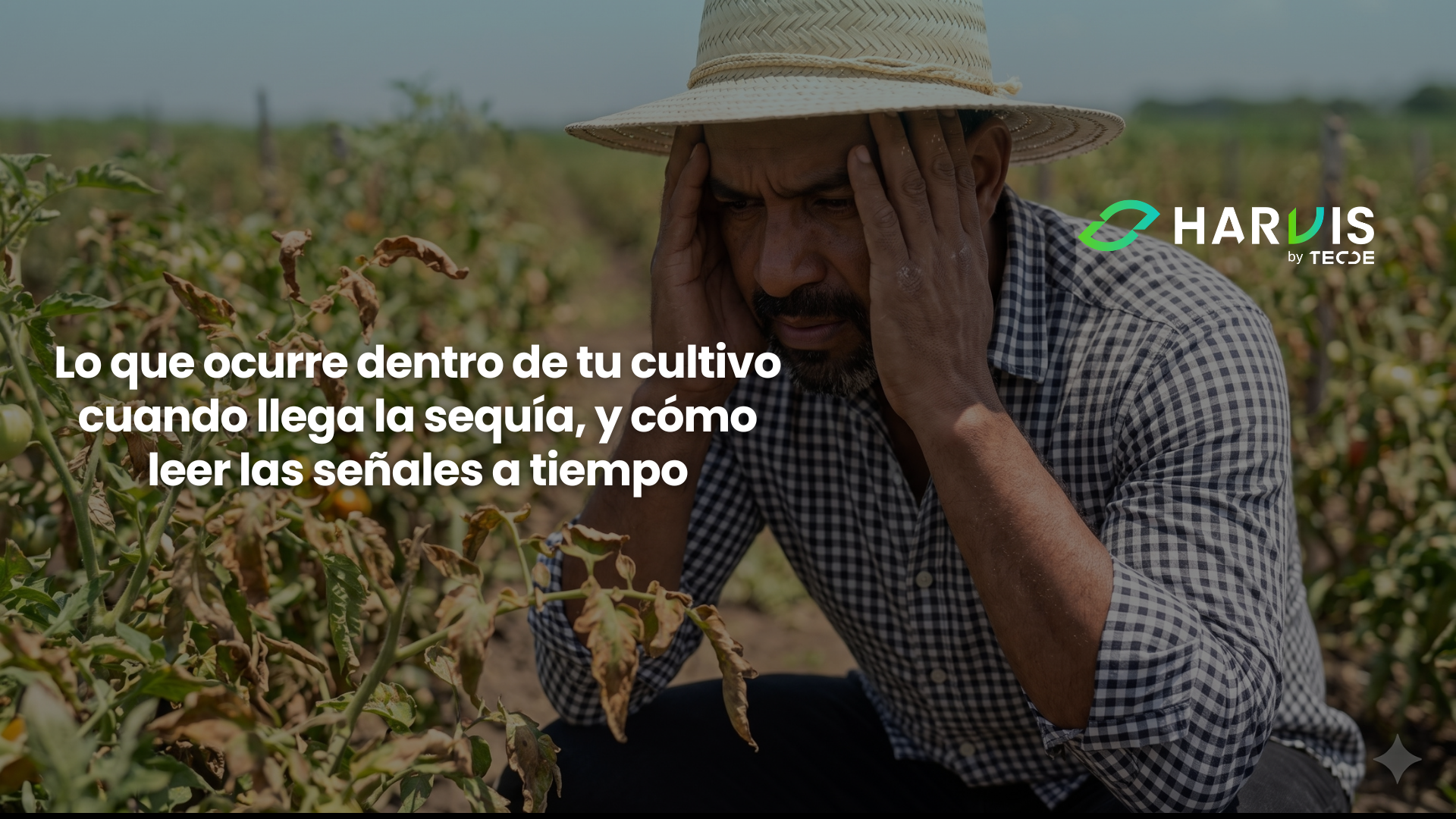
We close this season where it all began, in the field. We first explored the five families of hormones that direct your crop's decisions, and then the minerals that ignite those hormones, the molybdenum behind abscisic acid, the zinc and boron behind auxins, the copper behind ethylene. All that machinery exists for a reason: to allow the plant to respond when the environment changes. And with one of the strongest El Niño events announced, with ocean temperatures expected to exceed the average by several degrees and projected droughts for much of the coffee and avocado-growing areas of the region, that machinery is about to be put to the test.
What happens inside a stressed plant is not chaotic; it is an orderly sequence of physiological processes that activate one another. The plant perceives the lack of water, triggers hormonal signals, closes its pores, reorganizes its internal chemistry to avoid losing turgor, mounts defenses against cellular damage, and if the stress becomes too intense, it begins to sacrifice parts of itself. Understanding this sequence is what allows you to anticipate, because each of those processes leaves a visible mark long before the damage becomes irreversible. In this blog, we explore those processes and learn to read them, to move from reacting when there is already fruit on the ground to acting when the first signs begin to appear.
Photosynthesis and the Dilemma of Opening or Closing
It all starts with a decision that your crop makes every day, even without stress. To perform photosynthesis and produce the sugars that sustain its growth and fruits, the plant needs to capture carbon dioxide from the air, and to do this, it opens the stomata, those microscopic pores scattered across its leaves. The problem is that every time it opens them to let in CO₂, it also lets out water in the form of vapor. Under normal conditions, that exchange is balanced, but when water is scarce, the plant faces a costly situation of either continuing to open to feed itself or closing to avoid dehydration.
Under the drought that El Niño will bring, the plant leans towards survival. Abscisic acid, which as we saw depends on molybdenum to be produced, gives the order to close the stomata and stop water loss. It is a smart survival decision, but it has a direct cost on your harvest, because with the stomata closed, less CO₂ enters, photosynthesis drops, and the plant produces fewer sugars to fill its fruits. In coffee, stomatal closure is precisely the central component of the response to drought, and it is accompanied by a drop in gas exchange and in the water content of the leaves. The same happens in avocado; stomatal conductance, CO₂ assimilation, and transpiration are markedly reduced under water deficit.
The practical consequence is well known to you, even if you didn't know the name of the process. A crop that spends weeks with its stomata closed grows less, produces smaller leaves, and fruits that do not reach the expected size. It is not that the plant is sick; it is rationing, spending the minimum while waiting for water to return. So a first lesson in management is that over-fertilizing with nitrogen during drought does not help, because a plant with closed stomata cannot utilize that nitrogen to grow, and the salts concentrated in dry soil only exacerbate the stress. The crop does not need you to push it to grow when it is in savings mode; it needs you to help it get through the savings with as little damage as possible.
Osmotic Adjustment: The Silent Way to Retain Water
Closing the stomata slows water loss, but it does not solve the underlying problem, which is how to continue absorbing the little water left in an increasingly dry soil. For this, the plant resorts to a more subtle and fascinating mechanism known as osmotic adjustment.
The idea is simple in its logic. Water always moves towards where there are more dissolved substances, so the plant accumulates solutes inside its cells — sugars, amino acids like proline, and ions like potassium — thereby increasing its ability to "pull" water from the soil inward. By concentrating those solutes, the plant lowers its osmotic potential and manages to maintain the turgor of its tissues even when soil water is scarce. Maintaining turgor is vital because it is the internal pressure that keeps the leaves upright and allows the cells to continue functioning; without it, the crop wilts and many processes stop. In studies with avocado under water stress, turgor remained positive precisely because the plant reduced its osmotic potential by accumulating solutes, a clear signal of this adjustment in action.
Potassium plays a dual role here as we saw in previous blogs. On one hand, it participates in that osmotic adjustment that retains water, and on the other, it is the ion that physically moves the guard cells to open and close the stomata, thus executing the order that abscisic acid issues. A crop with good potassium status regulates its water economy better, both to retain it within its tissues and to control its pores precisely. This explains why pre-drought nutrition matters so much, because a plant that enters stress with its potassium reserves and osmotic machinery in order withstands much more than one that arrives unbalanced.
Oxidative Stress and the Antioxidant Shield That Depends on Minerals
There is a damage from drought that is not visible but occurs deep within the cells, and understanding it reveals why micronutrients matter even more than we have seen so far. When the plant closes its stomata and photosynthesis becomes disordered, the normal flow of electrons within the leaves becomes uncontrolled and begins to generate highly reactive and harmful molecules known as reactive oxygen species. These molecules, including superoxide radical and hydrogen peroxide, attack membranes, proteins, and the genetic material of cells, and if they accumulate uncontrollably, they end up killing tissue. Much of the visible damage from severe stress — spots, leaf edge death, accelerated aging — comes from this internal attack.
The plant is not defenseless against this, because it has a system of antioxidant enzymes that neutralize those harmful molecules before they wreak havoc. The first line of that defense is an enzyme called superoxide dismutase, which deactivates the superoxide radical at a rate ten thousand times faster than would occur spontaneously. And here is the connection that closes the circle of the entire season. That antioxidant enzyme is a metalloenzyme, which means it needs a metal at its center to function, and its three forms depend precisely on copper and zinc, manganese, or iron. Copper, zinc, and manganese — the same micronutrients that ignite hormones — are also the cofactors of the antioxidant shield that protects your crop from drought damage.
Think about what this implies in the face of El Niño. A plant deficient in copper or zinc not only poorly manufactures its hormones but also mounts a weak antioxidant defense, so oxidative stress damages it more and faster. The most recent studies in coffee confirm this, because the cultivars that best withstood severe water deficit were those that combined more efficient stomatal regulation with lower oxidative stress and better nutritional management. In avocado, the response to water stress explicitly includes the activation of redox homeostasis, that is, the control of these reactive molecules. Micronutrients thus work on two fronts at the same time: they ignite the hormones that direct the response, and they build the enzymes that repair and protect. Entering drought with them at adequate levels is equivalent to going into battle with both defenses active.

The Integrated Response and Why Fruits Drop
All these processes do not occur in isolation; they coordinate in an integrated response where the plant allocates its limited resources according to its priorities. With reduced photosynthesis, there are fewer sugars available, and the plant must decide where to send them. Its priority is almost always survival, so it protects its vital tissues and roots before its fruits. This reassignment of resources explains one of the most painful blows of drought to your wallet: the dropping of flowers and fruits.
When stress tightens and the plant calculates that it will not be able to sustain its entire load, ethylene — which as we saw needs copper to be perceived — triggers abscission, which is the mechanism by which the plant deliberately drops small flowers and fruits to avoid spending water and sugars it does not have on them. That fruit that appears on the ground is not always a direct victim of lack of water, but often the result of a hormonal decision by the plant to lighten its load. A good balance of auxins and boron helps sustain the setting and prevents the plant from abandoning its harvest at the first sign of trouble, while a hormonally unbalanced crop drops fruits too easily.
At the same time, the plant invests in searching for the missing water, and here come the auxins that depend on zinc, because they direct root growth towards the deeper and wetter layers of soil. A well-nourished crop can respond to drought by extending its root system, while a deficient one also loses that adaptive capacity. The response to stress is thus a permanent balance between what the plant sacrifices and what it protects, and that balance is governed by the hormones that the micronutrients ignite. When the foundational nutrition is complete, the plant makes more balanced decisions: it holds more fruit and explores more soil; when a link is missing, the decisions become more drastic and costly for you.
It is worth mentioning recovery, because stress does not end when the rain returns. In coffee, it has been observed that stomatal conductance recovers slowly after a period of deficit, much more slowly than it took to close. This means that a crop takes time to return to full production even when water has already returned, and that the damage from poorly managed stress lingers for weeks. A plant that went through drought with its hormonal and antioxidant systems intact recovers faster and loses less, which makes prior preparation not only a defense during the event but also an advantage during recovery.
Reading the Signs in the Field and Acting in Time
All this internal physiology translates into visible signals, and learning to read them is what separates timely intervention from a late rescue. The key is to recognize that the plant's response begins much earlier than the damage becomes evident, so the first signs are subtle and easy to overlook.
Early signs appear when the plant is just entering defense mode. You will notice growth that slows down for no apparent reason, leaves that lose their shine and look somewhat dull, and slight wilting during the hottest hours of midday that recovers by evening. You will also see that some leaves reorient or fold slightly to expose less surface to the sun, a gesture of self-defense by the plant to reduce water loss and overheating. These signals are the golden window to act, because they indicate that the crop has activated its response but has not yet suffered serious damage.
Advanced signs indicate that stress has already surpassed the plant's defense capacity, and by the time they appear, the crop has been in crisis for some time. Among them are persistent wilting that no longer recovers overnight, pronounced leaf curling, yellowing of older leaves, burning or necrosis of leaf edges that reveals oxidative damage, dropping of flowers and fruits, and total cessation of new shoots. If you wait to see these signs to react, much of the cycle's yield has already been lost.
The correct action in response to the first signs is agronomic and preventive, not emergency. It is advisable to conserve soil moisture with covers and organic matter, maintain or establish shade in coffee plantations, apply irrigation even if partially and deficit, and avoid adding other stresses during the critical window, such as severe pruning or transplanting. On the nutritional foundation, we have already insisted: the micronutrients that ignite hormones and build the antioxidant shield must be in the crop before the peak of stress, because they are not very mobile and do not arrive in time if applied when damage has already begun. The practical rule that summarizes the entire season is simple: at the first sign of stress, the response is to prepare and protect, never wait for the fruit to fall to act.
The Lots That Collapse First During an El Niño Event Are Not Always the Ones That Receive the Least Water
When data from many lots across several cycles is crossed, a pattern emerges that goes against intuition. The lots that collapse first during an El Niño event are not always the ones that receive the least water, but often those that enter stress with their physiological machinery incomplete: low molybdenum that weakens stomatal closure, deficient copper or zinc that leaves the antioxidant shield short, insufficient potassium that compromises osmotic adjustment. Two neighboring lots, with the same drought and the same crop, can respond completely differently depending on the status of the minerals that support their internal processes.
That pattern is almost impossible to anticipate at first glance, because physiological weakness does not manifest until stress puts it to the test, and by then the window for preventive action has already closed. Harvis crosses the nutritional status of each lot with the phenological stage of the crop and the El Niño weather forecast to signal in advance which lots are physiologically unprepared for the impending stress. Instead of waiting to see the crop wilted, the technology identifies where the internal response will fail and allows for correcting the nutritional foundation while there is still time for those minerals to reach their place.
The value of all this is not in applying more inputs, but in arriving prepared with the right ones. A lot with complete nutrition goes through drought by closing its stomata well, retaining water better, defending against oxidative damage, and holding more of its harvest, and it also recovers faster when the rain returns. Distinguishing, lot by lot, which is ready and which is not is what turns the knowledge of this season into a concrete decision that protects your production against one of the strongest El Niño events announced.
As we already addressed in our blog When Climate and Market Change, the Future of Coffee Farming, which you can read here, climate variability is today one of the greatest challenges for producer profitability, and anticipating is the only strategy that truly protects the harvest. This season named and mechanized that anticipation, because now you know that preparing your crop for El Niño is not just about managing water, but ensuring that the hormones, minerals, and physiological processes that determine its response are complete and timely.
With this, we close the season on hormones, micronutrients, and physiological processes. We explored how your crop decides, with which minerals it ignites those decisions, and how everything integrates into its fight against stress. The idea worth holding onto is that your crop already knows how to defend itself against El Niño, and that your job, more than rescuing it when it falls, is to give it everything it needs in time to defend itself.
Prepare the complete physiology of your crop before El Niño arrives. Write to us on WhatsApp and receive technical assistance to ensure that each lot enters stress with its hormones, minerals, and defenses in order. Talk to an expert from Harvis →
Consulted References
- Schroeder, J. I., et al. (2022). Plant hormone regulation of abiotic stress responses. Nature Reviews Molecular Cell Biology, 23. https://www.nature.com/articles/s41580-022-00479-6
- Jardim-Messeder, D., de Souza-Vieira, Y., and Sachetto-Martins, G. (2025). Dressed Up to the Nines: The Interplay of Phytohormones Signaling and Redox Metabolism During Plant Response to Drought. Antioxidants / MDPI. https://pmc.ncbi.nlm.nih.gov/articles/PMC11768152/
- Silva, P. C. da, Ribeiro Junior, W. Q., Ramos, M. L. G., Rocha, O. C., Veiga, A. D., et al. (2022). Physiological Changes of Arabica Coffee under Different Intensities and Durations of Water Stress in the Brazilian Cerrado. Plants / PMC. https://pmc.ncbi.nlm.nih.gov/articles/PMC9460576/
- Lopez-Merino, J. E., Huaman, E., Condori-Apfata, J. A., and Oliva-Cruz, M. (2026). Physiological and Biochemical Analysis of Coffea arabica Cultivars Subjected to Water Stress for the Selection of Cultivars Adapted to Drought. Stresses / MDPI. https://doi.org/10.3390/stresses6010002
- Moreno-Ortega, G., Zumaquero, A., Matas, A., and Olivier, N. A. (2021). Physiological and Molecular Responses of ‘Dusa’ Avocado Rootstock to Water Stress: Insights for Drought Adaptation. Plants / MDPI. https://www.ncbi.nlm.nih.gov/pmc/articles/PMC8537572/
- Water Relations and Physiological Response to Water Deficit of ‘Hass’ Avocado Grafted on Two Rootstocks. (2024). Agronomy / MDPI. https://doi.org/10.3390/agronomy14091959
- Chartzoulakis, K., Patakas, A., Kofidis, G., Bosabalidis, A., and Nastou, A. (2002). Water stress affects leaf anatomy, gas exchange, water relations and growth of two avocado cultivars. Scientia Horticulturae / ScienceDirect. https://www.sciencedirect.com/science/article/abs/pii/S030442380200016X
- Antioxidant Defense System in Plants: Reactive Oxygen Species Production, Signaling, and Scavenging During Abiotic Stress-Induced Oxidative Damage. (2025). Horticulturae / MDPI. https://www.mdpi.com/2311-7524/11/5/477
- Hasanuzzaman, M., Bhuyan, M. H. M. B., Zulfiqar, F., Raza, A., Mohsin, S. M., Mahmud, J. A., ... and Fotopoulos, V. (2020). The Significance of Reactive Oxygen Species and Antioxidant Defense System in Plants: A Concise Overview. Frontiers in Plant Science. https://www.frontiersin.org/journals/plant-science/articles/10.3389/fpls.2020.552969/full
- Cu/Zn superoxide dismutase homologs participate in Nicotiana benthamiana antiviral responses. (2025). Frontiers in Microbiology. https://www.frontiersin.org/journals/microbiology/articles/10.3389/fmicb.2025.1561731/full
- Finkelstein, R. (2013). Abscisic Acid Synthesis and Response. The Arabidopsis Book. https://pmc.ncbi.nlm.nih.gov/articles/PMC3833200/
- Castillo-González, J., Ojeda-Barrios, D., Hernández-Rodríguez, A., González-Franco, A. C., Robles-Hernández, L., and López-Ochoa, G. R. (2018). Zinc metalloenzymes in plants. Idesia / Redalyc. https://www.redalyc.org/journal/339/33957240004/html/
- Dluhosch, D., Kersten, L. S., Minges, A., Schott-Verdugo, S., Gohlke, H., and Groth, G. (2025). Molecular mechanism and structural models of protein-mediated copper transfer to the Arabidopsis thaliana ethylene receptor ETR1. Scientific Reports, Nature. https://www.nature.com/articles/s41598-025-19915-6
- Wang, Y., Lu, G., Ding, Y., and Shi, H. (2023). The Role of IAA in Regulating Root Architecture of Sweetpotato in Response to Potassium Deficiency Stress. PMC. https://www.ncbi.nlm.nih.gov/pmc/articles/PMC10181447/
- IFRC / Red Cross. (2026). “El Niño” 2026: How do we prepare for its effects in Latin America and the Caribbean?. https://www.ifrc.org/es/articulo/el-nino-2026-como-nos-preparamos-para-sus-efectos-en-america-latina-y-el-caribe