

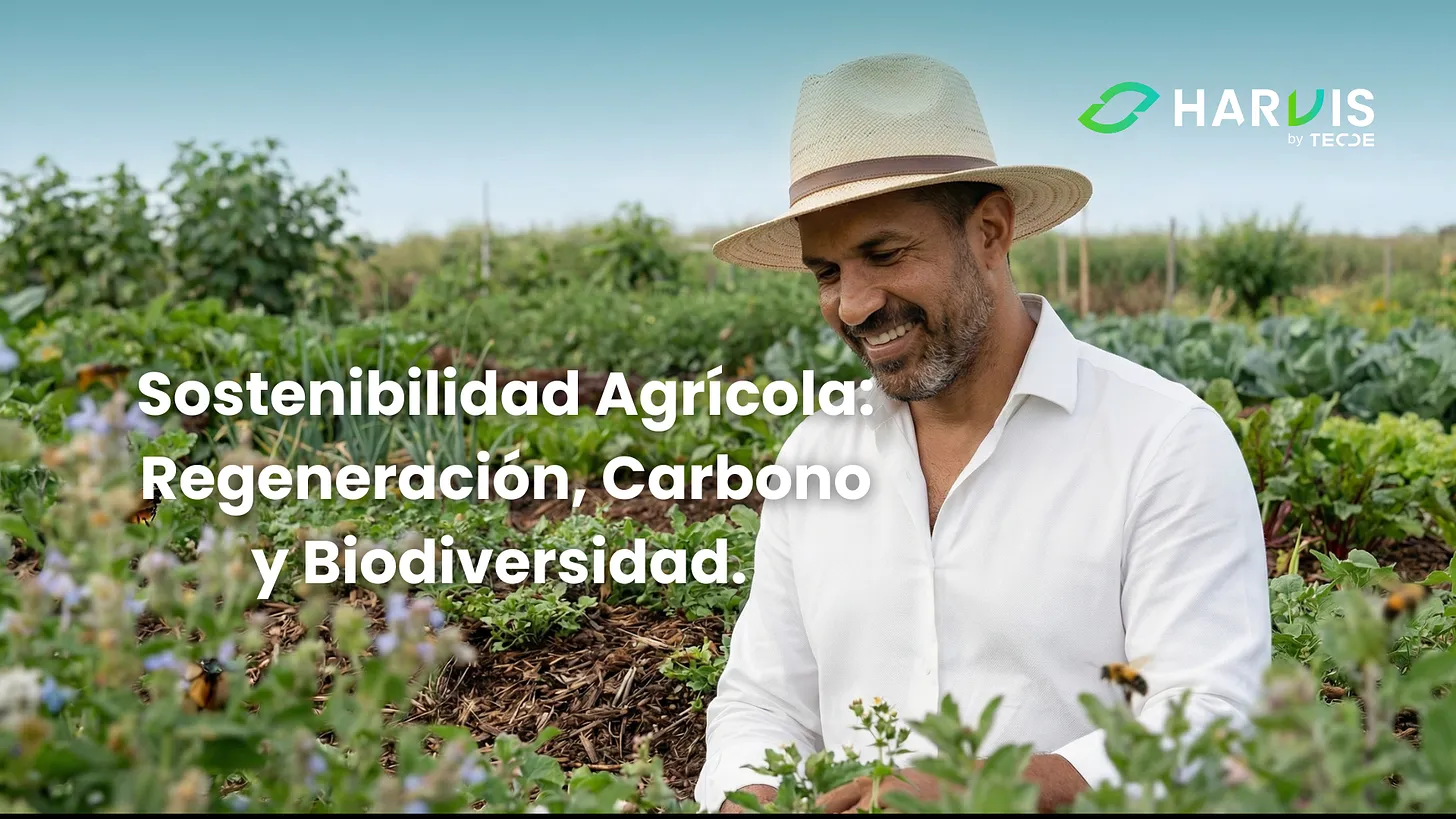
Global agriculture is undergoing an unprecedented transformation. With 209.8 million hectares dedicated to innovative crops and technologies that promise to revolutionize the way we produce food, we are at a historic turning point in agricultural sustainability.
In our previous editions, we have built the technical foundations of modern export agriculture: from international certifications (ICA, GlobalG.A.P., Rainforest Alliance) that open global markets, to a deep understanding of MRL and modes of action of pesticides, to the strategic integration of biocontrol agents with conventional chemicals. Each topic has been a link in the chain of knowledge that leads us to the most transcendent challenge of our time: comprehensive sustainability.
Today, we do not speak of sustainability as a marketing trend or a topic everyone wants to discuss, but as a scientific and technological revolution that is redefining every aspect of agricultural production. Agriculture in this century faces an equation with a rather complex challenge: feeding a constantly growing population while restoring degraded ecosystems, sequestering atmospheric carbon, preserving biodiversity, and generating economic profitability for millions of producers.
Agricultural sustainability transcends traditional conservation practices to become an integral discipline of major branches of knowledge such as: biotechnology, artificial intelligence, carbon markets, ESG (Environmental, Social and Governance) reporting, and regenerative systems that not only minimize environmental damage but actively improve the ecological conditions where they operate.
🔬 Foundations of Current Agricultural Sustainability
🌏Comprehensive agricultural sustainability:
Currently, a new term related to sustainability is emerging, which is integrality towards a systemic approach that seeks to optimize three fundamental dimensions: Economic productivity, ecological integrity, and social equity. This new concept of sustainability is based on the principle of active regeneration, where agricultural systems significantly contribute to the restoration of ecosystems.
Within the concept of comprehensive sustainability, the following fundamental components are defined:
🌦️Climate resilience: The ability of the production system to maintain its functionality in the face of extreme climate disturbances.
🌫️Net carbon sequestration: A positive balance between carbon captured by the system and carbon emitted by operations.
🦎Functional biodiversity: Biological diversity that fulfills specific roles in maintaining the productivity of the agroecosystem.
♻️Nutrient cycling: Optimization of nutrient flows through natural biological processes. This vital process involves the absorption of nutrients by plants, their transfer through the food chain, and their subsequent release back into the environment through the decomposition of organic matter, in which microorganisms play a crucial role.
⛰️Soil health: Maintenance and improvement of the physical, chemical, and biological properties of the soil.
Considering the above, where we define the current state of the concept of sustainability, it is valuable to understand the differences between the paradigm of traditional agriculture and modern agriculture that differ in the concept of sustainability, based on the fact that modern agriculture focuses on regenerative aspects in search of making the best practices translate into doing more good, in contrast to traditional agriculture which focuses on doing less harm.
🌿Traditional sustainable agriculture: Focuses on maintaining current productive capacity without compromising resources for future generations. Its main objective is stability: not degrading more than what is already degraded, maintaining current levels of biodiversity, controlling erosion without necessarily restoring lost soils.
☘️Modern regenerative agriculture: Goes beyond maintenance to actively generate improvements in ecosystem health. Its goal is restoration: increasing soil organic matter, enhancing biodiversity above historical levels, sequestering atmospheric carbon, improving local hydrological cycles, creating systems that are more resilient than the original natural ecosystems.
Next, we will delve into the most recent concept of sustainability in agriculture: The new era of Regenerative Agriculture.
The purpose of this concept is to enable the possibility of a productive system that not only produces food but also captures atmospheric carbon, regenerates the soil, and increases biodiversity.
The data is compelling: a regenerative soil stores 30 times more carbon than a conventional one. This figure, obtained from recent studies in European pilot farms, demonstrates that large crops can be part of the climate solution, not the problem; that is why regenerative agriculture goes beyond "not doing harm." It actively restores ecosystems through:
✔️Cover crops: that protect and nourish the soil.
✔️Minimum tillage: preserving soil structure.
✔️Intelligent integration of livestock: for natural nutritional cycles.
✔️Biological inputs: that strengthen the soil food web.
Currently, we can identify a large number of emerging technologies that aim to position themselves as the foundational solution to improve processes, digitize production systems, and implement records and information in data for the planning and prediction of various economically and functionally important crop variables.
📡 Agriculture from Precision Technologies:
By 2025, the most successful farmers will not only plant seeds: they will also plant and harvest data. Precision agriculture is transforming fields into digital ecosystems where each plant receives exactly what it needs, when it needs it.
Modern systems combine:
✔️Real-time satellite monitoring , providing a variety of data that allows understanding natural phenomena and defining planning processes more strategically.
✔️Ground sensors that have the ability to obtain data and that in turn allow understanding the needs of the crop.
✔️Artificial intelligence that processes and models millions of climatic, productive, phytopathological, nutritional, etc. data.
✔️High-precision GPS for specific applications for defined areas.
The result of applying technology allows reducing fertilizer and pesticide use by 30-40%, while maintaining or increasing yields. It is not about stigmatizing the use of chemical solutions, but rather about making informed and appropriate use based on need; it is a way to integrate knowledge and apply science more consciously and intelligently.

🌏 The Global Impact
Now, there is consideration and awareness towards implementing sustainable and regenerative agriculture due to the latent threat our planet faces from the consequences of pollution, degradation of the ozone layer, and the impact this has on human health. That is why technology is a key facilitator of better practices in agricultural and livestock environments.
The global adoption of precision technologies speaks for itself:
✔️209.8 million hectares use genetically optimized crops.
✔️1.9% growth in area dedicated to sustainable crops.
✔️More than 12% of the world's agricultural area already implements advanced technologies.
✔️Record investment in efficient irrigation systems and renewable energies.
🚀 Emerging Technologies in Sustainability
Artificial intelligence applied to sustainability, through the implementation of predictive models based on various variables:
💻Machine Learning
Based on machine learning algorithms supported by historical data, they allow training statistical models that can analyze soil conditions, productivity, pest and disease incidence, nutritional requirements, market dynamics.
📱Computer vision for biodiversity:
Thanks to the implementation of deep learning using convolutional neural networks trained with millions of images that allow the automatic recognition of all types of animal species such as birds, fauna, insects, and plants.
📊Digital twins:
Through a real-time virtual representation of a physical production system that integrates data from IoT sensors, satellite images, biophysical models, and machine learning algorithms to simulate, predict, and optimize agricultural operations.
Their applications supported for sustainability are based on:
✔️Water optimization: 20-30% reduction in water use through precision irrigation.
✔️Nutrient efficiency: Variable fertilization reducing applications by 15-25%.
✔️Carbon prediction: Continuous estimation of sequestration and emissions.
✔️Biodiversity: Habitat modeling, prediction of management change impacts.
✔️More rational and targeted pesticide applications.
🏷️ Blockchain for sustainable traceability
It is a technology that allows recording and sharing information from a production chain securely, transparently, and immutably, which is very useful in agriculture and livestock when we talk about sustainability.
Application:
1. Total traceability
Allows tracking a product from the farm to the final consumer: batch, farm, agricultural practices, transport, storage. An example of this is that a one-liter milk package can have a QR code with information about the farm of origin, animal management, input use, and quality tests.
2. More reliable certifications
Certifiers can record audits directly on the blockchain, which reduces fraud or counterfeiting of seals such as organic, deforestation-free, or carbon-neutral.
3. Regulatory compliance (EUDR, demanding markets)
Storing georeferencing of farms, production dates, and evidence of no deforestation in a verifiable manner; international buyers can scan a code and see that the product meets the requirements.
4. Incentives for the producer
If the records show good practices (reduction of emissions, animal welfare, soil conservation), the producer can access better prices, green financing, or carbon credits.
2025: Productive Ecosystems
Sustainable agriculture of large crops is not just a trend: it is the new economic reality. The benefits are tangible:
✔️Higher productivity with fewer resources.
✔️Crops more adaptable to climate change.
✔️Improved profitability in the long term.
✔️Positive contribution to the environment.
Agricultural sector leaders are discovering that sustainability is not an additional cost but a competitive advantage whose winning formula combines:
1. Advanced technology for resource optimization.
2. Regenerative practices for soil health.
3. Intelligent diversification for climate resilience/adaptation.
4. Continuous monitoring for constant improvement.
Agricultural sustainability in the 21st century is not simply an evolution of existing practices: it is a revolution that fundamentally redefines our relationship with natural systems. Every regenerated hectare, every ton of carbon sequestered, every species conserved contributes to a systemic transformation that transcends productivity to become restoration at the planetary level.
At TECDE, we do not just observe this green revolution: we drive it. As leaders in artificial intelligence technologies applied to the agricultural sector, we understand that the future of large crops is not in doing more of the same but in doing everything more intelligently.
While the industry talks about precision agriculture, we make it a reality. Our AI solutions not only analyze data: they predict, optimize, and transform every agricultural decision into an opportunity for sustainable growth.
We are transitioning from extractive agriculture that sees nature as a resource to exploit, to regenerative agriculture that recognizes producers as custodians of ecosystems, managers of environmental services, and creators of resilient landscapes. This transition is an existential necessity for the continuity of human civilization on a habitable planet.
Today's farmer faces the most significant historical opportunity since the Green Revolution: to lead the regeneration of degraded ecosystems while building more profitable, resilient, and socially just productive systems. The tools are available, markets are emerging, technologies are maturing. All that is missing is the conscious decision to be part of the solution.
Every management decision, every investment in sustainable technology, every strategic alliance with certifiers and conscious markets, every sustainability report published, builds the path towards agriculture that not only feeds the world but regenerates the planet while generating shared prosperity.
"The future of global food is being written in productive systems that embrace sustainable innovation"
In our next edition , we will delve into the efficient use and quality of water in agriculture.
We are making history by creating a large community of professionals and agriculture lovers, with whom we can create conversations around such important topics for farmers and actors in all productive systems. Join us!