

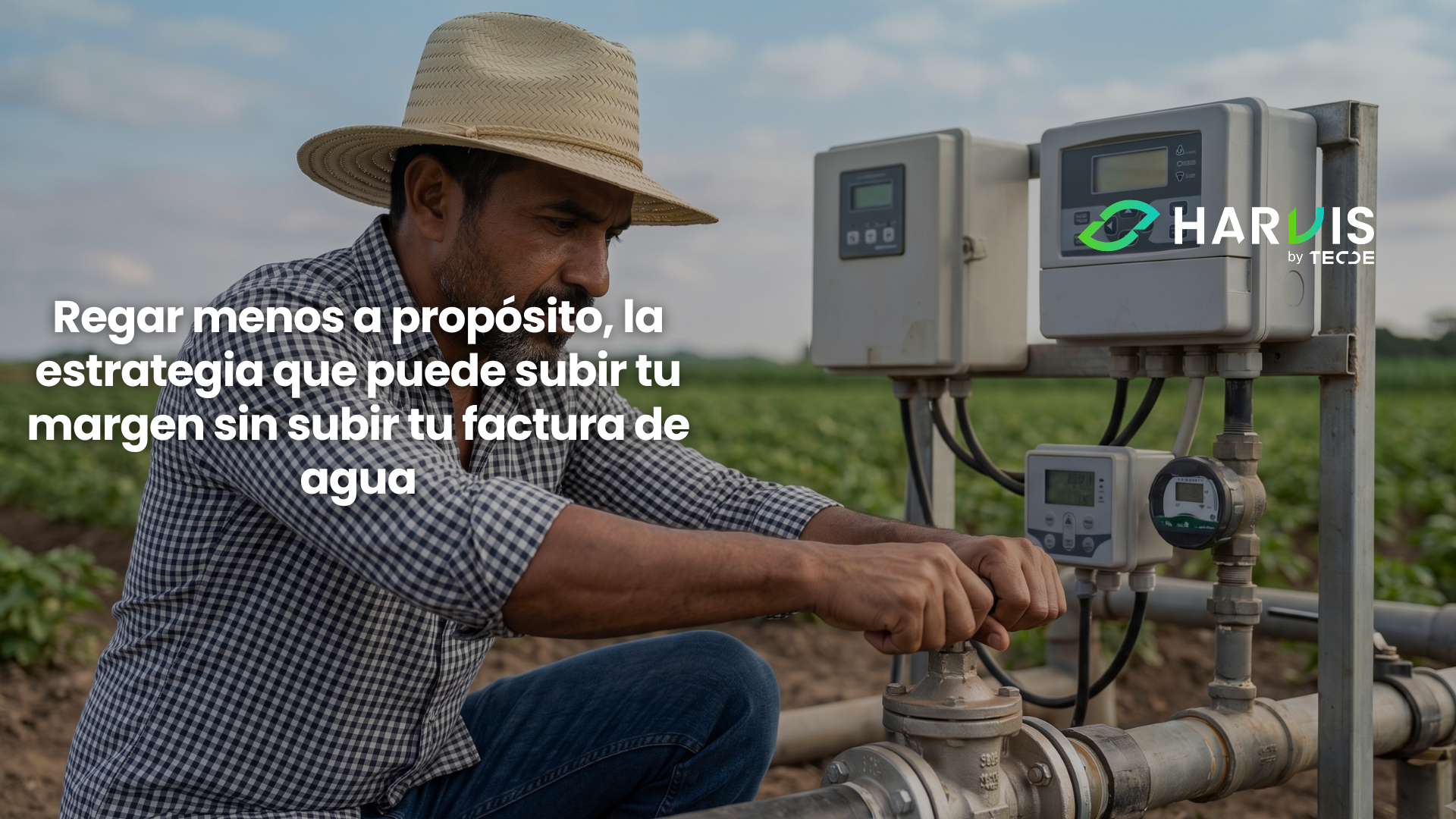
The previous two blogs this season built a solid foundation. First, we calculated how much water your crop consumes and how much the soil can retain, and then we reviewed how the application method determines what fraction of that water actually reaches the root. With those two pieces in hand, a question arises that completely changes the conversation, because until now we assumed that the goal is to always replenish one hundred percent of what the crop demands, and it turns out that this goal, in various situations and with various crops, is not the one that leaves the most money in your pocket.
The idea has a technical name and decades of experimental backing. It is called controlled deficit irrigation, and it consists of deliberately applying less water than the full demand of the crop, concentrating the restriction during phenological stages where the plant is less sensitive and ensuring full supply during stages where a deficit does destroy yield or quality. The word that underpins the entire concept is controlled, because the difference between this strategy and simply watering less is the same as the difference between a prescribed diet and starving.
The Goal Changes, from Maximum Yield to Water Productivity
To understand why this strategy works, you need to change the indicator by which you judge your irrigation. If your indicator is yield per hectare, the answer will always be to water until full demand is satisfied, because every additional millimeter contributes something as long as you don’t reach saturation. But if your indicator is water productivity, that is, how many kilos of product you obtain per cubic meter applied, the curve behaves differently, because the last millimeters you apply to go from ninety to one hundred percent of the demand produce a much smaller yield increase than the first ones, while costing the same per cubic meter.
There lies the economic heart of the matter. The FAO documents this logic by analyzing deficit irrigation practices and points out that both controlled deficit irrigation and partial rootzone drying rely on the knowledge of how the crop reacts to drought, and that both techniques require high management capacity with close monitoring of soil water content. That last condition is what separates producers who can apply the strategy from those who should not attempt it yet.
Numbers in specific crops help to size the opportunity. In Arabica coffee, research on the impact of controlled deficit irrigation under different shading levels found that a moderate deficit, with eighty percent of full irrigation, reduced yield by only 6.4 percent, while increasing protein, crude fat, and chlorogenic acid content in the dry grain and improving both the physical quality of the grain and the cup quality, in addition to the efficiency of water use. Think of it in terms of the farm, because twenty percent less water in exchange for six percent less yield and a better cup is not a loss; it is an exchange that in many price and scarcity scenarios is clearly favorable.
The Windows Where You Can Tighten and Those That Don’t Forgive
It all depends on when during the cycle you apply the restriction, and this is where the physiology of each crop dictates. The costly mistake is not to reduce water; it is to reduce it in the wrong week.
In coffee, there is a particularity that we already mentioned in the first blog of the season and that is worth reinforcing, because a period of water deficit prior to flowering serves a physiological function, as it prepares and synchronizes the floral buds to open when the water arrives. In that window, the deficit is not damage; it is a management tool that helps concentrate flowering and, consequently, the harvest. The situation reverses during the rapid expansion of the grain, when the supply must be complete because any restriction translates into smaller grains and loss of weight. Recent research on photosynthetic limitations in Arabica genotypes under water deficit also documented that the drop in water use efficiency varied between four and seventy-four percent depending on the evaluated genotype, an enormous range that leaves a practical lesson, because tolerance to deficit is not an abstract property of the crop but of the specific genetic material you have planted.
In Hass avocado, the margin for maneuver is much narrower, and it is worth saying so without embellishments. Studies show a proportional and quite relentless response, as trials with different levels of sustained deficit irrigation showed yield reductions of eight, nineteen, and thirty-three percent for increasing restrictions compared to the control, and the yield of treatments without water stress ranged between twenty-five and thirty-one tons per hectare compared to sixteen to twenty-one tons in stressed trees. A study under different growing conditions found that yield, tree growth, and fruit size were reduced proportionally to the applied deficit, and that even mild stress decreased fruit weight after accounting for the effect of fruit load. Added to what we already know about flowering and fruit set, where low water availability increases fruit drop and reduces size, the conclusion for avocado is that deliberate deficit has a very limited space and should be managed, if at all, outside of the fruit set and growth windows, with close monitoring.
In citrus, the outlook is the most favorable of the three, and the literature is abundant. Reviews on controlled deficit irrigation in citrus species place it among the best water-saving techniques, with the ability to maximize water productivity without substantial reductions in the final product compared to conventional irrigation. A 2025 study that combined water deficit with plastic mulching reported average increases in water use efficiency between 10.9 and 20.35 percent compared to full irrigation, with mulching contributing increases in yield between 3 and 16 percent compared to uncovered soil. Specific studies on navel orange during critical periods identified a fairly concrete optimal scheme, maintaining soil water content above eighty-five percent of field capacity during fruit expansion and lowering it to sixty-five to seventy-five percent during color change and maturation. That last data point is especially useful because it shows the correct way to apply the strategy, not as a uniform reduction throughout the season but as a profile that rises and falls according to the stage.
When Tightening Water Improves the Product
There is an effect of this strategy that is rarely anticipated and that in several crops is worth more than the water savings. A moderate deficit at the right stage usually concentrates the soluble solids of the fruit, slightly increases firmness, and reduces moisture content a bit, which translates into sweeter fruit with better post-harvest behavior. Most of the studies reviewed in citrus agree that a reasonable deficit can improve quality without reducing yield, or with very small reductions, including increases in the percentage of first-class fruit. In coffee, the same pattern appears in grain composition and cup rating. In avocado, research on terrace orchards found that deficit irrigation modified the lipid profile of the fruit, an attribute that is increasingly of interest to buyers who evaluate quality beyond size.
This set of results suggests that the conversation about deficit irrigation should not be framed solely as a response to water scarcity. In markets where price rewards quality, solid content, or shelf life, the strategy can be justified on the income side even when water is not the main limiting factor.
The Released Water Is Worth What You Can Do with It
Are you measuring your irrigation by yield per hectare or by profitability per cubic meter of water applied? That change in indicator is what opens the door to controlled deficit irrigation, and it requires reliable records of what you apply, what it rains, and what stage each lot is in. Harvis helps you keep that accounting by lot and identify where you have room to reduce without punishing the harvest.
Find the point where your irrigation yields the most, with data from your own farm. Write to us on WhatsApp and receive support to design a phenological window irrigation scheme, lot by lot, with Harvis.

Partial Rootzone Drying: The Finer Version of the Same Idea
There is a variant of deficit irrigation that deserves its own attention because its mechanism is different and quite elegant. It is called partial rootzone drying, and instead of reducing water across the entire root system, it keeps one half of the roots well supplied while allowing the other half to dry, alternating the sides in cycles of ten to fourteen days or longer periods depending on management.
What happens inside the plant explains why it works. The roots on the dry side perceive the lack of water and produce hormonal signals, mainly abscisic acid, which travel to the foliage and cause a partial closure of the stomata, reducing transpiration. At the same time, the roots on the wet side maintain the plant's water status without real deficit, so you achieve the water savings associated with stomatal closure without the physiological stress that normally accompanies it. In practical terms, the plant behaves as if it were rationing water while internally remaining well hydrated.
Experimental results in fruit trees are solid. A study on sweet orange grown in the tropics concluded that both partial rootzone drying and controlled deficit irrigation can be used as water-saving strategies without compromising yield or fruit quality, and in grapefruit, the application of partial drying alternating the irrigation side every fifteen to thirty days increased irrigation water use efficiency between forty-one and fifty-six percent compared to full irrigation. Reviews of the technique also document its effect on fruit quality, beyond water savings.
Its implementation requirement is concrete and should be clear before getting too excited. You need an irrigation system that allows independent wetting of both sides of the plant, which in practice means two lateral drip lines with separate valves, or an equivalent configuration in micro-sprinkling. On gravity irrigation, trials have been conducted with alternate furrows, and there are reported experiences in citrus and pear trees, but the control is less precise. This is one of the reasons why the previous blog on application methods is so important, because the infrastructure you install today defines what management strategies you can apply tomorrow.
How to Start Without Risking an Entire Lot
The responsible way to adopt this strategy is not to change the irrigation program of the farm next week. It is a process that builds over a season and has a fairly clear order.
The starting point is to have the water demand calculated by lot and a real record of what you are applying, because you cannot control a reduction of a value you do not know. Based on that, the restriction should be designed by phenological window and not as a uniform percentage throughout the season, precisely defining in which weeks the deficit is applied, to what extent, and in which weeks the supply returns to being complete. Monitoring soil water content is the condition that the FAO itself points out as indispensable, because the margin between a moderate deficit that improves quality and severe stress that destroys yield is narrow and is not detected at a glance until it has already occurred.
Prudence dictates starting in a pilot lot, of manageable size and with a comparable control lot under full irrigation, so that at the end of the cycle you can compare yield, size, quality, and water applied with your own data and not with averages from the literature. It is also advisable to consider the state of the crop before restricting, because a young lot in establishment, a recently pruned lot, one with root problems, or one with exceptionally high fruit load are not appropriate candidates for a deliberate deficit. And it is worth remembering the finding about genetic variability, because the response to deficit changes between materials, so that a result obtained in one lot does not automatically transfer to another with a different variety or rootstock.
As we already addressed in our blog Optimal Productive vs. Economic Optimal, why seeking maximum yield may be costing you money, which you can read here, the point where your money yields the most almost never coincides with the maximum yield point, and that logic that we already applied to fertilization translates with the same force to water. Controlled deficit irrigation is, at its core, the watery version of that reasoning.

What Is Worth Taking to the Lot
Watering to satisfy full demand, all the time and in all lots, is a goal that makes sense when water is abundant and cheap. When it ceases to be so, the useful goal becomes another: to obtain the greatest possible value for each cubic meter applied, and that implies knowing in which weeks of the cycle your crop can tolerate a restriction and in which weeks it cannot. Available data shows that this margin exists and that in citrus it is wide, in coffee it is exploitable, and in avocado it is narrow, but in all three cases the condition for using it is the same: measure what you apply and monitor what the soil has.
The water you release with this strategy does not remain in the tank as an accounting saving; it becomes hectares that you can sustain during a drought, available irrigation for the windows where the crop does not forgive, and a lower cost per kilo produced. That is producing more with less, and it does not depend on new technology but on deciding wisely when to turn the tap on and when to leave it off.
Consulted References
- Food and Agriculture Organization of the United Nations (FAO). (n.d.). Regulated deficit irrigation and partial rootzone drying as irrigation management techniques. https://www.fao.org/4/y3655e/y3655e11.htm
- Impacts of regulated deficit irrigation on yield, quality and water use efficiency of Arabica coffee under different shading levels. (n.d.). Agricultural Water Management / ScienceDirect. https://www.sciencedirect.com/science/article/abs/pii/S0378377418304165
- Photosynthetic Limitations and Growth Traits of Four Arabica Coffee Genotypes under Water Deficit. (2024). Agronomy, 14(8), 1713. https://doi.org/10.3390/agronomy14081713
- Response of 'Hass' avocado trees to irrigation management and root constraint. (n.d.). ResearchGate. https://www.researchgate.net/publication/236208918
- Irrigation of 'Hass' avocado, effects of constant vs. temporary water stress. (n.d.). Irrigation Science, Springer. https://link.springer.com/article/10.1007/s00271-019-00622-w
- Irrigation, Water Deficit and Crop Load Effects on 'Hass' Avocado Fruit Size. (n.d.). Horticulturae / MDPI. https://doi.org/10.3390/horticulturae12020230
- Regulated deficit irrigation under citrus species production, a review. (n.d.). Journal of Horticulture and Forestry. https://academicjournals.org/journal/JHF/article-full-text/B05293168049
- Effects of water deficit on fruit quality and water productivity of citrus under plastic film mulching. (2025). Frontiers in Plant Science. https://www.frontiersin.org/journals/plant-science/articles/10.3389/fpls.2025.1498798/full
- Effects of Regulated Deficit Irrigation on Growth, Yield and Quality of Navel Orange During Critical Fertility Period. (2025). SciOpen. https://www.sciopen.com/article/10.3864/j.issn.0578-1752.2025.24.011
- Impact of deficit irrigation on fruit yield and lipid profile of terraced avocado orchards. (n.d.). Agronomy for Sustainable Development, Springer. https://link.springer.com/article/10.1007/s13593-021-00731-x
- Partial rootzone drying and regulated deficit irrigation as water-saving strategies in tropically grown sweet orange. (n.d.). Journal of Horticultural Science and Biotechnology. https://www.tandfonline.com/doi/abs/10.1080/14620316.2021.1900750
- Application of partial rootzone drying to improve irrigation water use efficiency in grapefruit trees. (n.d.). Agricultural Water Management / ScienceDirect. https://www.sciencedirect.com/science/article/abs/pii/S0378377416303638
- Partial Root-Zone Drying Technique, from Water Saving to the Improvement of Fruit Quality. (n.d.). Frontiers in Sustainable Food Systems. https://www.frontiersin.org/journals/sustainable-food-systems/articles/10.3389/fsufs.2017.00003/full
- Adapting coffee to climate change, arabica rootstocks enhance physiological performance of robusta under water deficit. (2025). Frontiers in Climate. https://www.frontiersin.org/journals/climate/articles/10.3389/fclim.2025.1748714/full