

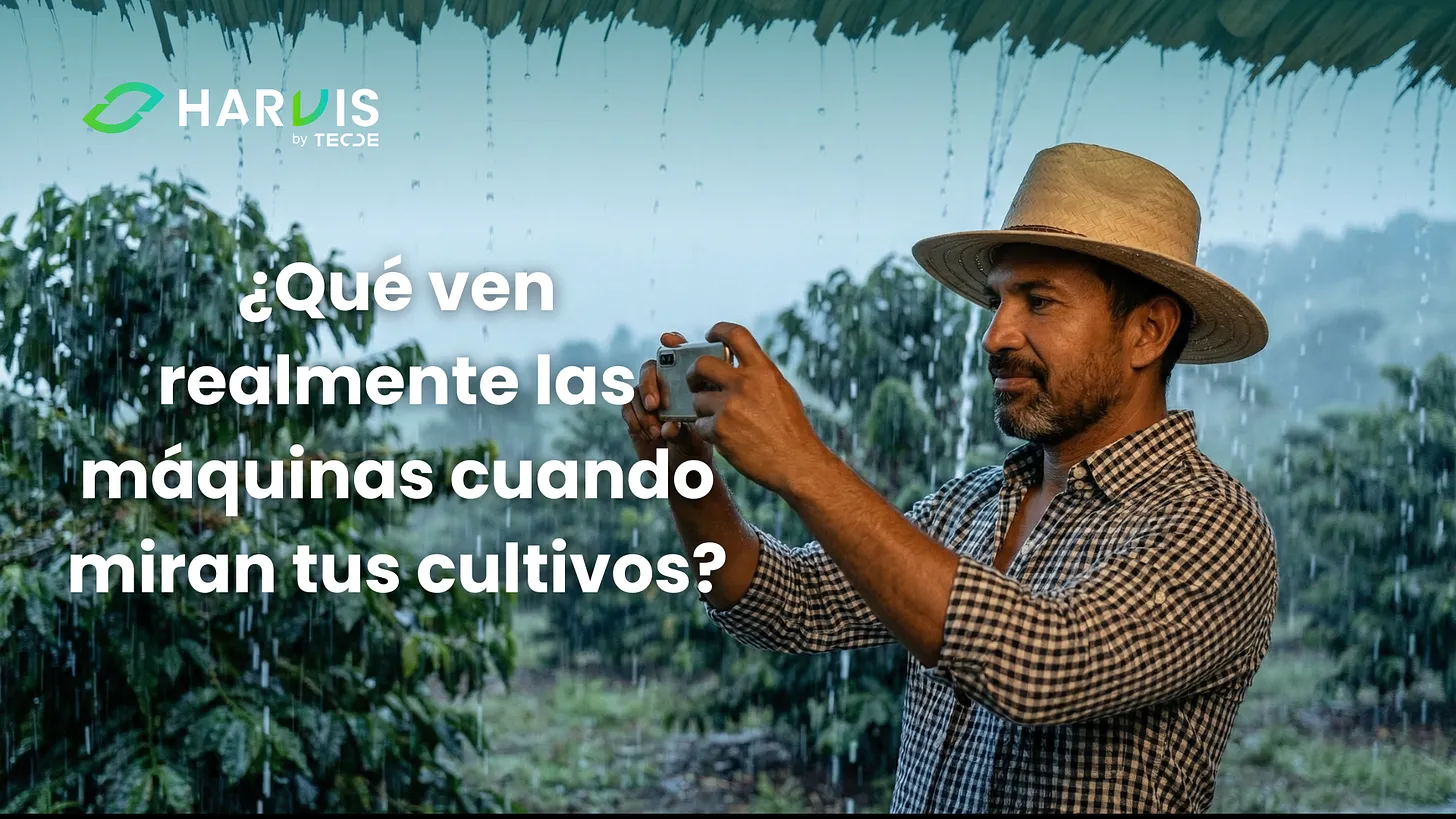
When you take a photo of your crop, your mind instantly understands: “this is a healthy leaf,” “here is a ripe fruit,” this could be a disease: you see yellow spots, pustules, white molds, wilted leaves, or weak stems: Your brain, without you realizing it, is processing patterns you learned through experience. But what happens when that same photo reaches a computer or a phone? The answer: for the machine, there are no leaves, diseases, or pests: AI uses descriptors that are numerical data summarizing the key characteristics of an image.
Colors, edges, textures, shapes… all of this translates into numbers. Each number represents something that is visual to us, but for the algorithm, it is information: the angle of a leaf, the roughness of a stem, the shine of a fruit. We call these representations descriptors, which are like the “fingerprints” of each object in the image.
For example, a descriptor can:
- Measure how much the green varies in the leaves: is there yellowing?
- Calculate the pixel density in an area: are there holes from pests?
- Recognize pests and diseases before they are visible to you.
- Measure the fruit's maturity without touching it.
- Estimate weight and yield with just a photo.
These numbers feed into a trained model that “learns” with thousands of similar images. Every time the system analyzes a photo, it compares its descriptors with what it already knows and makes decisions: is it a healthy or infected leaf? Does the color indicate maturity or nutrient deficiency? and learns to say: "This combination of values = 85% probability of being whitefly"
AI does not guess, it calculates. If you show it a photo with poor lighting or an odd angle, its descriptors will capture noise instead of useful signals. That’s why we always ask you to take photos under certain conditions so that the descriptors can work with better accuracy.
The most incredible thing is that all of this can happen from your phone. Every image sent via WhatsApp or captured in the field becomes a processed data point that feeds the AI and, in seconds, returns clear and actionable responses. Thus, behind a simple photo, there is a engine working for the precision of your crop.

How to start "training" your eye to understand what AI sees?
1. Play with the conditions: Take photos of healthy and sick leaves at the same time of day. Do you notice differences in the colors that the app detects?
2. Ask the "why": If a tool gives you a diagnosis, check if it explains what patterns it used (e.g., "circular spots + dark edges").
Fun fact: The most commonly used algorithms for descriptors in agriculture are SIFT, SURF, and in modern AI, convolutional neural networks (CNN) that automatically extract complex patterns.