

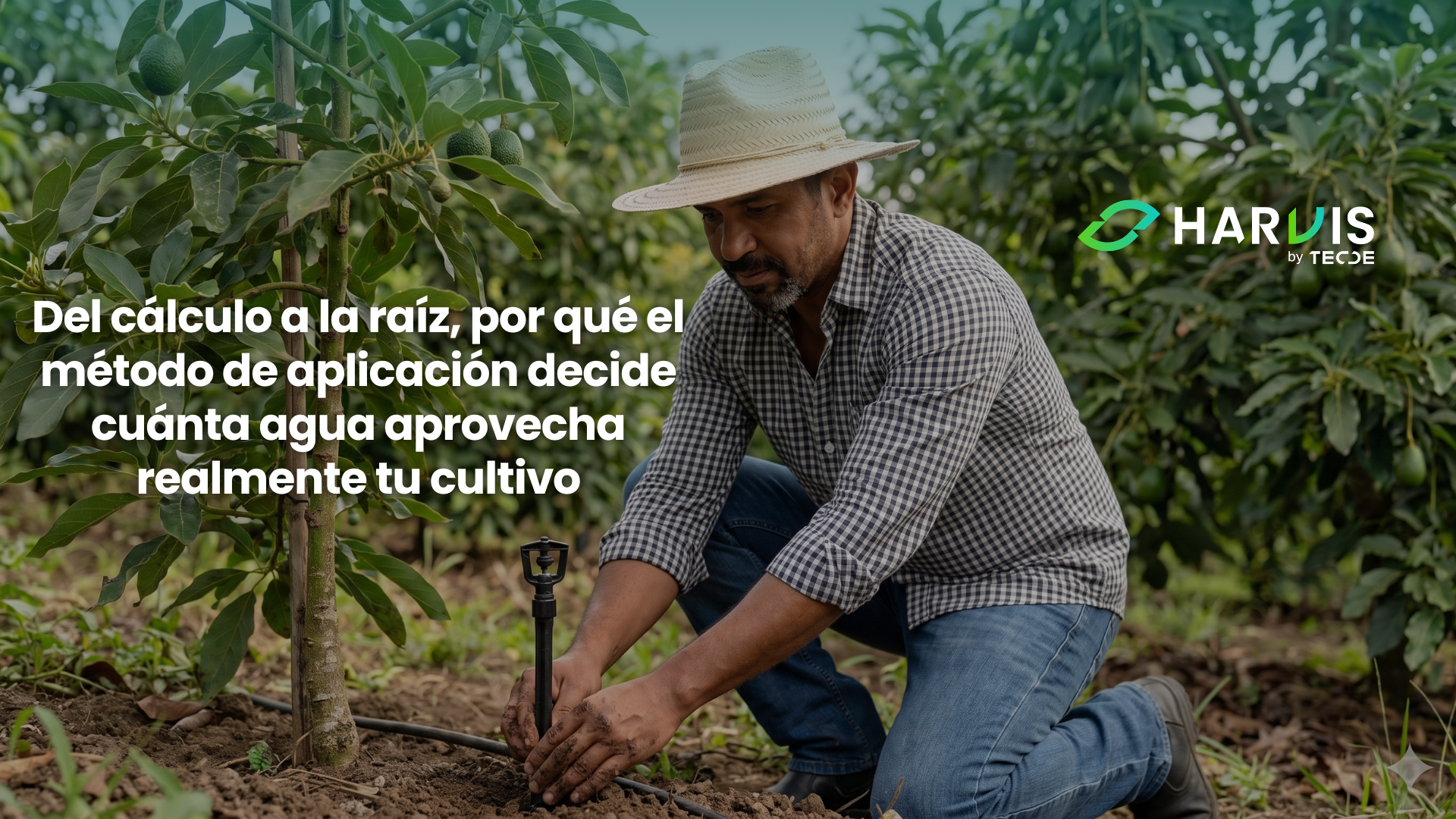
In the previous blog of this season, we calculated the water your crop needs, and we arrived at a specific number in millimeters per day. That number is the goal, but between the goal and what the plant receives lies a stretch that is almost never measured and explains why two farms with the same calculation, the same crop, and the same climate end up with different results. That stretch is the application method, meaning the physical way in which the water leaves the source, travels across the farm, and reaches, or does not reach, the area where the active roots are.
Agronomy has a name for that loss, and it’s called application efficiency. It is the fraction of water that leaves your system and is effectively stored in the root zone, available for the plant to use. Everything else evaporates into the air before touching the ground, runs off the surface to the edge of the lot, percolates below the roots dragging nutrients, or gets wet where there are no roots to take advantage of it. With water becoming the most limiting factor for production in the region, that fraction has ceased to be a curious technical datum and has become a direct line to your cost per hectare.
The Three Paths of Water and What Each One Charges You
Water can reach your crop through three main pathways, and the difference between them is not a matter of modernity but of how much water you waste for every liter you apply. In gravity irrigation, which includes furrows, beds, and flooding, water moves across the soil surface taking advantage of the slope and infiltrates along the way. It is the oldest and cheapest method to install, but the design application efficiency typically ranges between forty and sixty percent. This means that for every hundred liters you take from the source, between forty and sixty are lost along the way, and the distribution is also uneven, as the head of the furrow receives water throughout the entire irrigation time while the tail barely gets wet.
The second pathway is sprinkling, where water is pressurized and launched into the air to fall like artificial rain. It gains quite a bit in control because you can decide the layer you apply and distribute it more evenly, and its efficiency usually ranges between seventy and eighty-five percent depending on the design and conditions. Its weak point is the air itself, as part of the water evaporates before touching the ground, and the wind deflects the droplets, so watering at noon with a strong breeze can cost you a significant fraction of the applied layer. Additionally, wetting the foliage promotes several foliar diseases, a detail that in susceptible crops weighs more than the water savings.
The third pathway is localized irrigation, which includes drip and micro-sprinkling, and its logic is different because it no longer seeks to wet the lot but to wet the root. Water is conducted at low pressure through lines to emitters that deliver it drop by drop or in a small stream right in the root zone, leaving the rest of the land dry. Its design efficiency reaches eighty or ninety percent, and in well-managed systems, it can exceed that figure because it eliminates evaporation in the air, surface runoff, and wetting of soil without roots all at once. There is an additional fact that is often overlooked, which is that leaving most of the surface dry also reduces weed germination and the cost of controlling them.
Before the conclusion seems obvious, it is worth emphasizing a warning that the literature repeats. Several studies have shown that the actual efficiency of drip and sprinkler systems can drop to values comparable to those of gravity irrigation when the design is poorly sized or maintenance is neglected. Technology does not guarantee efficiency by itself; it enables it; what turns it into measurable savings is the correct design and operational discipline.
Uniformity: The Number That Decides If Your System Is as Good as They Told You
There is a second measure, less known than efficiency and sometimes more important, called distribution uniformity. It answers a simple question: if you measure how much water each emitter in your system delivers, how similar are those amounts between the first and the last in the line, between the upper and lower parts of the lot? A system can have an acceptable overall efficiency and at the same time poor uniformity, and in that case, what happens in the field is that some plants receive too much and others too little, even though the average of the lot matches on paper.
This detail matters because the plant does not respond to the average of the farm; it responds to the water that reaches its own root. When uniformity is low, the producer ends up trapped in an uncomfortable decision because if they irrigate to satisfy the plants that receive less, they necessarily over-irrigate those that receive more, and if they irrigate for the average, they leave a fraction of the lot in permanent deficit. Recent research on water management in drip systems found precisely this tension, as smaller volumes per application maximized efficiency in water use while larger volumes achieved better uniformity of soil moisture content, suggesting that less frequent and more abundant applications improve the homogeneity of the wet bulb.
The factors that ruin uniformity are quite identifiable, and for that reason, correctable. The pressure that drops along a long line causes the emitters at the end to deliver less than those at the beginning, an effect that is aggravated when the lot has a slope and gravity adds to or subtracts from the operating pressure. The spacing between emitters defines whether the wet bulbs overlap forming a continuous strip or if there are islands of wet soil separated by dry soil that the roots will not explore. The diameter of the pipe, the length of the branches, the sectorization of the lot, and the use of self-compensating emitters are the variables with which good design resolves all this before installing the first meter of hose. Recent work on system optimization found that adjusting emitter spacing and operating at regulated low pressure improved distribution uniformity and significantly reduced percolation losses.
The practical way to know how you are doing is a test you can do in a morning. Choose emitters at different points in the lot, at the beginning, in the middle, and at the end of the lines, in the upper and lower parts, place a container under each one for the same amount of time, and compare the volumes collected. If the poorest emitter delivers much less than the most generous, your problem is not with irrigation calculation but with hydraulics, and no fine programming will compensate for it.
Frequent Maintenance
Here appears the point where most localized irrigation systems lose their advantage, and that is the clogging of emitters. A drip emitter works with very small orifices, precisely because that restriction is what allows delivering low and controlled flow rates, and that same characteristic makes it vulnerable to anything that travels in the water. Clogging has three origins that are worth distinguishing because each one is treated differently. The physical is caused by solid particles like sand, silt, and organic debris. The chemical is produced by precipitates of calcium carbonate, iron, and manganese when the water is hard or has those elements dissolved. The biological is generated by algae, bacteria, and biofilms that form on the inner walls of the lines.
The specialized literature identifies four control tools, and the key is to apply the one that corresponds to your type of problem. Filtration at the system's entrance retains particles before they reach the emitters, and the type of filter must correspond to the source, with sand or hydrocyclone filters for loaded surface water and mesh or disc filters for cleaner water. Periodic washing of lines, opening the ends of the branches to let the flow carry away the accumulated material, is the simplest and most frequently omitted measure. Acid injection lowers the pH of the water to keep in solution or dissolve the precipitates of calcium, iron, and manganese that clog the orifices. Chlorination controls biological clogging by eliminating algae and bacteria, and there is a technical detail worth knowing, because its biocidal action loses effectiveness when the water's pH is above 7.5, so in alkaline waters, it is advisable to acidify first for the chlorine to work.
There is a non-negotiable safety warning on this topic. The acid and chlorine injection points must be separated, and those products should never be mixed in the same container, because the reaction releases chlorine gas, which is toxic. The frequency of treatment depends on the quality of your source, and as a general reference, two or three treatments per season are usually sufficient in reasonably good quality waters, while problematic sources require a more intense program. Research from 2025 has also explored combinations of acid washing with ultrasonic technology to recover already clogged emitters, with promising results in restoring flow.
The cost of ignoring all this is silent, and therein lies the problem. A partially clogged emitter does not look clogged; it simply delivers less, and the plant that depends on it enters into deficit while you think you applied the calculated layer. When the symptom appears in the foliage weeks later, the cause is already buried under a dozen possible explanations.
A Call to Look at Your System with Numbers
Do you know what the actual application efficiency of your irrigation system is and how uniform the delivery is between the first emitter and the last? That pair of data turns an investment in infrastructure into a verifiable decision. Harvis helps you record your irrigations, cross them with the calculated demand of each lot, and detect where the water is being lost. Write to us on WhatsApp and let’s talk about your system.

Fertigation: The Advantage That Only Appears When Water Reaches Precisely
When water stops being distributed throughout the lot and starts being delivered at a controlled point over the root, a possibility opens up that no gravity system can offer with the same precision, which is to apply nutrients dissolved in that same water. Fertigation changes the logic of fertilization because it ceases to be an isolated event, with a bulk applied randomly on a date, and becomes a continuous and adjustable supply that accompanies the crop's demand curve throughout the cycle.
The experimental data in crops of our interest are compelling. In citrus, a study comparing four fertilization schemes found that drip fertigation increased the absorption of nitrogen, phosphorus, and potassium, promoted plant growth, and achieved the highest total soluble solids and titratable acidity in the fruit, in addition to recording the highest efficiency in fertilizer use, with reductions of around sixty percent in the applied dose without sacrificing performance. That last number deserves to be read twice because it means that the same agronomic response was achieved with a fraction of the purchased fertilizer, and the savings did not come from applying less out of austerity but from losing less due to precision.
In Arabica coffee, a two-year consecutive experiment on five-year-old trees evaluated the distribution of fertigation at three moments: early flowering, grain expansion, and maturation, measuring everything from photosynthetic rate and stomatal conductance to partial fertilizer productivity, grain yield, water use efficiency, and volatile compounds that define cup quality. The relevant finding for the producer is that the timing of fertigation, and not just the total dose, modified both yield and quality attributes, confirming that the advantage of the system lies in its ability to synchronize supply with phenology. Recent reviews on fertigation with soluble fertilizers reach the same general conclusion: delivering precise amounts of water and nutrients directly to the root zone optimizes the use of both inputs and reduces the environmental impact of the operation.
As we already addressed in our blog How to Know What Fertilizer Each Lot Needs and How Much You Save by Being Specific?, which you can read here, fertilization ceases to be an average of the farm when calculated lot by lot; fertigation is the tool that allows executing that precision in the field because it makes no sense to calculate a differentiated dose by lot if the application method distributes the same everywhere.

When Drip Irrigation Is Not the Answer
It would be dishonest to close this journey implying that localized irrigation is always the best decision because it is not, and the difference between a good advisor and a salesperson lies precisely in recognizing the cases where it is not advisable. The initial investment in drip irrigation is considerably higher than in gravity, and that figure must be added to the recurring costs of filtration, pumping energy, line replacement, and the maintenance time we have already described. An economic analysis at the farm scale comparing drip and flooding irrigation through efficiency analysis found that the economic superiority of drip depends on the productive context and is not automatic, which in practical terms means that the answer changes with the value of the crop, the cost of water and energy, and the scale of the operation.
There are specific conditions that discourage drip irrigation or that require resolving something before installing it. Water with a high load of sediments, iron, or carbonates, without an adequate filtration and treatment system, turns the investment into a permanent maintenance problem. Low-value crops per hectare hardly amortize the cost per hectare of the system. In very small lots or with irregular geometry, the cost per hectare of accessories and sectorization rises disproportionately. And in areas where the electrical supply is unstable, a system that depends on pressurized pumping inherits that fragility.
The sensible decision, then, is not to choose the most advanced technology but to choose the one that best converts your particular situation into water utilized by the plant. A well-leveled gravity irrigation, with measured flows, controlled times, and furrow lengths adjusted to the soil, performs much better than a poorly designed and worse-maintained drip system. The FAO puts it in those terms when addressing the improvement of production under irrigation, pointing out that the biggest gains often come from better operating what already exists before replacing it.
What Is Worth Taking to the Lot
The calculation of water demand tells you how much water your crop needs, and the application method determines how much of that water effectively reaches the root. Between those two points, there is an efficiency you can measure, a uniformity you can test with containers in a morning, and maintenance you can schedule. None of those three things requires a new investment; they require attention, and they are the difference between having an irrigation system and having an irrigation system that works.
In the next blog of this season, we will take a step that surprises many producers because we will see how applying less water than the crop demands, at precise moments in the cycle and deliberately, can increase the profitability of your farm instead of reducing it.
References Consulted
- Allen, R. G., Pereira, L. S., Raes, D., and Smith, M. (1998). Crop evapotranspiration - Guidelines for computing crop water requirements. FAO Irrigation and drainage paper 56. Food and Agriculture Organization of the United Nations. https://www.fao.org/4/x0490e/x0490e00.htm
- Food and Agriculture Organization of the United Nations (FAO). (n.d.). Water Use Efficiency, Thematic Brief. https://www.fao.org/fileadmin/userupload/agwa/docs/EfficiencyThematic%20Brief_En.pdf
- Food and Agriculture Organization of the United Nations (FAO). (n.d.). Annex I, Irrigation efficiencies. https://www.fao.org/4/t7202e/t7202e08.htm
- Adequate Irrigation Amount per Application Is Required to Secure Uniform Water Management in Drip Irrigation Systems. (2025). Agronomy, 15(7), 1639. https://doi.org/10.3390/agronomy15071639
- Economic efficiency of drip and flood irrigation, comparative analysis at farm scale using DEA. (2025). Agricultural Water Management / ScienceDirect. https://www.sciencedirect.com/science/article/pii/S0378377425000289
- Prevention and treatment of drip emitter clogging, a review of various innovative methods. (n.d.). Water Practice & Technology, IWA Publishing. https://iwaponline.com/wpt/article/17/10/2059/91275/Prevention-and-treatment-of-drip-emitter-clogging
- Reducing the clogging of emitters in drip irrigation systems using acid washing and ultrasonic technology. (2025). Scientific Reports, Nature. https://www.nature.com/articles/s41598-025-95915-w
- Rutgers NJAES. (n.d.). FS795, Treating Drip Irrigation Systems with Chlorine. Rutgers University. https://njaes.rutgers.edu/FS795/
- Lamont, B. (n.d.). Maintaining Drip Irrigation Systems. Penn State Extension. https://s3.wp.wsu.edu/uploads/sites/2056/2014/01/Maintaining-Drip-Irrigation-Systems-Bill-Lamont-Penn-State.pdf
- Effects of Fertilization Approaches on Plant Development and Fertilizer Use of Citrus. (n.d.). PMC. https://www.ncbi.nlm.nih.gov/pmc/articles/PMC9572086/
- Optimizing drip fertigation at different periods to improve yield, volatile compounds and cup quality of Arabica coffee. (n.d.). PMC. https://pmc.ncbi.nlm.nih.gov/articles/PMC10272449/
- Drip fertigation of water-soluble fertilizers, a tool to enhance nutrient and water use efficiency, a comprehensive review. (n.d.). Plant Science Today. https://horizonepublishing.com/index.php/PST/article/view/10298
- Food and Agriculture Organization of the United Nations (FAO). (n.d.). Improving irrigated production. https://www.fao.org/4/y3918e/y3918e10.htm
- Optimizing water-efficient agriculture, evaluating the sustainability of soil management and irrigation synergies. (2025). Scientific Reports, Nature. https://www.nature.com/articles/s41598-025-15426-6