

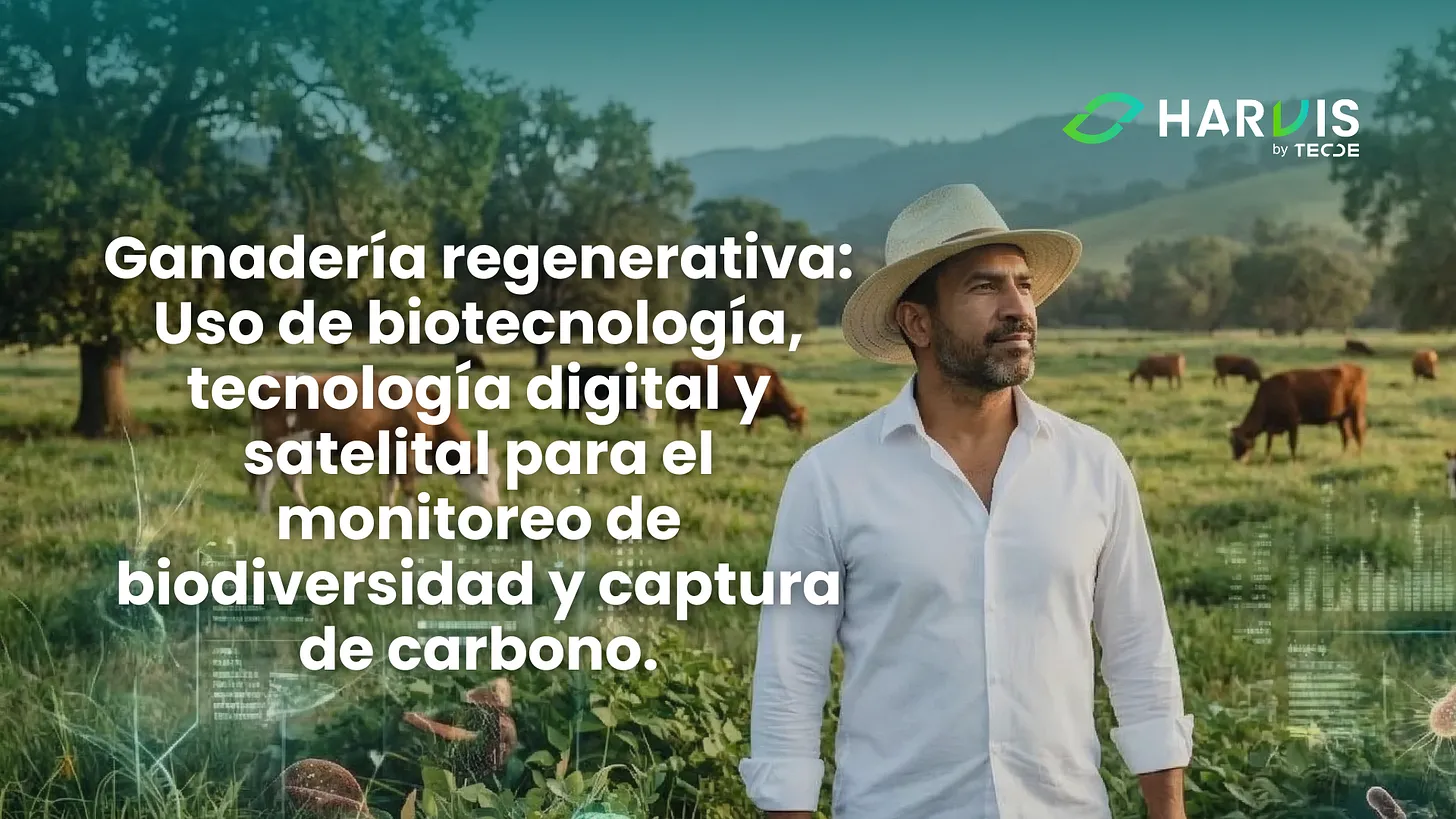
Global livestock systems occupy approximately 3.8 billion hectares, equivalent to 26% of the planet's ice-free land surface, managing carbon flows, nutrient cycles, and biodiversity dynamics that for decades were considered exclusively from productive perspectives until the convergence of satellite remote sensing technologies, soil IoT sensors, environmental DNA sequencing, and artificial intelligence algorithms have radically transformed the ability to quantify, verify, and monetize ecosystem services provided by regenerative livestock systems.
Through these technological advancements, it is possible to transition from extractive livestock to regenerative systems that sequester atmospheric carbon, restore functional biodiversity, contribute to the regeneration of fertility in degraded soils, and generate monetizable ecosystem services through digital verification platforms that integrate satellite data, in situ measurements, genomic analyses, and biogeochemical models in certification ecosystems that guarantee complete and auditable traceability of each ton of CO₂ equivalent captured and each biodiversity indicator restored.
In our previous publications, we have addressed topics related to the traceability of antimicrobials, applied biotechnology, and the digital transformation of livestock systems, understanding how emerging technologies become facilitating pillars of productive efficiency. This series of analyses has allowed us to identify disruptive technological patterns that are redefining traditional paradigms in livestock production systems through the integration of digital tools with management protocols based on updated scientific evidence.
In the current context, regenerative livestock transcends simple holistic pasture management to become an integrated system of environmental monitoring, quantification of ecosystem services, and digital verification of impacts where each generated data feeds biogeochemical models that quantify carbon sequestration, computer vision algorithms that monitor biodiversity, and blockchain platforms that ensure the integrity of environmental credits traded in increasingly demanding voluntary markets. Today we delve into the most transformative digital technologies that are revolutionizing the measurement of regenerative impact: satellite systems for monitoring vegetation cover, IoT sensors for soil organic carbon, biodiversity platforms, and artificial intelligence algorithms for quantifying ecosystem services that turn livestock into a verifiable and economically viable climate solution, taking into account the duality that exists between its environmental impact and how it can be a solution to face the global climate crisis.
🌍 Livestock in the Climate Duality: Problem or Solution
The global livestock sector contributes approximately 14.5% of all anthropogenic greenhouse gas emissions according to the Food and Agriculture Organization of the United Nations (FAO), with beef production responsible for 41% of these emissions through enteric fermentation that generates methane, manure management, land-use change, and production of concentrated feed. This figure, frequently cited in narratives demanding drastic reductions in the consumption of animal products, requires critical contextualization that distinguishes between confined intensive systems and regenerative livestock through well-managed pastures.
Enteric methane emissions represent approximately 2.8 gigatons of CO₂ equivalent annually, constituting the largest individual source of emissions from the livestock sector. However, recent research published in Nature Climate Change demonstrates that biogenic methane from ruminants in grazing systems presents fundamentally different atmospheric dynamics than fossil CO₂, with life cycles of approximately 12 years compared to centuries for carbon dioxide, generating a stable flow climate effect instead of progressive accumulation when livestock populations remain constant.
Land-use change for livestock expansion, particularly in tropical ecosystems, has significantly contributed to global deforestation. Approximately 70% of Brazilian Amazon deforestation has historically been attributed to conversion for livestock pastures, releasing carbon stored in forest biomass and deep tropical soils. However, this dynamic is concentrated in low-productivity extractive systems that require continuous expansion, contrasting radically with intensified regenerative livestock that increases productivity per hectare while restoring ecosystem functions in already anthropized landscapes.
🐮Regenerative Livestock
It is based on ecological principles that mimic natural grazing processes of large migratory herds that historically shaped ecosystems of temperate grasslands, tropical savannas, and prairies that evolved under intense but intermittent herbivory pressure. These principles include planned grazing with high animal density and short occupancy periods, prolonged recovery times that allow for complete plant regeneration, integration of functional biodiversity, and minimization of synthetic external inputs.
Intensive rotational grazing concentrates animals in small subdivisions for 12-48 hours, generating trampling that incorporates organic matter into the soil, uniform defoliation that stimulates vigorous regrowth, and concentrated deposition of excreta that naturally fertilizes. After occupancy, pastures remain rested for 30-90 days depending on the season and speed of plant growth, allowing plants to recover root reserves, complete phenological cycles, and develop deep root systems that sequester carbon in stable underground horizons.
The diversity of forage species constitutes an essential foundation of ecosystem resilience in regenerative systems. Multi-species pastures that integrate warm and cool-season grasses, nitrogen-fixing legumes, deep-rooted mineral-fixing herbs, and forage shrub species generate more stable production in the face of climatic variability, provide balanced nutrition that optimizes feed conversion, and create structurally complex habitats for functional biodiversity including pollinators, natural pest enemies, and soil microbiota.
Silvopastoral integration incorporates trees and shrubs in designed spatial configurations that provide shade moderating extreme temperatures, supplemental forage during droughts, biological nitrogen fixation, hydraulic pumping from deep horizons, landscape connectivity for native fauna, and additional carbon capture in woody biomass. Well-designed silvopastoral systems increase animal productivity per hectare by 20-40% compared to treeless pastures in tropical regions, while sequestering an additional 2-4 tons of carbon per hectare annually in aerial biomass and root systems.

🛰️ Satellite Remote Sensing Technologies for Monitoring Vegetation Cover
Earth observation satellites provide great capabilities for monitoring vegetation dynamics in livestock systems at scales ranging from individual farms to regional landscapes. Sentinel-2 from the European Space Agency captures multispectral images with a spatial resolution of 10 meters every 5 days, allowing the calculation of vegetation indices that quantify biomass, primary productivity, chlorophyll content, vigor, and water stress with precision validated through ground measurements.
The Normalized Difference Vegetation Index (NDVI) derived from reflectance in the red and near-infrared bands is the most commonly used indicator for monitoring vegetation cover and pasture productivity. NDVI values range from -1 to +1, where values above 0.6 indicate dense and vigorous vegetation, values between 0.3-0.6 represent moderate cover, and values below 0.3 indicate bare soil or severely stressed vegetation. NDVI time series allow for the identification of degradation or regeneration trends, quantification of responses to extreme climatic events, and validation of adherence to regenerative management protocols.
The Enhanced Vegetation Index (EVI) incorporates atmospheric and soil background corrections that improve sensitivity in high-biomass regions where NDVI saturates. EVI is particularly useful for monitoring dense tropical pastures and silvopastoral systems where tree cover may exceed the discrimination capacity of conventional NDVI. The algorithms combine information from blue, red, and near-infrared bands to generate more robust metrics of actual photosynthetic productivity.
Synthetic Aperture Radars (SAR) operate independently of cloud conditions, transmitting microwaves that penetrate clouds and quantify the three-dimensional structure of vegetation through backscatter analysis. SAR is critical for continuous monitoring in humid tropical regions where persistent cloud cover limits the utility of optical sensors. Polarimetric backscatter allows for the discrimination between types of vegetation cover, estimation of biomass in silvopastoral systems, and detection of changes in vegetation structure associated with intensification or degradation of management.
🧬 Environmental DNA Metabarcoding for Biodiversity Monitoring
Functional biodiversity constitutes a critical indicator of ecosystem health in regenerative livestock systems. Diverse communities of plants, invertebrates, soil microorganisms, birds, and small mammals provide pollination services, biological pest control, nutrient cycling, soil formation, and resilience to disturbances that underpin long-term sustainability. However, traditional biodiversity monitoring through morphological identification by expert taxonomists is costly, slow, and limited to specific taxonomic groups.
Environmental DNA metabarcoding revolutionizes biodiversity monitoring through massive sequencing of marker gene fragments extracted from environmental samples such as soil, water, insect traps, or herbivore feces. A single soil sample analyzed through sequencing detects thousands of microbial species that constitute a driver of critical ecosystem functions.
Portable sequencing platforms allow for field analyses that generate results in 24-48 hours, eliminating the need to send samples to distant specialized laboratories. Devices the size of a cell phone connected to laptops execute complete protocols for DNA extraction, PCR amplification, library preparation, and sequencing that produce millions of reads that bioinformatics algorithms compare against reference databases to identify present species.
Longitudinal studies in systems transitioning to regenerative livestock document increases of 40-75% in soil microbial diversity during the first 3-5 years of implementing intensive rotational grazing and eliminating synthetic agrochemicals, positively correlating with improvements in soil structure, water infiltration, and pasture productivity.
🚀 The Future
Projections indicate that by 2035, approximately 60% of livestock systems in developed countries and 30% in developing countries will operate under digitally verified regenerative impact certification schemes, driven by increasingly stringent environmental regulations, consumer demand for products with documented sustainability attributes, and monetization opportunities for ecosystem services through carbon and biodiversity credits. This massive adoption will generate giant databases that will facilitate a deep understanding of the biophysical limits of carbon sequestration in different agroecosystems, the comparative effectiveness of alternative regenerative practices, and the development of public policies that incentivize transitions based on objective evidence.
Automated remote verification systems will integrate artificial intelligence applied to continuous flows of satellite data, images from autonomous drones, low-cost IoT sensors, and blockchain to generate real-time certifications that eliminate prohibitive third-party verification costs that currently limit small producers' access to carbon markets. Computer vision algorithms will automatically detect violations of regenerative protocols such as localized overgrazing, applications of prohibited agrochemicals, or deforestation, issuing alerts that allow for corrective interventions.
The integration of regenerative livestock with renewable energies in agrovoltaic systems represents an emerging frontier where the use of elevated solar panels allows for simultaneous grazing while generating clean electricity. Studies in arid regions demonstrate that the partial shade provided by panels increases pasture productivity by reducing evapotranspiration, while electricity production provides complementary income that finances investments in regenerative management infrastructure.
“The regeneration of the planet begins on every well-managed hectare. Digital technology turns that invisible impact into measurable and marketable value. The time to act is now”
In our next installment, we will address the importance of the circular economy in livestock systems and how blockchain technology revolutionizes the traceability of by-products and the valorization of organic waste.
📚REFERENCES
- Food and Agriculture Organization of the United Nations (FAO). “Livestock’s Long Shadow: Environmental Issues and Options”. 2024 Update. https://www.fao.org/livestock-environment
- Nature Climate Change. “Biogenic methane emissions and climate neutrality of ruminant livestock”. Allen et al., 2024. https://www.nature.com/nclimate
- Science. “Global carbon sequestration potential of regenerative grazing”. Teague et al., 2024. https://www.science.org
- Nature Sustainability. “Soil organic carbon sequestration rates in improved pasture management systems: A global meta-analysis”. 2024. https://www.nature.com/natsustain
- Global Change Biology. “Biodiversity responses to agricultural intensification and management in grassland ecosystems”. 2025. https://onlinelibrary.wiley.com/journal/gcb
- Remote Sensing of Environment. “Monitoring grassland degradation and recovery using multi-temporal Sentinel-2 imagery”. 2024. https://www.journals.elsevier.com/remote-sensing-of-environment
- European Space Agency (ESA). “Copernicus Sentinel-2 Mission Guide”. 2024. https://sentinel.esa.int/web/sentinel/missions/sentinel-2
- Soil Biology and Biochemistry. “High-throughput soil carbon analysis using visible and near-infrared spectroscopy”. 2025. https://www.journals.elsevier.com/soil-biology-and-biochemistry
- Molecular Ecology Resources. “Environmental DNA metabarcoding for biodiversity assessment in agricultural landscapes”. 2024. https://onlinelibrary.wiley.com/journal/men
- Frontiers in Microbiology. “Soil microbiome responses to regenerative grazing management”. 2024. https://www.frontiersin.org/journals/microbiology
- Agriculture, Ecosystems & Environment. “DayCent model parameterization and validation for tropical silvopastoral systems”. 2024. https://www.journals.elsevier.com/agriculture-ecosystems-and-environment
- Global Change Biology. “Machine learning models for predicting soil carbon sequestration in grasslands”. 2025. https://onlinelibrary.wiley.com/journal/gcb
- Ecosystem Marketplace. “State of Voluntary Carbon Markets 2024: Agriculture and Land Use Sector Trends”. Forest Trends.https://www.ecosystemmarketplace.com
- Verified Carbon Standard (VCS). “VM0032 Methodology for Adoption of Sustainable Grassland Through Adjustment of Fire and Grazing”. Verra. 2024.https://verra.org
- Gold Standard. “Land Use & Forests Activity Requirements”. 2024.https://www.goldstandard.org
- Nature Food. “Economic viability of carbon farming in regenerative livestock systems”. 2024. https://www.nature.com/natfood
- Regen Network. “Blockchain-