

In our previous editions, we have built the foundations of modern phytosanitary knowledge: we explored international certifications (ICA, GlobalG.A.P., Rainforest Alliance) that open the doors to global markets, analyzed the MRLs as guardians of food safety, and delved into the modes of action of pesticides and resistance management as pillars of productive sustainability.
Today, we take a step further to delve into a strategy that complements and strengthens good IPM: the use of biocontrol agents and bioinputs, defining their foundations and explaining how they integrate with conventional methods to create a truly holistic pest management approach.
These are not a total replacement for chemical tools; they represent a production philosophy that harmonizes productivity with ecosystem preservation, creating resilient agricultural systems that not only meet the most demanding international certification standards but also build the foundation for truly regenerative agriculture.
Biocontrol agents are not a novelty: they are the scientific rediscovery of the mechanisms that nature has perfected over millions of years. However, their modern application, backed by advanced biotechnology and rigorous quality protocols, makes them indispensable strategic tools for farmers looking to compete in increasingly conscious and demanding international markets.
Modern agriculture faces a double challenge: to produce food efficiently for a growing population while minimizing environmental impact. This is where the integration of biological solutions becomes fundamental. It is not about following a trendy term but about a necessary evolution towards practices that respect biodiversity and reduce dependence on synthetic inputs.
🍀Scientific Foundations
🐞What are Biocontrol Agents?
They are living organisms or products derived from living organisms used to suppress, control, or eliminate pests, diseases, and weeds in crops. Unlike synthetic pesticides that act through specific biochemical mechanisms, biocontrol agents use natural biological processes such as parasitism, predation, competition, antibiosis, and other ecological interactions to exert their controlling effect.
The main types of biocontrol agents are:
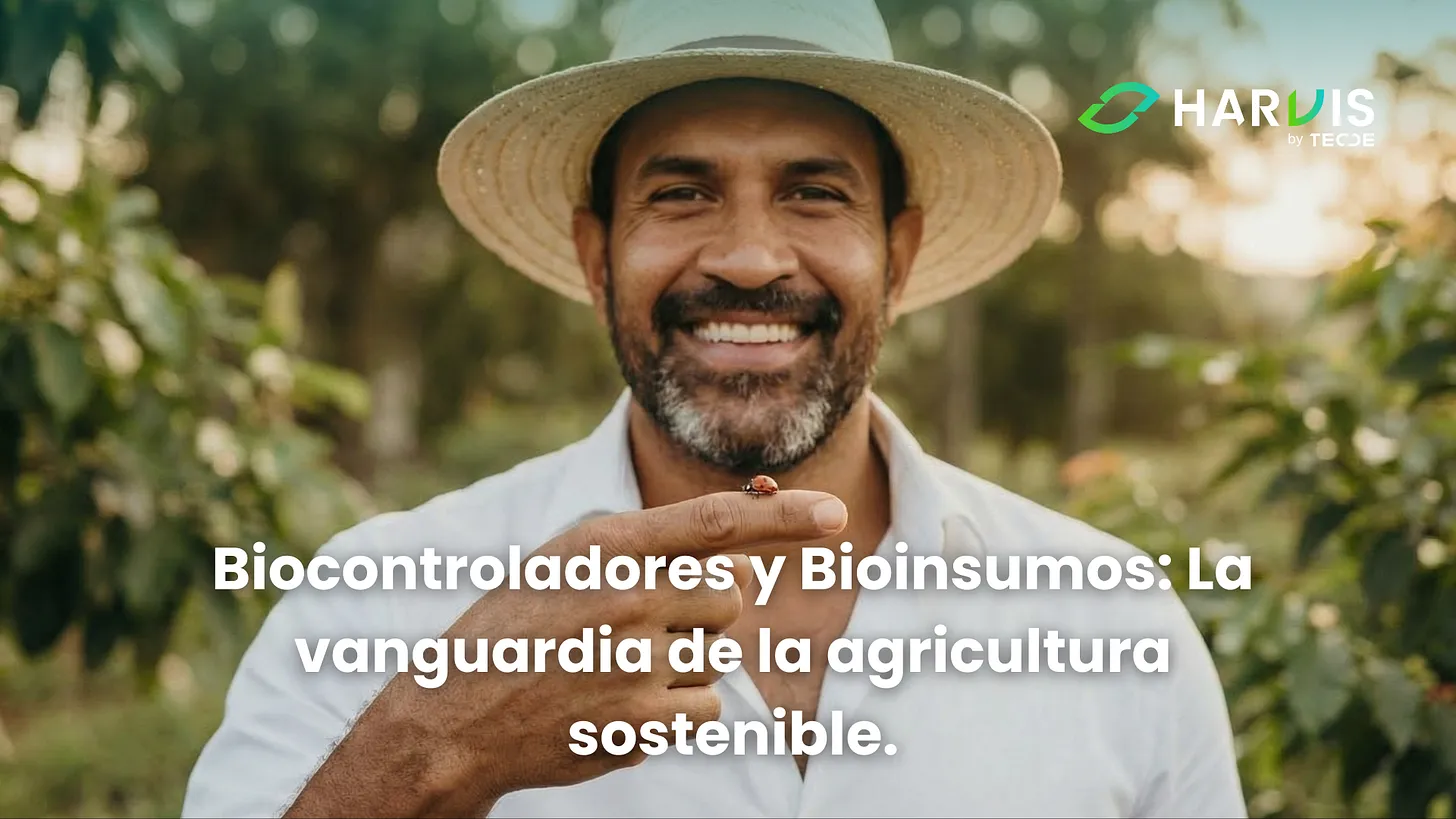
🕷️Macrobiological: Include insects, mites, and nematodes that prey on or parasitize pests. For example, ladybugs feed on aphids, and the parasitoid wasp lays its eggs inside the larvae of other pests, eliminating them.
🍄Microbial: These are microorganisms such as fungi, bacteria, and viruses that act as antagonists to pests and pathogens. A common example is the fungus Beauveria bassiana, which infects and kills a wide range of insects, or the bacterium Bacillus subtilis, which colonizes roots and competes with soil disease pathogens.
🧪Semiochemicals: These are natural substances that affect the behavior of organisms, such as pheromones, used to confuse, attract, or repel pests, disrupting their life cycle and reproduction.
Their most representative characteristics are:
🪱Biological origin: Derived from microorganisms, plants, or animals.
🌿Natural mechanisms: Utilize evolutionarily established processes.
🎯High specificity: Generally targeted at specific organisms.
🌍Minimal environmental impact: Biodegradable and ecologically compatible.
🧬Reduced resistance: Multiple mechanisms of action make adaptation difficult.
🧄🌳What are Bioinputs?
Bioinputs constitute a broader category that includes products of biological origin used to improve agricultural productivity, soil health, and plant nutrition, such as nitrogen-fixing microorganisms or phosphorus-solubilizing agents. They encompass biocontrol agents, biofertilizers through organic amendments that enrich the soil, biostimulants such as extracts that enhance growth and stress tolerance, biological soil conditioners, and other products that leverage biological processes to optimize crop growth and development.
These are classified into:
🌱Biofertilizers: These are products based on microorganisms (bacteria, fungi) and organic matter that, when incorporated into the soil, improve fertility, soil structure, and nutrient availability for plants, promoting more vigorous and healthy growth without harming the environment.
🧴Biostimulants: A substance or mixture of substances, including microorganisms, applied to plants to stimulate natural processes and improve their growth, development, and stress tolerance, without being a nutrient in itself. Biostimulants operate through mechanisms different from fertilizers, focusing on optimizing nutrient absorption, increasing metabolic efficiency, and improving resistance to adverse conditions such as drought or high temperatures.
🍄Biocontrol Agents: A living organism, microorganism, or biological substance used to control pests and diseases in agriculture, livestock, and other environments. Their goal is to provide an ecological and natural alternative to chemical pesticides, acting specifically to kill, repel, or compete with target pests without harming the environment or crops.
⛰️Biological Conditioners: A product containing beneficial microorganisms and stabilized organic matter that increases soil fertility and nutrient availability for plants.
🎯 Types of Biocontrol Agents by Mechanism of Action
1. Biological Control by Parasitism 🪱
Utilizes parasitoid organisms that complete part or all of their life cycle inside or on the body of the target pest, causing its death.
Main organisms:
🐝 Trichogramma spp.: Parasitoid wasps of lepidopteran eggs.
🐝 Aphidius spp.: Parasitoids of aphids that deposit eggs inside the host.
🐝 Encarsia formosa: A widely used parasitoid of whiteflies in greenhouses.
Mechanism of action: The parasitoid locates the host through chemical signals, pheromones, or volatile organic compounds produced by the attacked plants or by the hosts themselves, deposits its eggs inside or on the host, and the larvae develop by consuming the host's tissues in a controlled manner, keeping the host alive until they complete their development, at which point the host dies and the adult parasitoid emerges.
2. Biological Control by Predation 🐞
Employs predatory organisms that feed directly on pests, consuming multiple individuals during their life cycle.
Main organisms:
🐞 Amblyseius spp.: Predatory mites specialized in thrips and pest mites.
🐞 Orius spp: Predatory bugs of thrips, aphids, and lepidopteran eggs.
🐞 Chrysoperla spp.: Lacewings whose larvae are voracious predators of aphids.
🐞 Phytoseiulus persimilis : A predatory mite specific to spider mites.
🐞 Harmonia axyridis : Ladybugs.
Mechanism of action: Predators actively locate their prey through visual, chemical, or vibrational stimuli, capture them using specialized structures such as chelicerae, rostrum, or jaws, and consume them completely. Their effectiveness depends on the density of available prey and environmental conditions.

3. Microbial Biological Control 🧫
Utilizes pathogenic microorganisms such as bacteria, fungi, viruses, and/or nematodes that infect and cause specific diseases in target pests.
🦠Entomopathogenic Bacteria
These are bacteria that infect and kill pest insects, acting as biological control agents.
🧫Bacillus thuringiensis (Bt):
✔︎ Mechanism: Produces protein crystals that activate in the alkaline gut of lepidopteran larvae, forming pores in the intestinal membrane and causing paralysis and death.
✔︎ Specificity: Different strains specific to lepidopterans, dipterans, and coleopterans.
✔︎ Advantages: Harmless to mammals, specific to insects, compatible with IPM.
✔︎ Certifications: Approved in organic farming and international protocols.
🧪 Bacillus subtilis:
✔︎ Mechanism: Colonizes the rhizosphere producing natural antibiotics such as surfactin, iturin, fengycin that inhibit phytopathogens.
✔︎ Application: Control of fungal and bacterial diseases in soil.
✔︎ Additional benefits: Promotion of plant growth and induction of systemic resistance.
🍄 Entomopathogenic Fungi
These produce diseases and cause the death of insects and other arthropods. About 750 species of these fungi are known, most of them included in the groups Hypocreales (Ascomycota) and Entomophthorales (Zygomycota).
🍄 Beauveria bassiana:
✔︎ Mechanism: Conidia adhere to the insect's cuticle, germinate, penetrate through cutinase enzymes, and colonize the hemocoel, producing toxins that cause the host's death.
✔︎ Spectrum: Wide range of insects including thrips, whiteflies, aphids, beetles.
✔︎ Persistence: Forms resistant structures that remain viable in the environment.
🍄 Metarhizium anisopliae:
✔︎ Mechanism: Similar to Beauveria, with special affinity for coleopterans and orthopterans.
✔︎ Characteristics: High tolerance to adverse environmental conditions.
✔︎ Application: Especially effective against wireworms and other soil coleopterans.
🍄 Lecanicillium lecanii:
✔︎ Mechanism: Spores firmly adhere to the cuticle of insects, penetrate the cuticle with the help of enzymes produced by the fungus (lipases, chitinases, and proteases) that decompose the tissue and facilitate spore penetration, causing infection and death of the pest insect.
✔︎ Organisms it controls: Useful for controlling sucking and scraping insects such as: thrips, whiteflies, aphids, spider mites, and caterpillars.
Entomopathogenic Nematodes. 🪱
🪱 Steinernema and Heterorhabditis:
✔︎ Mechanism: Infective juveniles penetrate through natural openings of the insect, releasing symbiotic bacteria that kill the host, reproduce inside the carcass, and emerge as new infective juveniles.
✔︎ Application: Control of soil pests such as wireworms, budworms, and thrips in pupal stage.
✔︎ Advantages: Active search for hosts, multiplication capacity, persistence in soil.
🌿 Plant Extracts: Natural Biocontrol Agents
🌳Neem Extracts (Azadirachta indica) Main active components: Azadirachtin A and B: tetranortriterpenoid limonoids.
Multiple action mechanism:
✔︎ Antifeeding: Interferes with gustatory chemoreceptors, reducing consumption by up to 90%.
✔︎ Growth regulator: Inhibits the synthesis of ecdysone, the molting hormone.
✔︎ Antiovipository: Affects the reproductive behavior of adult females.
✔︎ Systemic: Translocates via xylem providing internal protection.
Control spectrum:
Lepidopterans: Spodoptera spp., Tuta absoluta, Helicoverpa armigera.
Hemipterans: Aphids, whiteflies, stink bugs.
Coleopterans: Diabrotica spp., defoliating beetles.
Dipterans: Fruit flies, leaf miners.
🌸Chrysanthemum Extracts: Natural Pyrethrins.
Chrysanthemum extracts are valuable bioinputs, mainly as natural bioinsecticides due to the pyrethrins, which act quickly on insects by contact and ingestion and are less toxic to mammals and the environment.
Active components: Pyrethrin I and II, cinerin I and II, jasmolin I and II.
Neurotoxic mechanism:
✔︎Hyperexcitation of the central nervous system.
✔︎Rapid knockdown effect followed by mortality.
✔︎Action similar to synthetic pyrethroids but biodegradable.
Specific advantages:
✔︎Rapid UV degradation (2-4 hours).
✔︎Compatible with beneficial organisms due to low persistence.
✔︎Displacement effect for cleaning applications.
✔︎International organic certification.
🧄Garlic Extracts (Allium sativum)
Active component: Allicin: diallyl thiosulfinate.
Mechanism of action:
✔︎ Fungistatic: Inhibits germination of fungal spores.
✔︎ Bacteriostatic: Alters cell membrane permeability.
✔︎ Repellent: Interferes with the olfactory system of insects.
✔︎ Antiviral: Induces defense proteins in plants.
Specific application:
✔︎Control of downy and powdery mildew.
✔︎Prevention of bacterial infections in solanaceous crops.
✔︎Repellent for thrips, aphids, and mites.
✔︎Inducer of acquired systemic resistance.
🌶️ Chili Extracts (Capsicum annuum)
Active component: Capsaicin.
Mechanism of action:
Irritates insects and causes digestive problems, acting on pests such as aphids and caterpillars. These extracts are organic, biodegradable, and non-toxic to the environment and humans, making them an ecological alternative for pest control in integrated management.
🦋 Pheromones: Advanced Behavioral Control
♀️♂️Sexual Pheromones
These are volatile chemical substances produced by one sex, usually females, to attract the opposite sex for mating.
Mechanism of action:
✔︎Attraction from a distance: Effective up to 1-2 km depending on species and conditions.
✔︎Extreme specificity: Each species has a unique blend of compounds.
✔︎Sensory detection: Specialized receptors in male antennae.
✔︎Critical concentration: Effective in nanograms per cubic meter of air.
Usage strategies:
1. Monitoring and early detection:
✔︎Delta traps with pheromone septum.
✔︎Determination of flight peaks for timing applications.
✔︎Mapping of distribution and population density.
✔︎Prediction of subsequent generations.
2. Mass capture:
✔︎High density of traps.
✔︎High potency and long-lasting pheromones.
✔︎Population reduction through male elimination.
✔︎Effective in isolated or island populations.
3. Sexual confusion:
✔︎Environmental saturation with synthetic pheromone.
✔︎Disorientation of males to locate females.
✔︎Drastic reduction of successful matings.
✔︎Requires wide-area application: minimum 5-10 ha.
🐝 Aggregation Pheromones
Main uses:
✔︎ These are chemical compounds that attract insects of both sexes and are used in pest control by disrupting their mating behavior and dispersing them, which is a sustainable and species-specific pest management strategy.
Operational advantage:
✔︎Concentrates dispersed populations in specific points.
✔︎Allows targeted applications of chemical or biological control.
✔︎Significantly reduces the treated area.
✔︎Minimizes impact on non-target fauna.
🌿 Biofertilizers and Growth Promoters
Biological Nitrogen Fixers
Rhizobium spp:
✔︎ Mechanism: Forms symbiotic nodules on the roots of legumes, fixing atmospheric nitrogen through the enzyme nitrogenase.
✔︎ Benefit: Reduces dependence on synthetic nitrogen fertilizers by up to 80%.
✔︎ Specificity: Different species for different legumes (R. leguminosarum for peas, R. phaseoli for beans).
Azotobacter spp:
✔︎ Mechanism: Free nitrogen fixation in the rhizosphere, does not require symbiosis.
✔︎ Additional benefits: Produces phytohormones (auxins, cytokinins) and solubilizes phosphorus.
✔︎ Application: Non-leguminous crops such as corn, wheat, vegetables.
Phosphorus Solubilizers
Bacillus megaterium:
✔︎ Mechanism: Produces organic acids that solubilize insoluble phosphates in the soil, making them available to plants.
✔︎ Impact: Improves phosphorus fertilization efficiency by 30-40%.
✔︎ Certifications: Compatible with international organic standards.
Pseudomonas fluorescens:
✔︎ Mechanism: Solubilizes phosphorus and produces siderophores that improve iron availability.
✔︎ Dual benefit: Improved nutrition and suppression of root pathogens.
✔︎ Application: Especially effective in alkaline pH soils.
Mycorrhizae
Arbuscular Mycorrhizal Fungi (AMF):
✔︎ Mechanism: Form mutualistic symbiosis with roots, extending a network of hyphae that increases the absorption surface.
✔︎ Multiple benefits: Improves absorption of phosphorus, zinc, copper, increases drought and salinity tolerance, improves soil structure, and reduces the need for fertilizers by up to 50%.
✔︎ Main species:
Glomus intraradices: Wide range of hosts.
Glomus mosseae: Especially effective under stress conditions.
Gigaspora margarita: Produces abundant external hyphae.
The Synergy of IPM: How to Integrate Chemical and Biological Approaches?
The key to successful integrated pest management is not to choose between chemical and biological but to combine them intelligently. Integration creates a more robust system that is less susceptible to resistance.
1. Complementarity of modes of action:
Rotating pesticides to avoid resistance is a key strategy. By introducing biocontrol agents, we are adding a completely different and biological mode of action. For example, while an insecticide acts on the pest's nervous system, a biocontrol fungus like Metarhizium anisopliae infects the insect through its cuticle. This combination reduces the selection pressure on pest populations, drastically slowing the development of resistance.
2. Selectivity and preservation of beneficial organisms:
Many broad-spectrum pesticides do not discriminate between pests and natural enemies, such as pollinators and predatory insects. Biocontrol agents, by their nature, tend to be highly selective. Integrating them into IPM means applying chemical products only when strictly necessary and at opportune times, using biocontrol agents to keep pest populations in check continuously and sustainably. This protects the farmer's natural allies, creating an ecological balance that reduces the need for aggressive interventions.
3. Low exposure and low impact tools:
Unlike many systemic or highly persistent pesticides, biocontrol agents and bioinputs often have a low re-entry time to the field (the interval between application and the possibility of a worker re-entering the crop), a more favorable safety profile for operators, and minimal environmental impact. This characteristic is increasingly valued by international markets and certifications that promote sustainability.
The new era of agriculture: The farmer as a key player in the use of Bioinputs
The use of biocontrol agents and bioinputs transforms the farmer's role from a simple applicator to a true ecosystem strategist. It involves understanding the life cycles of pests and their natural enemies, actively monitoring crops, and making informed decisions about when and how to intervene.
Constant monitoring: The successful application of biologicals depends on early detection of pests. Acting before populations become uncontrollable is crucial, as biocontrol agents often require more time to establish and have a visible effect than a chemical product.
Informed decision: Not all situations require a chemical solution. IPM teaches us to use action thresholds to decide if a pest population justifies intervention. A good strategist starts with lower-impact tools like biologicals and reserves chemicals for high-pressure situations, always rotating modes of action.
The Future is Biological
The transition to biocontrol agents and bioinputs does not simply represent a change of products: it constitutes a fundamental evolution in our understanding of agriculture as an ecosystem. Every microorganism introduced, every population of beneficials established, every enhanced biological interaction contributes to building productive systems that transcend mere crop yields to become generators of ecosystem services.
International certifications are evolving towards increasingly demanding sustainability standards, where consumers demand transparency in production processes, and where climate change requires resilient agricultural systems, biocontrol agents emerge not as an alternative option but as a strategic necessity.
At TECDE, we invite you to explore the wonderful complexity of biological systems. Every gram of soil contains more organisms than there are inhabitants on Earth. Every plant is a universe of microbial interactions. Every application of a biocontrol agent is an opportunity to align ourselves with the evolutionary wisdom of millions of years. Only then will we build an agriculture that not only produces but regenerates, conserves, and thrives in harmony with nature.
In our next edition, we will explore in detail a very important concept for organizations: Environmental Sustainability.