


A trial comparing four ways to decide on applications against the Asian citrus psyllid left a table that is hard to believe the first time you read it. The calendar program made eight sprays in the season, spent $487.22 per hectare on management, and still accumulated $271.48 per hectare in harvest loss, for a total of $758.70. The program that applied only when the count exceeded one adult per tray tap made three sprays, spent $166.92 on management, lost $236.18 in harvest, and closed at $403.09 in total loss. That is, the producer who sprayed less than half as many times ended up with less accumulated pest than expected, with a slightly higher harvest loss, and with almost half the total bill.
The previous three blogs of this season built the framework and tested it on two crops. The first set the economic threshold and sampling, the second took it to a pest that lives hidden inside the fruit, and the third to a group of pests that do not lower yield but rather commercial grade. Citrus are missing, and they are missing precisely because they are the case where the framework becomes more difficult, as the central pest is managed not by the damage it causes but by what it transmits.
It is advisable to enter with the right expectations. Nothing that follows prevents the arrival of Huanglongbing to an area where it is not yet present, and nothing that follows cures a sick tree. What a good vector management program can do is reduce the number of applications without increasing risk, protect the budding that determines the growth of the young tree, and care for the skin quality that defines the price of fresh fruit.
Eight Applications Cost More Than Three, and the Bill Explains Why
The table that opens this blog does not say that applying less is always better. It says something more uncomfortable, that the calendar spends money at times when the population did not justify it and also leaves uncovered the moments when it did, because its logic is the date and not the insect.
The trial compared four treatments in young citrus in an area where Huanglongbing is already endemic. Three of them triggered the application upon crossing a threshold of 0.2, 0.5, or 1.0 adults per tray tap, and the fourth applied by calendar. The threshold was calculated as the average number of adults per tap in twenty randomly taken trees per plot, which is relevant data because it defines how much work the decision costs.
The intermediate results clearly outline the panorama. The 0.2 threshold required seven sprays and closed at $657.74 in total loss, barely better than the calendar. The 0.5 threshold required four and closed at $441.79. The 1.0 threshold required three and closed at $403.09. Keep that range of 0.5 to 1.0 in mind, because later we will see why it cannot be copied to any farm.
The practical reading is that a threshold that is too low behaves almost like a calendar, as the population crosses it all the time and the trigger loses its filtering function. An overly demanding threshold saves applications but allows the pest to accumulate damage. In the middle, there exists a band where the savings in sprays far exceed the additional harvest loss, and finding it is the work of a counting campaign, not a general recommendation.
There is a second finding that does not appear in the money table and that weighs in the medium term. The plots with a higher frequency of spraying showed fewer spiders, one of the groups of predators of the crop, and the work itself warns that a year of intensive program is enough to reduce the abundance of natural enemies and alter the seasonal pattern of some key predators. The cost of the calendar, then, does not end in the bill of the year.
The Threshold in Citrus Does Not Measure Damage, It Measures Transmission Risk
The first correction that needs to be made to the framework of the first blog of this season is what the threshold is measuring.
In coffee and avocado, the threshold compares avoided damage against control cost, and the damage is expressed in lost fruits or in fruits that drop in grade. In citrus with the presence of Huanglongbing, the psyllid causes modest direct damage, and almost all its economic weight comes from transmitting the bacteria that causes the disease. This changes the nature of the number, because what you manage is no longer a percentage of damage but a probability that an infective insect reaches a susceptible bud.
From that difference comes the most important restriction of the method, and it is worth stating it plainly. Managing by threshold for the vector makes sense where the disease is already established and most trees are infected, because there the goal has shifted from preventing entry to reducing damage from feeding on trees that already carry the bacteria. Where the disease has not yet arrived, or where its distribution is sporadic, the health objective is different and the decisions are not made solely by the producer.
In the country, the situation is precisely that, intermediate and monitored. The health authority has maintained a specific surveillance program for the pathosystem formed by the bacteria and its vector for over fifteen years; the bacteria was first detected around 2016 and its distribution remains restricted to a limited number of citrus areas, and recent epidemiological modeling work seeks precisely to anticipate where it may advance. In farm terms, this means that your vector program is not just yours, that detecting a focus is a reporting obligation and not a commercial decision, and that the economic threshold operates within a health framework that precedes it.
Budding Rules, and That’s Why the Calendar Fails Twice
If there were one biological fact about the psyllid to remember, it would be this. The female only lays eggs on tender shoots, and the earliest budding stages are the most suitable for oviposition, nymph survival, and adult emergence. Without bud, reproduction is not possible, and therefore the population of the crop moves at the pace of vegetative flows and not the calendar.
This rearranges monitoring and application at the same time. The tray tap, which consists of counting the adults that fall onto a tray after three quick taps on a branch, is the most efficient method when densities are moderate to high, and sampling protocols report that around thirty trees distributed evenly over up to four hectares, excluding the edges of the block, are sufficient for reasonable accuracy. Sticky yellow traps serve another function, that of detecting presence and movement, and work better when the population is low.
The operational consequence is that the monitoring route must follow the bud and not the date. A lot that is budding evenly concentrates risk and deserves weekly counting; a lot in vegetative rest can wait. A producer who sprays during rest is paying to kill adults that have nowhere to reproduce, and one who does not spray during a strong flow is giving away exactly the window that the insect needs.
There is also an implication about managing the budding itself. When the budding of the lot is uneven, there is always some tender bud available and the population never finds a period of scarcity, so practices that synchronize the vegetative flow, starting with pruning and managing irrigation and fertilization, are part of vector management even if no one classifies them as such.
Knowing Which Bud Each Lot Is In
Could you today, lot by lot, say which is in vegetative flow, when the last psyllid count was in each one, and what product was applied last on that bud? In most operations, that information lives scattered between the memory of the foreman, a field notebook, and an input invoice, and that’s why applications are ordered for the entire farm when the risk window was in two lots. Harvis helps you record the budding status and the count by lot and date, compare each reading against the threshold you defined, keep a history of applications with product, dose, and responsible party, and have the series ready when it’s time to justify why you applied three times and not eight. Contact us and we’ll set up that record based on the lot structure you already manage.

The Leafminer Does Not Transmit Canker, But It Opens the Door
The leafminer is probably the citrus pest that receives the most unjustified applications in the region, and the reason is that its damage is very visible. The silvery galleries on the new leaf are shocking to the eye and the producer reacts to what they see.
The evidence of management is quite clear and quite counterintuitive. In adult trees, although the new leaves may be heavily damaged, the growth of the tree and yield are not affected, so insecticides are generally not necessary, except for lemons due to their multiple budding pattern. In young trees, the story changes, because foliar damage does delay growth and because control usually comes included with what is already applied against the psyllid.
The point that does deserve attention is the relationship with citrus canker, where the bacteria are present. It has been shown that adult leafminers are not efficient vectors, with estimated direct transmission rates below 0.2 percent per oviposition event. The real mechanism is another and is purely mechanical; the gallery breaks the epidermis of the leaf and leaves an open wound through which the bacteria enter much more easily, so the incidence and severity of canker increase in infested orchards even though the insect does not carry the pathogen.
The management rule that emerges is different depending on the scenario. If canker is not present in your area, the leafminer in adult trees is an aesthetic problem and you can skip the application. If canker is present, the leafminer stops being aesthetic and becomes a disease risk factor, so the decision is made on the young tree and on the budding window, which in this case is located when the first visible mines appear, about thirteen days after the start of budding.
The Rust Mite: The Same Skin Problem with Another Crop
The previous blog of this season closed with the idea that in Hass a large part of the management is played on the skin of the fruit. In citrus for the fresh market, the same occurs, and the pest that causes it is the rust mite.
The insect feeds on the epidermal cells of leaves and fruits and produces the characteristic bronzing or silvering that leaves the fruit out of the fresh market without removing a gram of weight. The fruit becomes susceptible when it reaches about one and a half centimeters in diameter, which places the risk window in a phase of development much closer to harvest than that of the psyllid, with all the consequences that this has on withdrawal periods and residues.
Monitoring, it should be noted, does not work with a fixed number of mites per fruit. Integrated management guides propose a different approach, where the alert level depends on the history of the lot the previous year and on market conditions, so it is enough to find one or more infested fruits to intensify the review if there was a problem last year, and the application is justified when the population grows rapidly or when the scar starts to appear. In many cases, the infestation is localized and a targeted treatment to a sector resolves the problem without touching the entire lot.
This market pest character is what connects the two ends of this blog. The threshold of the rust mite is not defined by the mite; it is defined by whether your fruit goes to the fresh market or to industry, and therefore the same count can justify an application in one lot and none in the next. There is also a line of work on biological control of this mite with predatory mites, with results measured directly on fruit quality, which is the type of tool that the next blog of this season will address in detail.
Where This Framework Does Not Apply, and the Part That Does Not Depend on You
The first limit is the age of the tree. The trial itself warns that keeping low populations in young trees, aged five to six years, requires more input and lower thresholds than in adult trees, because the young tree produces new buds much more frequently and therefore offers more oviposition opportunities. Copying the 1.0 threshold to a newly established lot is an efficient way to lose the lot.
The second limit is resistance. The recent review on insecticide resistance in the vector documents that sustained pressure with the same chemical families has already produced less susceptible populations in several producing regions. Each application that the threshold saves you is also one less generation of selection, which makes the threshold a tool for conserving the molecules that still work and not just a tool for savings.
The third limit is the one that is most uncomfortable, because it cannot be resolved within the farm. The vector flies; neighboring farms and backyard trees are part of the same population, and that is why area-wide management coordinated between farms is how this problem has been tackled with results in countries that have been living with the disease longer. A farm that does everything right surrounded by abandoned orchards faces a permanent reinfestation that no threshold can correct.
The Entry Point That Does Not Fly
There remains a door that is almost never monitored with the same care as the insect's flight, and that is the plant you buy.
A nursery tree infected enters the lot with the bacteria inside, without any adult count anticipating it and without any application preventing it. That is why citrus health programs place so much weight on producing propagation material under protected conditions and on certifying the nursery of origin, and that is why the question of where your plant came from weighs as much as the question of how many psyllids you counted this week.
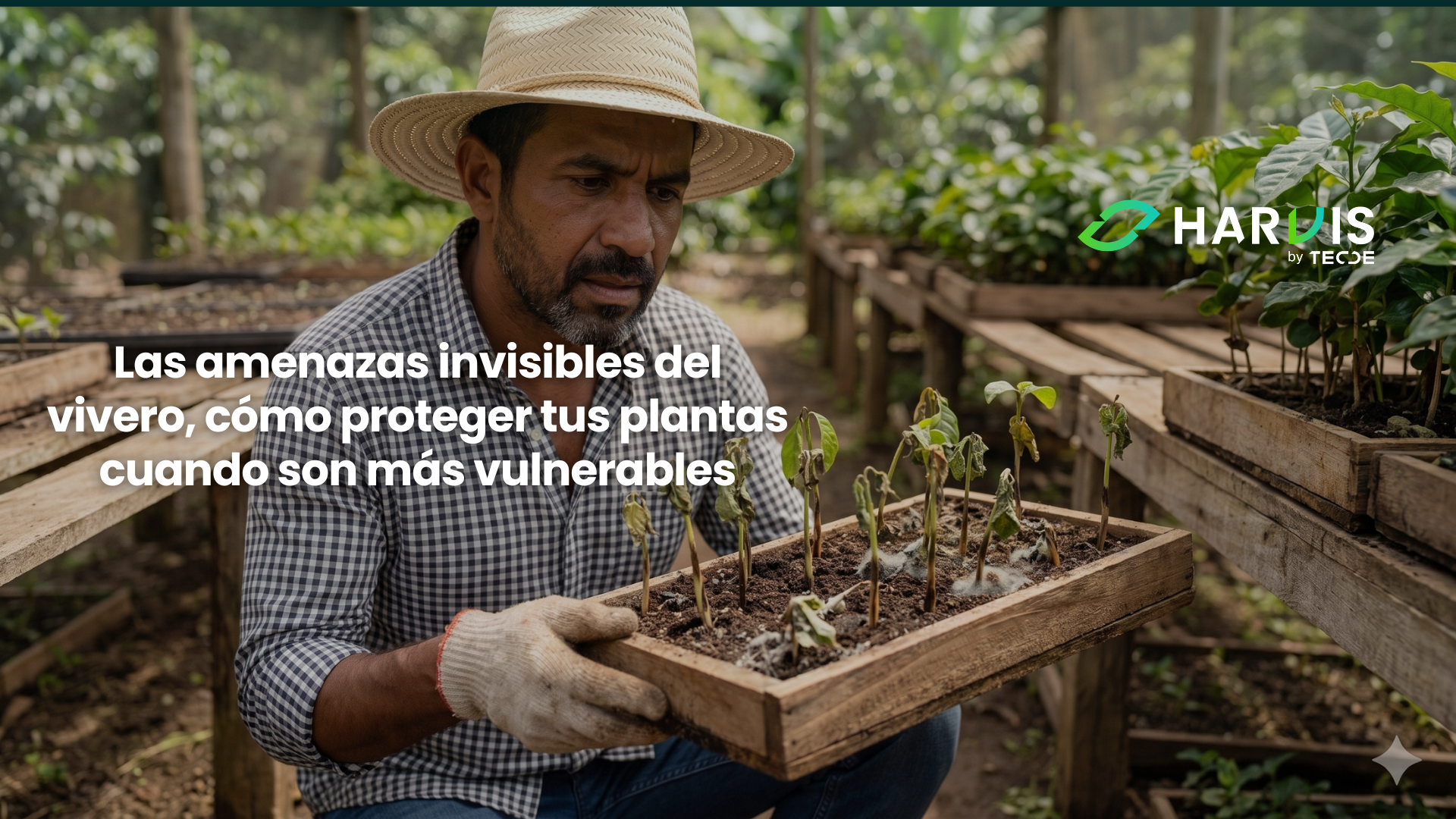
As we already addressed in our blog The Invisible Threats of the Nursery, How to Protect Your Plants When They Are Most Vulnerable, which you can read here, the seedbed concentrates all the conditions that a pathogen needs, and a problem that installs there travels with the plant to all the lots where you plant it; in citrus, this logic reaches an extreme, because a poorly made purchase can introduce to your farm the only disease for which there is no cure, and no subsequent vector management decision can correct it.
Twenty Trees, One Tray, and a Firm Tap
All of the above can be tested in a lot and in a campaign, with a clear plastic tray and a notebook. Choose a production lot and mark on the sketch thirty trees distributed throughout the block, excluding the edges and deliberately entering sectors where no one walks. Set a day of the week. Under each tree, place the tray under a branch with budding and give three quick, firm taps, always with the same intensity and at the same height, and note how many adults fall. The average of those counts is your reading for the week.
Note on the same sheet the budding status of the lot, with three categories that suffice: no bud, budding starting, and developed bud. That column is what will later explain your peaks and allow you to anticipate the next one, because the population does not rise by the date but by the bud.
During the first four weeks, count and note without changing anything in your usual management. That calibration period is the one that requires discipline and makes the exercise useful, because it will show you the range in which your farm really moves. Starting from the fifth week, define your threshold and respect it, starting with the range of 0.5 to 1.0 adults per tap if your lot is adult and a lower value if the lot is young.
At the end of the campaign, compare two numbers and you already have the exercise done: the total applications you actually made against the total you would have made with your previous calendar, and the cost of each. Add what you observed about fruit quality and skin damage. That comparison is yours; it corresponds to your tree age, your vector pressure, and your market, and is worth more than the table that opens this blog.
The Management That Does Not Fit Within Your Fence
Citrus compel acceptance of something that no other crop this season demanded so clearly: that part of the sanitary result does not depend on what you do. The vector moves between farms, the disease enters both through the air and through the plant you bought, and the regulatory framework precedes your economic calculation. Within that space, however, there remains a decision band that is entirely yours and that evidence shows is poorly utilized: how many times you apply, when, and against what.
What you can do starting Monday fits into five decisions. Start counting with a tray tap on thirty trees distributed throughout the lot and keep the series for four weeks before changing anything, because without a baseline there is no possible threshold. Record the budding status alongside the count and order your applications behind the bud and not the date, since without tender bud the female cannot reproduce. Adjust the threshold to the age of the tree and do not copy it, since a young lot buds more frequently and requires more care than an adult one. Stop applying against the leafminer in adult trees if canker is not present in your area, and concentrate it on the young tree and the window that opens about thirteen days after budding. And check the certified origin of each plant that enters your farm with the same rigor with which you check the product you spray, because that is the only entry point that no application can correct. The producer who finishes the campaign knowing how many applications they saved and what that savings cost them has their own threshold for the coming year; the one who followed the calendar will repeat the same bill without knowing what they bought with it.
Do you want to set up the psyllid count by lot, cross it with the budding status, and keep track of what each application you did not make saved you? Contact us via WhatsApp or schedule a demo and we’ll show you how Harvis turns your routes and applications into a series you can consult when it’s time to decide.
Consulted References
- Chen, X. D., Stockton, D., Gossett, H., Qureshi, J. A., Ibanez, F., Pelz-Stelinski, K. S., and Stelinski, L. L. (2022). Comparisons of economic thresholds for Asian citrus psyllid management suggest a revised approach to reduce management costs and improve yield. Frontiers in Sustainable Food Systems. https://www.frontiersin.org/journals/sustainable-food-systems/articles/10.3389/fsufs.2022.948278/full
- Colombian Agricultural Institute. Epidemiological surveillance of Huanglongbing in citrus and its vector Diaphorina citri. https://www.ica.gov.co/areas/agricola/servicios/epidemiologia-agricola/huanglongbing
- Colombian Corporation for Agricultural Research, Agrosavia. Potential risk analysis of Huanglongbing through geospatial technology in Colombia. Ciencia y Tecnología Agropecuaria. https://revistacta.agrosavia.co/index.php/revista/article/view/1552
- Flush shoot stage and oviposition preference of Diaphorina citri, implications for control strategies. PubMed. https://pubmed.ncbi.nlm.nih.gov/26313984/
- Hall, D. G. and Hentz, M. G. Sticky trap and stem-tap sampling protocols for the Asian citrus psyllid. Journal of Economic Entomology. https://pubmed.ncbi.nlm.nih.gov/20429472/
- University of Florida, IFAS. (2025). 2025–2026 Florida Citrus Production Guide, Citrus Leafminer, CG098. https://edis.ifas.ufl.edu/publication/CG098
- Adult citrus leafminers (Phyllocnistis citrella) are not efficient vectors for Xanthomonas axonopodis pv. citri. Plant Disease, APS. https://apsjournals.apsnet.org/doi/10.1094/PD-89-0590
- University of Florida, IFAS. Citrus Rust Mite, Phyllocoptruta oleivora, EENY-748. https://edis.ifas.ufl.edu/publication/IN1278
- UC Statewide IPM Program, University of California. Citrus Rust Mite (Silver Mite), Pest Management Guidelines. https://ipm.ucanr.edu/agriculture/citrus/citrus-rust-mite-silver-mite/
- Integrated biological control strategies for citrus rust mites, distribution, impact on mandarin quality, and the efficacy of Amblyseius largoensis. (2024). PMC. https://pmc.ncbi.nlm.nih.gov/articles/PMC11594963/
- Insecticide resistance in Diaphorina citri Kuwayama. (2026). Journal of Integrated Pest Management, Oxford Academic. https://academic.oup.com/jipm/article/17/1/pmag008/8644235
- Spatial distribution and development of sequential sampling plans for Diaphorina citri Kuwayama. (2021). Agronomy, MDPI. https://www.mdpi.com/2073-4395/11/7/1434
- University of Florida, IFAS. (2025). 2025–2026 Florida Citrus Production Guide, Asian Citrus Psyllid, CG097. https://edis.ifas.ufl.edu/publication/CG097
- Exacerbation of citrus canker by citrus leafminer Phyllocnistis citrella. Florida Entomologist, BioOne. https://bioone.org/journals/florida-entomologist/volume-93/issue-4/024.093.0413/
- UC Statewide IPM Program, University of California. Selectivity of Insecticides and Miticides, Citrus. https://ipm.ucanr.edu/agriculture/citrus/selectivity-of-insecticides-and-miticides/
- Risk-based regionalization approach for area-wide management of HLB vectors. PMC. https://www.ncbi.nlm.nih.gov/pmc/articles/PMC10725980/
- Lethal and sublethal effects of insecticides used on citrus on the ectoparasitoid Tamarixia radiata. PLOS One. https://journals.plos.org/plosone/article?id=10.1371/journal.pone.0132128