

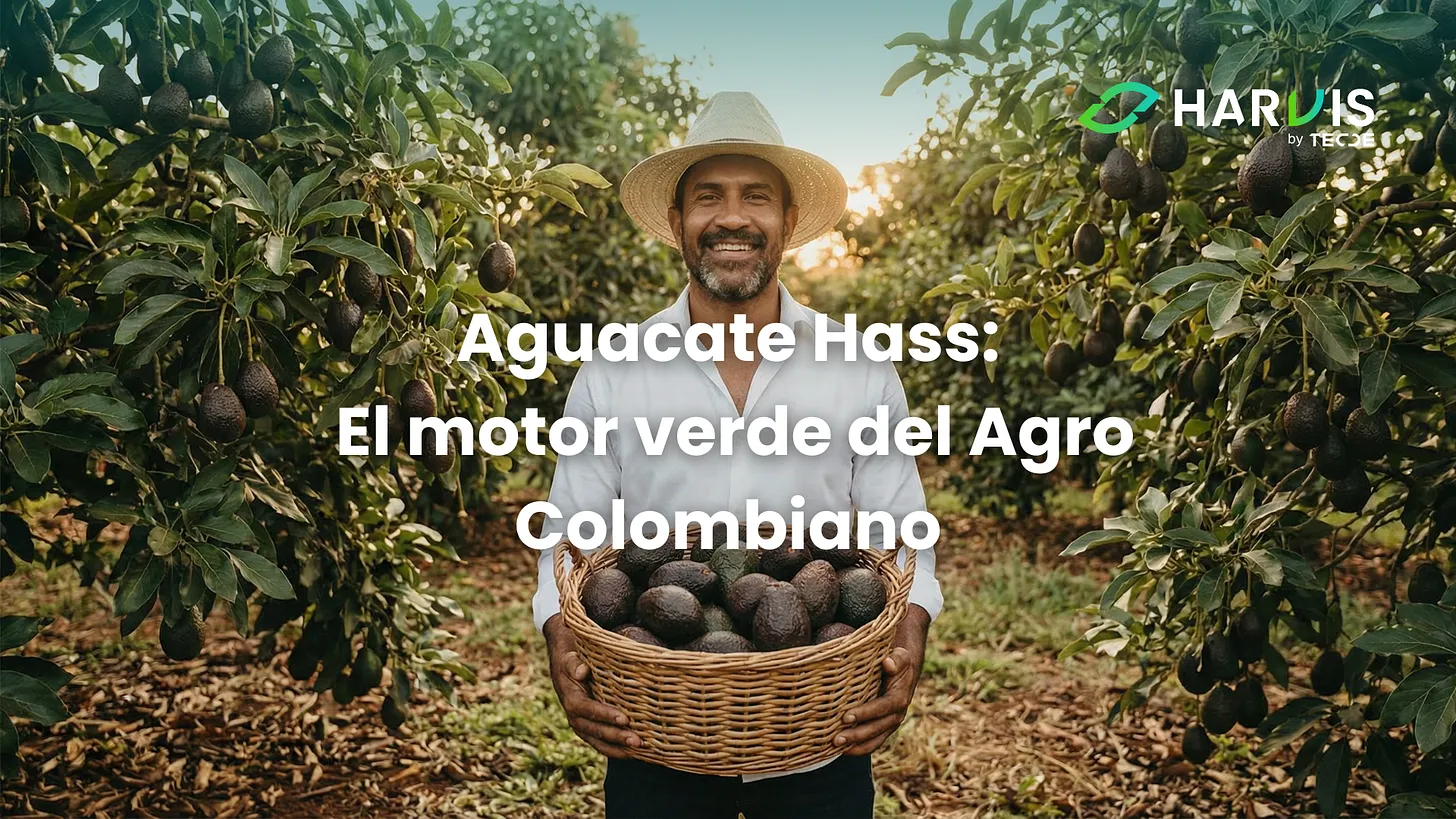
On World Avocado Day, we couldn't miss discussing a market with potential and high importance for Colombia, viewed from production to its economic potential.
On World Avocado Day, we celebrate more than just a fruit: we recognize a revolution that is transforming Colombian agriculture, energizing the rural economy, conquering international markets, and leaving a mark on sustainability. The Hass avocado has become the second fruit generating the most income for the country, after bananas, and its story is an example of what happens when vision, territory, and commitment align.
In 2024, Hass avocado exports surpassed US$310 million, growing 54% in value compared to 2023 and consolidating Colombia as the third-largest global exporter, after Mexico and Peru (Analdex, Asohofrucol, Corpohass).
✔︎So far in 2025, Colombia has exported over 152,000 tons, with a growth of 10.2% compared to 2024.
✔︎Antioquia leads in volume, with 1.67 million tons, but Valle del Cauca stands out for its annual growth of 7.8%, and Risaralda for its regional logistical connection.
Since 2019, the United States has become the largest destination, with a 334% increase in imports from Colombia in just the first five months of 2025.
What truly makes the Colombian offer unique is its ability to produce consistently throughout the year. With over 55,000 hectares planted and 250 producing municipalities in 17 departments, the country leverages its climatic diversity and thermal floors to maintain a stable and fresh supply.
Now, we face a significant challenge focused on conquering new destinations such as Asian and Arab countries, which involves logistical challenges ranging from the long distances and time required for shipping to these countries, as well as the deficient quality of our country's tertiary roads, which are mostly complex routes requiring improvements in road infrastructure.

As increasingly active participation strategies, attention is focused on Puerto Antioquia in the Urabá Antioqueño, considering the production potential of the Antioquian region, which will not only reduce departure times but also decrease costs for exports in the logistics chain; another way to participate in the market is through the development of derived by-products such as avocado oil, which also emerges as a profitable alternative to utilize non-exportable fruit, with markets in the U.S., Europe, and Asia.
Colombia is writing a powerful story with the Hass avocado. A story that blends science, sustainability, agro-industry, rural development, and technology. A story in which every tree, every producer, and every fruit matters.
At Tecde, we believe that the future of Colombian avocado lies in the intelligent use of data, field automation, and artificial vision.
That's why we created Harvis, a tool that allows:
✔︎Capture crop information via video from WhatsApp.
✔︎Count fruits, estimate productivity, and detect pests.
✔︎Generate digital traceability for certifications, exports, and internal control.
✔︎Assist producers in critical decisions such as harvest timing or quality forecasting.
Harvis has already been implemented in avocado-producing areas and other crops such as coffee, sugarcane, and citrus, demonstrating that technology can indeed be accessible, useful, and profitable for Colombian agriculture.
📬 Are you interested in the future of avocado and the digitalization of agriculture?
Subscribe to our newsletter, tell us what topics you would like us to delve into, and let's create a strong community that dreams of transforming Colombian agriculture.