
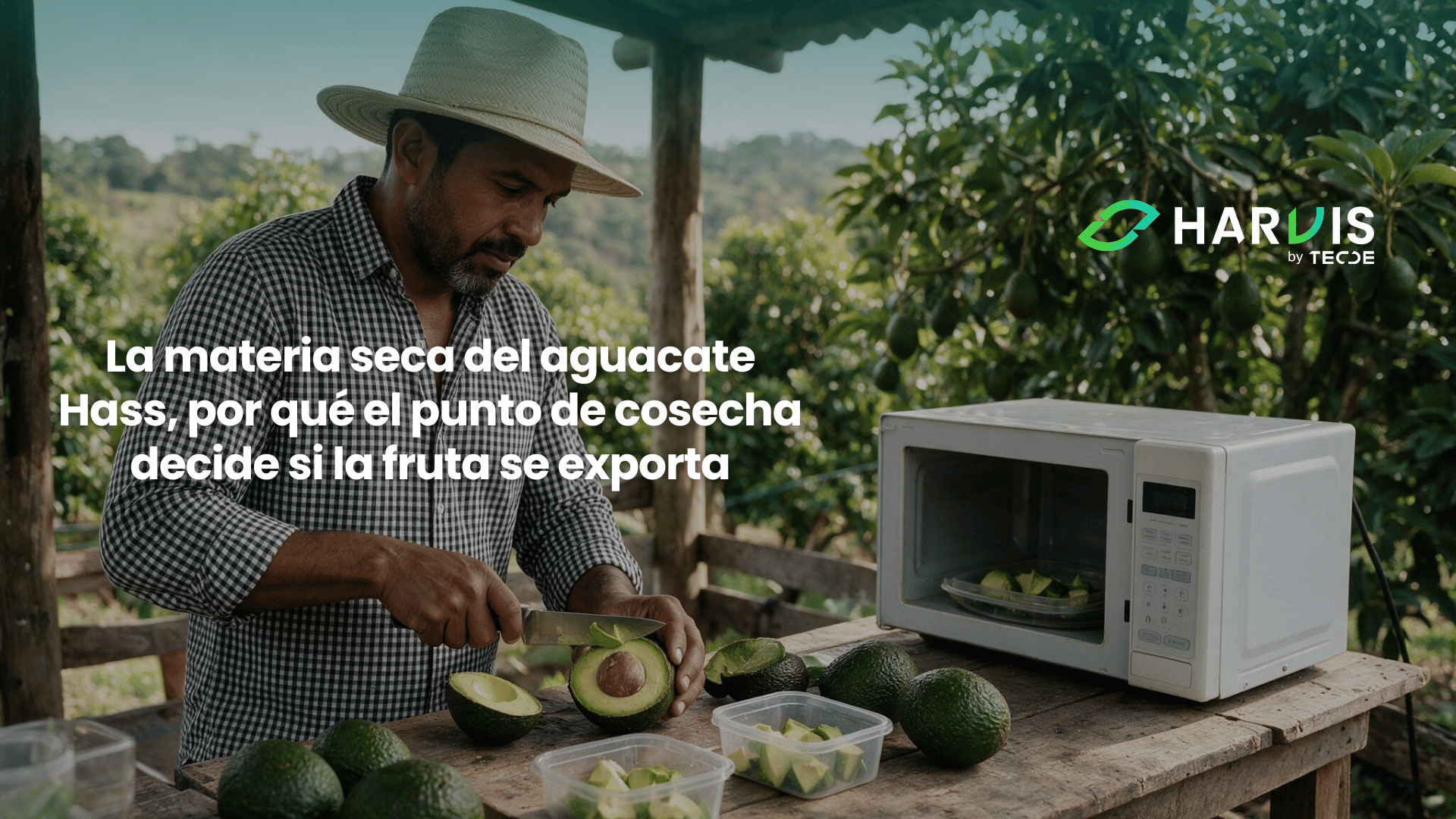
A Hass lot harvested too early looks just like one harvested at the right time: the same green skin, the same size, the same shine. The difference appears weeks later, in another country. In a trial with a Hass selection harvested at 17.6% dry matter, more than half of the avocados shriveled and 40% showed dark spots in the flesh. That damage is not visible on harvest day; it appears after the cold chain and the trip, when the fruit is already far from the farm.
That is why the countries that buy Colombian avocado no longer accept that harvest timing be decided by eye. For some destinations, the fruit must leave the tree with between 21.5% and 29% dry matter, and the packing house must provide a signed statement at each inspection proving that the test was done. The number that used to be a good practice is now a document that is checked at the port.
In this blog we are going to talk about how Hass avocado exports are looking this year, what dry matter is and why it is the best sign that the fruit is ready, the ranges required by markets, and what happens to the fruit when it is harvested before or after its point.
A year with less fruit, and therefore more demanding on quality
In just a few years, Hass avocado became one of the strongest products in Colombian agricultural exports. In 2025, 201,479 tons left the country, 45.6% more than the previous year. About 36% of that value went to the Netherlands, the gateway for the fruit into much of Europe, and the rest was distributed among Spain, the United Kingdom, Belgium, Germany, and other destinations.
2026 is different. Between January and July, 96,479 tons of avocado were exported, 15.4% less than in the same period of 2025. In July alone, in the middle of the off-season harvest, the exported volume was half of what it was a year earlier. The fruit available was not enough to meet all commitments.
A year with less fruit changes the way each box is viewed. When there is abundance, a rejected lot is replaced by another one; when fruit is scarce, every container that arrives with problems is a customer left waiting and a space taken by another country. At that point, quality stops being a packing house detail and becomes a decision made in the lot, on the day the crew is sent to harvest.
And the first factor in that quality is not size or skin color. It is whether the fruit was ripe inside when it was cut, something Hass avocado does not show on the outside while it is still on the tree.
Dry matter, the clock you cannot see in the skin
Avocado is a climacteric fruit, meaning it continues ripening after harvest. But it has one particular trait: it does not soften while it is on the tree. Hanging there, it keeps growing and accumulating oil in the flesh; softening only begins after it is cut. That is why fruit from a freshly harvested lot can look equally green and hard whether it is ready or still weeks away. Hass skin darkens when the fruit ripens for eating, not when it is ready to harvest.
What does change inside is the proportion between water and oil. As the fruit matures on the tree, the flesh gains oil and loses water, and the two move almost in mirror image. Measuring oil is expensive and time-consuming because it requires a specialized laboratory. Measuring water is easy: weigh a piece of flesh, dry it until it stops losing weight, and weigh it again. What remains, expressed as a percentage, is dry matter.
The international quality standard for avocado sets the minimum for Hass at 21% dry matter, measured by drying the flesh to constant weight, and clarifies that the requirement applies to the lot, not to each individual fruit. Each producing country has set its own minimum, which can be between 21% and 21.8% in some crops in Australia and the United States, 22% in Mexico, and 23% in South Africa, Chile, and Spain.
In Colombia, a study lasting more than three years in 15 orchards in the same producing region linked dry matter to flesh oil content. The lots reached the minimum quality oil content with dry matter values ranging from 22% to 26%, depending on the farm, and the authors proposed 23.5% as the minimum harvest index for the country. In other words, the same dry matter figure does not mean the same thing on every farm, and later I will explain why that matters when using a number from another area.
In practice, several Colombian farms already harvest using that criterion. In two orchards at 2,000 and 2,200 meters, harvest took place when the flesh reached 24% dry matter and the fruit exceeded 70 millimeters in diameter. Size and dry matter together say more than either one alone, because a large fruit can be immature and a small one can be ready.
Between 21.5% and 29%, what markets ask for and why
To export fresh Hass to Uruguay, ICA establishes that the fruit must have between 21.5% and 29% dry matter at harvest. The exporter or packing house must provide a signed certificate at each inspection stating that the test was performed and what range the fruit fell into. Without that document, the shipment does not pass.
Chile asks for exactly the same range for Colombian Hass and explains why in its own regulation: within that range, Hass avocado does not serve as a host for fruit flies. In this way, dry matter is not only a flavor requirement; it is also a phytosanitary guarantee that the importing country uses to open the door.
The range has a floor and also a ceiling. The floor protects the consumer from watery, flavorless fruit. The ceiling, 29%, marks fruit that stayed too long on the tree. A lot that goes over the ceiling has the same commercial problem as one that does not reach the floor: it does not comply.
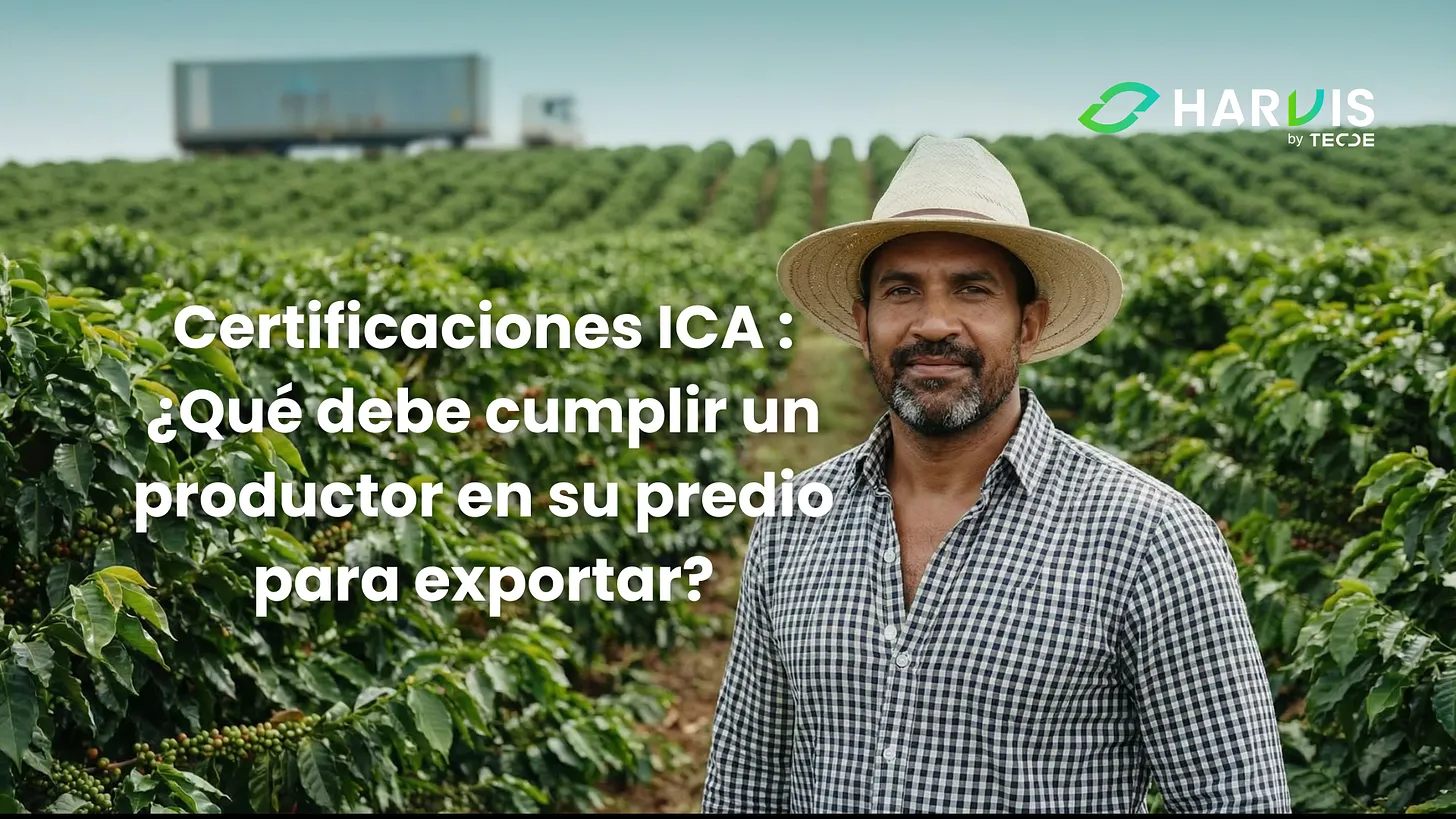
On top of that come the usual requirements. Every shipment needs the farm, packing house, and exporter to have current registration with ICA, as well as the phytosanitary certificate and inspection at the point of departure. As we already covered in our blog ICA certifications: What must a producer comply with on the farm to export?, which you can read here, farm registration is the foundation of everything else; the dry matter test adds to that foundation as the data that proves the fruit from that farm was cut at the right time.
Knowing which lot has already reached export dry matter
Do you know what dry matter each of your lots has today, and how many weeks the most delayed one still needs to reach the range your buyer asks for? On many farms, the test is done only once, at the packing house, when the fruit has already been cut, and if it comes out low there is no way to put it back on the tree. Harvis helps you record each dry matter sample from your phone with its lot, date, and trees, and shows you how it rises in each lot so you can schedule harvest when the fruit is already in range. Write to us and we will set it up using the lots you already have.
Harvesting before or after the point, what happens on the trip
Fruit harvested too early does not ripen well. In taste tests with Hass avocado, fruit below 24% dry matter was described as watery, not very creamy, flavorless, and with a green grass taste; acceptance improved when average dry matter rose above 24%. In addition, under-ripe fruit stored in cold conditions showed skin damage that made it look worse.
The most visible damage is shriveling. In the trial mentioned at the beginning, fruit harvested at 17.6% dry matter ended up shriveled in more than half of the cases. The reason is simple: immature fruit has more water and less oil, loses that water during the trip, and the skin shrinks before the flesh has time to soften. For the buyer, that is fruit that cannot be sold.
Waiting too long is not the solution either. In the same trial, fruit with very high dry matter, between 33% and 49%, still showed dark spots in the flesh, and at one of the sites the problem reached 80% of the fruit. Going past the point does not fix anything; it only replaces one problem with another, and it also takes the fruit out of the range the buyer asks for.
The harvest point is not everything either. Fruit at the right point that gets bruised during harvest is also lost. A drop from 30 centimeters, the height of a poorly unloaded picking bin, multiplied flesh rot by two to eight times when the fruit ripened. Measuring dry matter tells you when to harvest; the way you harvest decides whether that work is preserved until destination.
Why dry matter from another farm is not yours
First, minimums change by country and by farm. The international standard asks for 21%, several countries require 22% or 23%, and for Colombian Hass, 23.5% was proposed. That 23.5% came from farms in a single region, and the authors themselves warn that the index should be adjusted with samples from more areas and with climate information.
Second, the dry matter of a lot is not the dry matter of each fruit. The standard clarifies that the requirement applies to the lot, and within the same tree, fruit on the sunnier side and the upper part is usually riper than fruit below and in the shade. A sample taken only from the roadside edge, from the prettiest trees, can give a number that does not represent the lot.
Third, the home method has its margin of error. Microwave oven drying gives results in a few hours, but each oven heats differently and the sample can burn if too much power is used. If there is no microwave, a conventional oven at between 100 and 110 degrees for about five hours serves the same function, with very finely grated pulp. In any case, it is a good idea to compare the farm result from time to time with that of a laboratory or the packing house, to know how far it deviates.
Fourth, none of these numbers can be copied exactly to another farm. The shriveling and spotting figures came from trials in another country and with Hass selections different from the one planted here, and the flavor figures came from tasting panels in the United States. What can be taken to any farm is the method: measure the dry matter of each lot several times before harvesting, and harvest when the lot, not a single fruit, is within the range your buyer asks for.
One lot, five avocados, and a microwave oven
Choose the lot you planned to harvest first and start measuring about six weeks before the date you had in mind. Take five avocados at harvest size, from trees spread throughout the lot and not just from the edge, and collect some from the shaded part of the tree, which usually ripens later. Label the bag with the lot and the date, and do the test the same day, before the fruit softens.
Cut each avocado open, remove the skin and seed, and slice the flesh into very thin strips with a potato peeler. Weigh an empty plate and note the weight. Place about 100 grams of flesh on it and note the weight of the plate with the flesh. Put it in the microwave at 40% power for 15 minutes, take it out and weigh it; then repeat in three-minute and then one-minute intervals until the weight no longer drops.
Here is the calculation: subtract the plate weight from the dry weight, divide it by the wet weight minus the plate, and multiply by one hundred. If you started with 100 grams of flesh and ended with 24 grams, dry matter is 24%. You need a scale that measures to tenths of a gram, because with a 100-gram sample, every gram of error is one dry matter point.
Repeat the test every two weeks in the same lot and write the result next to the date. You will see dry matter rise week by week, and you will be able to calculate when it reaches the range your buyer asks for. When two consecutive tests fall within the range, schedule harvest. By the end of the season, you will know on what date each lot reached the point, and that date, compared year after year, is what lets you plan the crew in advance.
The fruit is harvested from the inside, not the outside
Hass avocado hides its harvest point. The skin does not change, size can be misleading, and the fruit does not soften on the tree. The only thing that says whether the fruit is ready is dry matter, and several markets no longer accept guessing: the 21.5% to 29% range is required with a certificate in hand. This year, with less fruit available for export, every lot that leaves outside that range matters more than ever.
What you can do starting this week fits into five decisions. Ask your buyer what dry matter range is required for each destination. Measure the dry matter of each lot every two weeks, starting before the harvest date you had planned. Take the sample from trees spread throughout the lot and from the shaded part, not just from the edge. Do not cut a lot until two consecutive tests are within range. And take care with fruit drop during harvest, because one impact undoes what the measurement achieved.
The producer who arrives at the next harvest with the dry matter of each lot recorded will cut when the fruit is ready and will have the document requested at the port; the one who keeps harvesting by size and calendar will find out about the problem when the buyer opens the box.
Do you want to know what dry matter each lot has this week and on what date it will be ready for export? Write to us and we will show you how Harvis turns your dry matter tests into a harvest date for each lot.
References consulted
- Kleinert, A., Crouch, E., Lemmer, D. and Roux, W. (2023). Reviewing minimum harvest maturity levels for 'Maluma Hass' and 'Lamb Hass'. South African Avocado Growers' Association Yearbook, 46. https://www.avocadosource.com/Journals/SAAGA/SAAGA%5F2023/SAAGA%5F2023%5F46%5FPG%5F064.pdf
- ICA (2026). Circular 20262006966, exports of fresh Hass avocado fruit from Colombia to Uruguay. Colombian Agricultural Institute. https://www.ica.gov.co/areas/agricola/direccion-tecnica-de-epidemiologia-y-vigilancia-fi/registros-para-exportacion-de-vegetales/circular-ica-20262006966-exportaciones-de-frutos-f.aspx
- Analdex (2026). Avocado exports grew 21.3% during 2025. National Foreign Trade Association. https://analdex.org/wp-content/uploads/2026/02/Nota-de-prensa-exportaciones-aguacate.pdf
- UPRA (2026). Exports of agricultural and agro-industrial products, July 2026. Rural Agricultural Planning Unit. https://upra.gov.co/sites/default/files/2026-09/20260904%20Exportaciones%20de%20productos%20agropecuarios%20y%20agroindustriales%20JULIO%20de%202026.pdf
- Codex Alimentarius (2013). Standard for Avocado, CXS 197-1995, amendment 2005 and revision 2013. FAO and WHO. https://www.fao.org/input/download/standards/321/CXS%5F197s.pdf
- Bernal Estrada, J. A., Builes Gaitán, S., Caicedo Vallejo, A. M., Carabalí Muñoz, A., Casamitjana Causa, M., Córdoba Gaona, Ó. J. and collaborators (2020). Technological update and good agricultural practices (GAP) in avocado cultivation. AGROSAVIA. https://doi.org/10.21930/agrosavia.manual.7403831
- Carvalho, C. P., Velásquez, M. A. and Van Rooyen, Z. (2014). Determination of the minimum dry matter index for the optimum harvest of 'Hass' avocado fruits in Colombia. Agronomía Colombiana, 32(3), 399–406. https://doi.org/10.15446/agron.colomb.v32n3.46031
- Mejía-Jaramillo, L. M., Montoya-Areiza, C., Saavedra-Porras, S., Salazar-García, S. and Osorio-Vega, N. W. (2023). Removal of macronutrients in the avocado fruit cv. Hass in Antioquia and Caldas, Colombia. Revista Colombiana de Ciencias Hortícolas, 17(3), e16556. https://doi.org/10.17584/rcch.2023v17i3.16556
- SAG (2021). Exempt Resolution 6861 of 2021, phytosanitary requirements for the import of fresh Hass avocados from Colombia. Agricultural and Livestock Service of Chile. https://www.sag.cl/sites/default/files/Res%206861%202021%20paltas%20Hass%20Colombia.pdf
- Arpaia, M. L. and Obenland, D. (2012). Avocado postharvest biology, determinants of eating quality. University of California Riverside, USDA-ARS and California Avocado Commission. https://www.californiaavocadogrowers.com/sites/default/files/Avocado-postharvest-biology-determinants-of-eating-quality.pdf
- Perkins, M. L., Usanase, D., Zhang, B., Joyce, D. C. and Coates, L. M. (2020). Impact injury at harvest promotes body rots in 'Hass' avocado fruit upon ripening. Horticulturae, 6(1), 11. https://doi.org/10.3390/horticulturae6010011
- Mccarthy, A. and McCauley, D. (2019). Avocado maturity testing using dry matter. Department of Primary Industries and Regional Development, Western Australia. https://www.agric.wa.gov.au/avocados/avocado-maturity-testing-using-dry-matter