
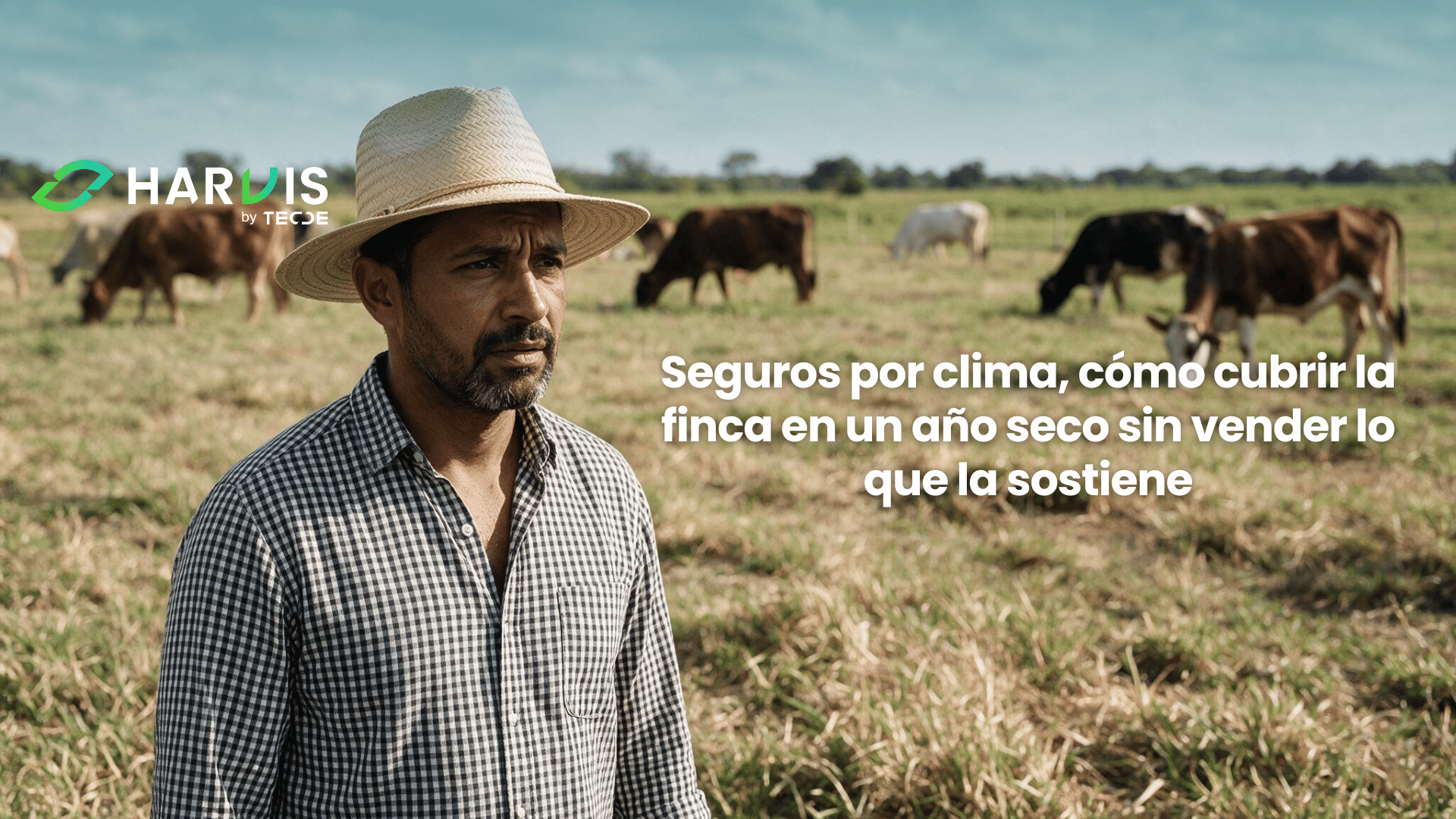
An insurance policy can pay you even if your field lost nothing, and leave you with no money even if you lost almost everything. It is not a scam; that is how a type of policy works that is being used more and more in agriculture, the one that does not pay for what happened on your farm but for what a rain gauge or a satellite recorded in your area. Anyone who buys it without knowing that gets the surprise at the worst possible moment.
There is more than a 95% chance that El Niño will remain active through the first quarter of 2027, and a 63% chance that it will become very strong between November and January, with less water in rivers and streams and more heat across much of the country. For a crop farm, that can mean a short harvest or a failed planting; for livestock, dry pastures and thin animals. And both end up facing the same question: where does the money come from to get through the bad months?
In this blog, we are going to talk about what is really lost in a dry year, the difference between traditional insurance and index-based insurance, what the country currently offers for crops and livestock, and why no insurance replaces your own savings for the bad months.
What is really lost in a dry year: the rushed sale
The first loss in a drought is the visible one: the field that did not set, the grass that did not regrow, the liters that dropped. But the loss that lasts the longest is the second one, the one that comes when the farm has to get cash fast to cover the first. In crops, that means not having money to replant or fertilize the next harvest, and dragging one bad year into the next. In livestock, it means selling animals when all the neighbors are selling too, thin and at a bad price, because there is no grass to keep them.
That rushed sale is more expensive than it looks. Selling cattle to get through a drought compensates much less than people think; in rural households in West Africa that experienced droughts, selling animals covered at most 30% of the lost income, and probably closer to 20%. In other words, the livestock producer gives up part of their capital and still comes up short. And what is sold does not come back quickly: after losing half a herd, rebuilding it can take up to ten years.
The rushed sale has another trap. The cow sold in a drought is often the one that should not have been sold, the replacement heifer or the pregnant cow, because those are the ones someone will buy; in crops, something similar happens when a healthy field is left unfertilized to save a sick one. What is lost there is the ability to produce in the following years, and that is why the question is how to avoid having to sell. Insurance is part of the answer and your own savings are the other part, and later I come back to how that savings fund is built.
Traditional insurance and index-based insurance: who decides there was a loss
There are two main ways to insure a farm against weather, and the difference is who says there was a loss. In traditional insurance, also called indemnity insurance, the insurer pays for the damage that the insured crop or animal actually suffered, and to know that it has to measure what was lost in the field. An adjuster visits the farm and calculates how much was damaged, like with car insurance.
Its advantage is that it pays for what happened on your farm. But visiting every property is expensive, and insurers protect themselves against people who only insure the field they already know is going to fail. That is why voluntary traditional insurance usually has high premiums, from 7.5% to 10% of the insured value or more, and in the world it usually works with state support. The premium is what you pay for the policy; the insured value is the maximum the policy can pay.
Index-based insurance works the other way around. It does not measure your field: it pays when an external indicator, such as rainfall recorded at a station or pasture greenness seen from a satellite, crosses a threshold agreed in advance, without anyone having to go to the farm. If the rainfall in your area during the season falls below what was agreed, the policy pays; if not, it does not. Because it does not need visits, it is cheaper to manage, and that is why its use grew: it went from about 3% of the world’s agricultural premiums in 2009 to about 12% in 2019.
Its weakness has a name: basis risk. It is the possible difference between what the index pays and what the insured actually lost, and it explains the sentence that opens this blog: the index can pay you even if you did not lose, or fail to pay you even if you did. In an index-based livestock insurance program in Kenya, in one out of every four seasons evaluated the index showed a loss when there was none, and in one out of every eight it did not show a loss when there was one. A field on a slope that is drier than the reference station falls outside the index.
What exists today in Colombia for crops and what is still missing for livestock
The country has support to buy insurance, the Agricultural Insurance Incentive, managed by Finagro. The state pays part of the premium and the producer pays the rest. For policies in the second half of 2026, that support covers up to 85% of the premium for small producers and up to 35% for medium-sized ones. In pesos, on a policy worth one million, the small producer pays about 150,000 plus VAT.
The policy can cover excess or lack of rain, strong winds, flooding, frost, hail, landslides, and fires, as well as pests and diseases. And it is not only for crops: cattle and buffalo livestock can also be insured with this incentive, as long as the farm has its sanitary registration with the Colombian Agricultural Institute and its vaccination record up to date. Each insurer decides which risks it offers, so the policy should be read before signing it.
For the second half of 2026, 54.453 billion pesos were allocated to traditional policies, and 30% of that money was reserved for municipalities prioritized because of El Niño. Resources are assigned on a first-come, first-served basis until they run out, and that has a practical consequence: the producer who waits to see whether the drought arrives may find the quota gone when the drought is already here. Added to that is another seasonal tool, a subsidy of up to 40% of the remaining loan balance for those who invest it in irrigation or water infrastructure.
What remains scarce is insurance. In 2025, 75,419 producers were insured, fewer than the previous year, and the insured area has historically never exceeded 5% of what is planted in the country. In other words, the vast majority of farms face every drought without any policy.
Index-based insurance, which should be easier to reach for small producers, is also declining: at the beginning of the year, a 20,000 million peso fund was opened for that type of policy, but in 2025 it fell 58% in the number of insured clients. And for livestock, what exists is mostly traditional insurance per animal; index-based pasture insurance that already works in other countries is still not a common offer here.
Other countries show what it can look like. In Mexico, a catastrophic insurance program bought by state governments for their smallest producers covered about 8 million hectares and more than 4.2 million head of livestock in 2011, with pasture insurance based on greenness seen by satellite. In Uruguay, a pilot for beef-cattle production paid half the insured value when field greenness fell well below normal and the full amount when it fell much more, and delivered the payment in feed supplement for the animals, before the peak of the drought. As we already covered in our blog Use of AI in Agriculture: More Than Technology, a Strategic Ally, which you can read here, technology on the farm is useful when it turns what happens in the field into information someone can use to make decisions; in insurance, that information is what allows the payment to arrive on time and gives a claim something solid to stand on.

Knowing what you have to show the insurer
If tomorrow you had to file a claim, could you show how much it rained on your field, what you had planted, and how many animals were in each paddock before the drought? On most farms, that information lives in the foreman’s memory or in a notebook nobody can find, and the claim becomes the producer’s word against the adjuster’s. Harvis helps you record rainfall, tasks, animal inventory, and the condition of each field and each paddock from your phone, with date and location, so that the day you need to prove a loss you have the full history and not just a memory. Write to us and we will set it up on the fields and paddocks you already have.
The fund for the bad months: what no insurance covers
A well-chosen insurance policy protects against the big loss, the one that comes once every several years, but it does not cover everything. In Kenya, index-based livestock insurance reduced exposure to the large losses that hit an entire area by an average of 62.8%, but households still retained 69.3% of their original risk. The reason is simple: a large share of what happens to a farm happens only to that farm, and no area index sees that.
Even so, when insurance pays, it changes what the family does. In the same country, after a drought year, insured households expected to sell animals in a rush at a proportion 61 percentage points lower than uninsured households. Among households with more animals, the difference reached 96 points. Insurance did not bring back the grass, but it kept them from giving up the herd to get through the drought, which is exactly the loss that lasts the longest.
What insurance does not cover has to be covered by the farm, and that is where your own savings come in. In livestock, that savings is almost never money in the bank: it is stored feed. Silage and hay made during the months of abundant grass are the pasture fund, because they make it possible to keep animals without selling them when the grass runs out. With the rains that are still falling before the announced drought, this is the time to cut and store the surplus, and to fill reservoirs and tanks that in February will be worth more than any emergency purchase.
In crops, savings take another form. It is the reserve to replant if the sowing is lost, the fertilizer saved for the next harvest, or a portion of each good harvest set aside for the bad one. Studies on index insurance recommend exactly that: combine it with savings and risk-oriented credit, because none of the three works alone. The order matters: your own savings cover the small, frequent hits, insurance covers the big, rare hit, and credit, if it comes, covers rebuilding.
What insurance does not do and how far these figures go
First, insurance does not replace management. A policy against lack of rain does not pay for irrigation that was never done or for a paddock that was overgrazed before the drought, and in traditional insurance the adjuster also checks whether the producer did what they were supposed to do. Insurance protects a well-managed farm from what it could not avoid; it does not protect a poorly managed one from what it could have avoided.
Second, index-based insurance requires accepting basis risk. It may pay without a loss or fail to pay with one, as seen in Kenya with one out of every four seasons in which the index showed a loss when there was none. Before buying that kind of policy, it is worth knowing which station or image is used, how far it is from the farm, and what exact threshold triggers payment.
Third, public support changes from one half-year to the next. The premium percentages, caps, and amounts in this blog are those in force in 2026, and the money is assigned on a first-come, first-served basis. Before counting on the incentive, you need to confirm with the financial institution or insurer whether there is still room and what conditions apply that month.
Fourth, much of the evidence on livestock insurance comes from Africa and from small programs in Mexico and Uruguay, with grazing systems, breeds, and markets very different from those on a Colombian farm. The Kenya figures on rushed sales refer to what households said they would do, not what was observed afterward, and the ten years to rebuild a herd are a reference from nomadic herders. They help explain how insurance works, not calculate how much it will pay you.
A policy read, a rainfall record, and a list of what you would not sell
Start with the policy, if you already have one, or with the quote, if you do not, and underline three things: what risks it covers, what the insured value is, and what has to happen for it to pay. If it is traditional insurance, note what documents they ask for when filing a claim; if it is index-based, which station or image is used and what the threshold is. That half hour of reading avoids surprises on claim day.
Then put a rain gauge in the main field or next to the largest paddock, and write down every day the millimeters that fell, including zeros. With index-based insurance, that record tells you whether your rainfall resembles that of the reference station; with traditional insurance, it proves the drought was real. Along with rainfall, once a week note the condition of each field or paddock and, in livestock, how many animals are in each one.
The third piece is a short list, made calmly and before the drought: the animals or fields you would not sell even if the hardest year came. The replacement heifer, the pregnant cow, the newly renovated field. Next to each one, write what would keep it going: how much silage or hay you still need to store, how much water you need to store, what part of the harvest you will set aside to replant. That list is your fund for the bad months put on paper.
Finally, if your farm qualifies for the incentive, check with your bank or insurer this week to see whether there is still room, because it is assigned on a first-come, first-served basis. And decide what part of the list above the policy would cover and what part you have to cover with what you have stored.
A dry year starts being paid for before it arrives
What a drought takes from a farm is not just the harvest or the liters from those months. It is what the farm has to give up to survive it, and that is decided before it arrives: with the policy that was read or not, with the grass that was stored or not, with the list of what is not sold. Traditional insurance pays for what happened on your farm, index-based insurance pays for what happened in your area, and your own savings cover what neither of the two sees. None is enough on its own, and the three together are the difference between getting through an El Niño year and being left undercapitalized by it.
What you can do starting this week fits into five decisions. Read your policy or ask for a quote and underline what it covers, how much, and when it pays. Check with your bank or insurer whether there is still room in the incentive for the semester, because it is distributed on a first-come, first-served basis. Put a rain gauge on the farm and start recording daily rainfall, including zeros. Cut and store the extra grass from the rains of these weeks, and fill tanks or reservoirs while it is still raining. And write the list of what you would not sell, with what you need to keep it going. The producer who reaches December with those five things will face the drought with a plan; the one who reaches it without them will be deciding in February, with a dry paddock, what to sell and at what price.
Do you want to have rainfall, task, and animal records for each field and each paddock ready for when you need to prove a loss? Write to us and we will show you how Harvis turns what happens on your farm into the history that supports you with the insurer.
References consulted
- IDEAM (2026). IDEAM indicates that El Niño-like conditions are already present. Institute of Hydrology, Meteorology and Environmental Studies. https://www.ideam.gov.co/sala-de-prensa/noticia/ideam-indica-que-las-condiciones-tipo-el-nino-ya-se-encuentran-presentes
- Fafchamps, M., Udry, C. and Czukas, K. (1998). Drought and saving in West Africa, are livestock a buffer stock? Journal of Development Economics, 55(2), 273–305. https://ideas.repec.org/a/eee/deveco/v55y1998i2p273-305.html
- Calcutt, E. and Abel, S. (2025). Horn of Africa, building regional risk protection for pastoralist livelihoods. Disaster Risk Financing Case Study. World Bank Group. https://documents1.worldbank.org/curated/en/099047002102616810/pdf/IDU-f6f6363e-e604-40a9-a525-76f216f5767d.pdf
- World Bank (n.d.). Risk finance instruments, an in-depth look at agricultural insurance. Disaster Risk Financing for Agriculture Technical Learning Series, Fact Sheet 6. World Bank Group. https://documents1.worldbank.org/curated/en/099061925234027976/pdf/P176613-f1480900-c2bf-4828-8448-27a087d8cf7e.pdf
- Hazell, P., Anderson, J., Balzer, N., Hastrup Clemmensen, A., Hess, U. and Rispoli, F. (2010). The potential for scaling up and sustainability of climate index-based insurance for agriculture and rural livelihoods. IFAD and WFP. https://www.ifad.org/documents/38714170/40239486/The+Potential+for+Scale+and+Sustainability%5Fs.pdf/f8748dd5-fa5c-4528-9d06-64b7566556ea
- Jensen, N. D., Barrett, C. B. and Mude, A. G. (2016). Index insurance quality and basis risk, evidence from northern Kenya. American Journal of Agricultural Economics, 98(5), 1450–1469. https://ideas.repec.org/a/oup/ajagec/v98y2016i5p1450-1469..html
- Finagro (2026). Service Manual, Third Title, Sixth Chapter, Agricultural Insurance Incentive. Fund for Financing the Agricultural Sector. https://www.finagro.com.co/sites/default/files/field%5Ftst%5Fpdf%5Fattached/node/2026-07/T%C3%ADtulo%203%20Cap%206%20ISA.pdf
- Finagro and Ministry of Agriculture and Rural Development (2026). El Niño Phenomenon booklet for producers. Finagro. https://www.finagro.com.co/sites/default/files/basic-page/2026-06/Cartilla%5FFenomenoNino%5FProductores.pdf
- Finagro (2026). External Circular No. 77 of 2026. Fund for Financing the Agricultural Sector. https://www.finagro.com.co/sites/default/files/notifications/2026-07/Circular%20Externa%20No.%2077%20de%202026.pdf
- Torres Armenta, P. A. (2026). Traditional insurance is regaining ground in the agricultural sector. Revista Fasecolda, 201, 14–19. https://revista.fasecolda.com/index.php/revfasecolda/article/view/1145
- Torres Armenta, P. (2021). Importance of stability in the agricultural insurance incentive. Revista Fasecolda, 184, 88–91. https://revista.fasecolda.com/index.php/revfasecolda/article/view/777
- Finagro (2026). External Circular No. 12 of 2026, Agricultural Insurance Incentive. Fund for Financing the Agricultural Sector. https://www.finagro.com.co/sites/default/files/notifications/2026-02/Circular%20No.%2012%20de%202026.pdf
- Arias, D. and collaborators (2013). CADENA catastrophe insurance, a social safety net for small-scale farmers in Mexico. Mexico Agriculture Insurance Market Review. World Bank. https://documents1.worldbank.org/curated/en/124521468287160777/pdf/881000BRI0P1300urance04Pager0Cadena.pdf
- Methol, M. and Mila, F. (2015). Implementation of a pilot drought insurance test for beef cattle based on the NDVI index. OPYPA Yearbook 2015, Ministry of Livestock, Agriculture and Fisheries of Uruguay. https://www.gub.uy/ministerio-ganaderia-agricultura-pesca/sites/ministerio-ganaderia-agricultura-pesca/files/documentos/publicaciones/implementacion%5Fde%5Funa%5Fprueba%5Fpiloto%5Fdel%5Fseguro%5Fde%5Fsequia%5Fpara%5Fganderia%5Fde%5Fcria%5Fbasado%5Fen%5Fel%5Findice%5Fndvi.pdf
- Janzen, S. A. and Carter, M. R. (2019). After the drought, the impact of microinsurance on consumption smoothing and asset protection. American Journal of Agricultural Economics, 101(3), 651–671. https://www.nber.org/papers/w19702
- Carter, M., de Janvry, A., Sadoulet, E. and Sarris, A. (2017). Index insurance for developing country agriculture, a reassessment. Annual Review of Resource Economics, 9, 421–438. https://ideas.repec.org/a/anr/reseco/v9y2017p421-438.html