
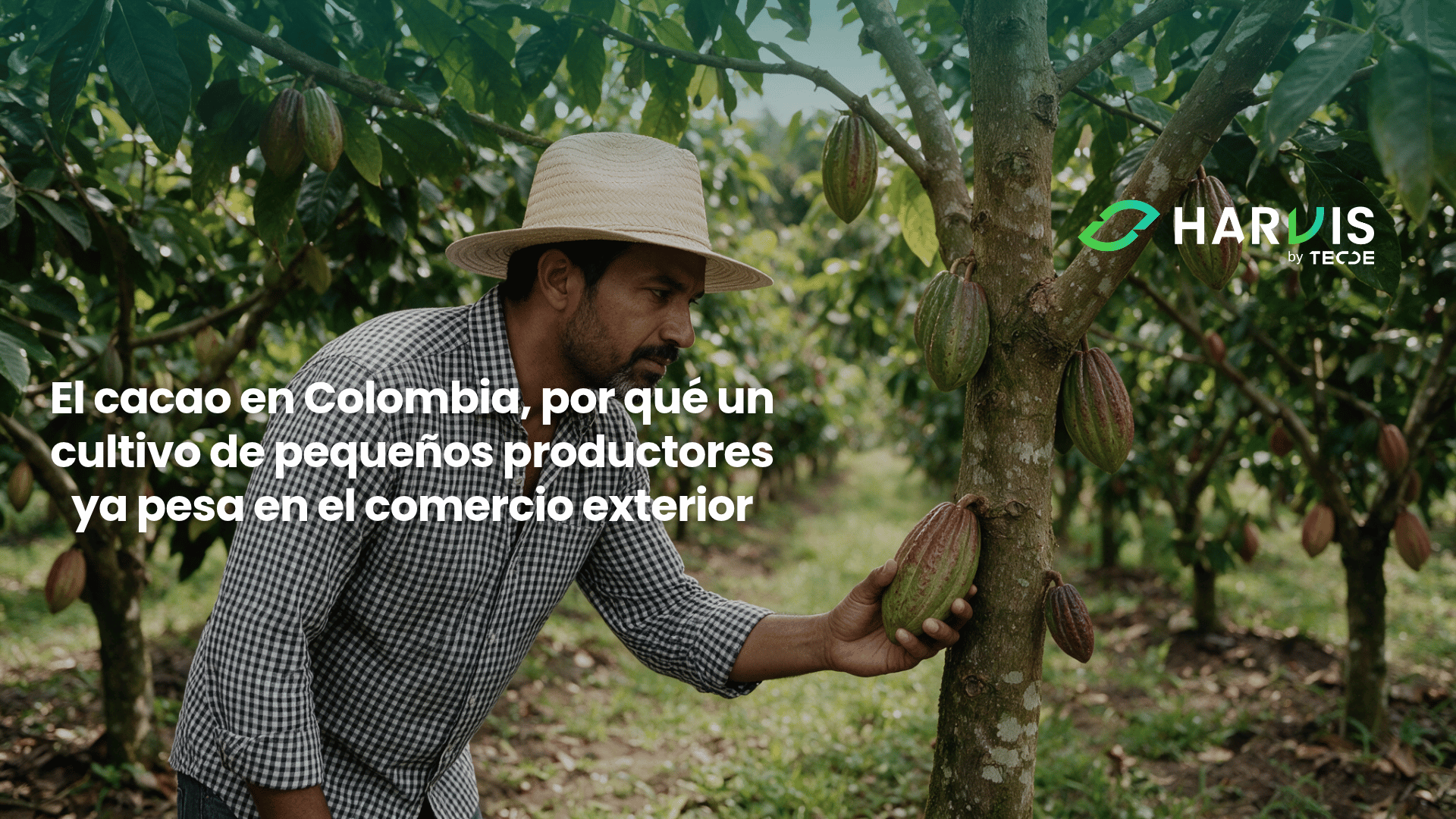
By weight, cocoa is almost invisible in Colombian agriculture. It represents just 0.2% of the country’s total agricultural production. However, in 2025 its exports totaled 413.1 million dollars, 56% more than the previous year. Few crops move so much money with so little volume, and almost all of that grain comes from small, family farms.
That jump is not explained only by planting more. The international cocoa price hit historic highs and then fell by half in a matter of months, European buyers began asking for the map of each plot, and cadmium, a metal the tree takes from the soil, became a reason to reject entire shipments. At the same time, national research already has more productive clones and cheaper ways to measure what used to be known only in a laboratory.
In this blog, we are going to talk about what cocoa means for the country’s rural economy, what is happening in the foreign market, the rules that are already changing the way it is sold, and the technological advances that producers can take advantage of now.
A small crop in tons and big in families
In 2025, Colombia had about 269,000 hectares planted with cocoa, around 10,000 more than the previous year. Production reached about 151,000 tons of dry beans, 8.2% more than in 2024. The crop is growing in area and production at the same time, something that does not happen with many other permanent crops. The 2025 figures are still preliminary, but the trend is clear.
What makes cocoa different is who plants it. It is grown in almost all the country’s departments, 96.8%, in about 88,500 production units. Most are family farms with 400 to 500 trees per hectare, mixed with plantain, timber trees, or fruit trees. That is why cocoa is rarely the only source of income for the farm, but it is usually the one that brings in the big money from the harvest.
The jobs it generates are also broad. Behind the crop there are about 52,000 producers who live on the farm and close to 248,000 permanent workers.
The weak point is yield. The national average is around 0.6 tons of dry beans per hectare, that is, about 600 kilos. In well-established cocoa-growing areas, the farms studied reached 0.7 and even 1 ton per hectare between years five and eight of the crop. The difference between the average and what is already being achieved in some regions shows there is a lot to gain without planting a single additional hectare.
That gap is explained by old trees, low-yield materials, little pruning, and diseases such as moniliasis, which rots the pod before harvest. A farm that goes from 400 to 800 kilos per hectare doubles what it sells without expanding the area, and in a crop of small producers that is the most direct way for the boom to reach the household.
The year of high prices and what remains when they fall
To understand 2025 exports, you have to look at price. In the first half of that year, a ton of cocoa on the international market reached 10,900 dollars. By the last quarter, it was moving between 5,000 and 6,000 dollars. In other words, the same bean was worth almost half a few months later.
The high price came because West Africa, where most of the world’s cocoa comes from, had poor harvests due to weather in the 2024-2025 season. When those harvests recover, the price falls. By the end of 2025, the World Bank expected global production to rise by more than 10% and the price to fall by about 6% in 2026. That forecast was made before this year, but it shows where the market was heading.
In November 2025, the drop accelerated for three reasons: the postponement of the European anti-deforestation rule, the U.S. tariff exemption, and weaker demand from grinders. So Colombian cocoa sold a lot and at a good price in 2025, but producers cannot plan their farms assuming that price will return. Exports grew 56% in value, but only 16.4% in tons, and that difference is almost entirely price.
What does remain when the price falls is quality. The International Cocoa Organization recognizes that 80% of what Colombia exports is fine flavor and aroma cocoa. That type of cocoa represents only 5% of global production, and it is sold to chocolatiers who pay for flavor and not just weight. The United States is the main destination, with 37.1% of purchases.
In national agribusiness trade, cocoa and its preparations are already the fourth exported product, behind palm oil, coffee extracts, and sugar. The fact that these sales include cocoa butter and chocolates, in addition to beans, indicates that part of the value is already staying in the country. For producers, the market lesson is twofold: the price rises and falls with what happens on another continent, and bean quality is the only thing that depends on them.
What buyers already demand: zero deforestation and low cadmium
The first requirement comes from Europe. The European anti-deforestation regulation requires cocoa, coffee, cattle, and other products to come from land that was not deforested after December 31, 2020. To prove it, each plot must have its location with coordinates of at least six decimal places, and plots larger than four hectares must be submitted as a polygon marking the entire boundary.
The dates changed several times. With the latest amendment, large and medium-sized companies importing to Europe must comply starting December 30, 2026, and micro and small companies starting June 30, 2027. For small producers in countries classified as low risk, there is a simplified declaration. Even so, the exporter will ask the producer for the point or polygon of the plot, because without that data it cannot be sold.
The second requirement is cadmium. It is a metal that exists naturally in some soils, and the cocoa tree absorbs it and stores it in the bean. Europe sets a cadmium limit for chocolate depending on how much cocoa it contains. Dark chocolate, with 50% cocoa or more, has a limit eight times higher than the softer milk chocolate, so beans with more cadmium are limited to specific uses and buyers.
In Colombia there is no national sampling of cadmium in beans. In two informal samplings, more than half of the beans exceeded a level already above the reference many buyers use. According to those studies, between 30% and 50% of the beans could be rejected if they are not blended with low-cadmium beans. That is why lots are blended today to meet the limit, and why the buyer wants to know which farm each sack comes from.
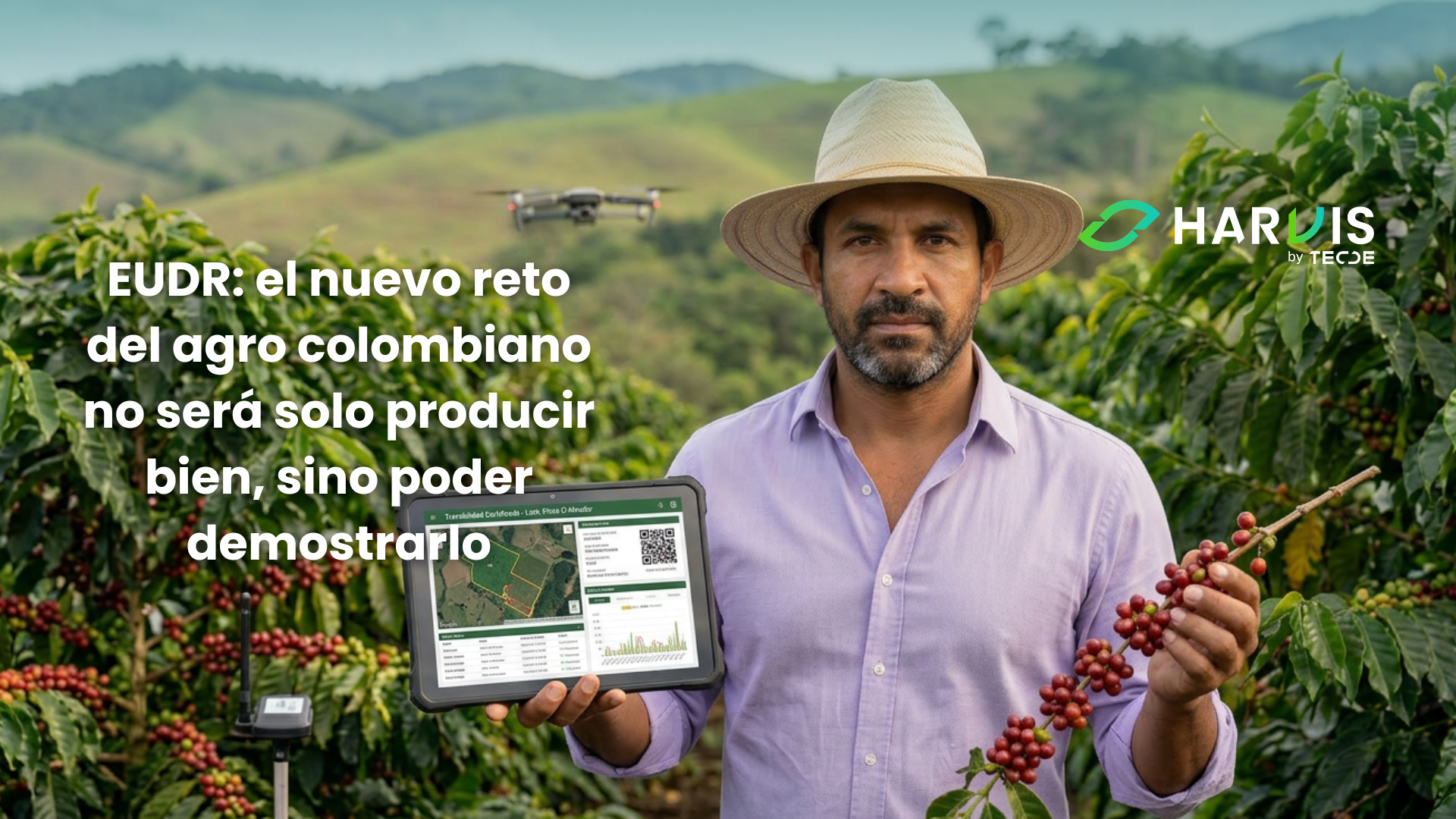
As we already covered in our blog EUDR: the new challenge for Colombian agriculture will not be just producing well, but being able to prove it, which you can read here, the European rule turns farm information into a condition for selling; in cocoa, that information includes the plot map and, increasingly, a cadmium analysis showing where the beans come from.
Knowing which cocoa plot can prove where it comes from
Do you have the coordinates of each cocoa plot, the date it was planted, and the result of its latest soil analysis in one place? On most farms, that information is in loose papers, in the owner’s memory, or in the association’s office, and the exporter asks for it just when the beans are ready to leave. Harvis helps you save each plot’s polygon, plantings, analyses, and what comes out in each harvest from your phone, and shows you which plot has everything the buyer asks for and which one is missing something. Write to us and we will set it up using the plots and harvests you already have.
Clones, cadmium, and analysis: what research has already put in the cocoa grower’s hands
The first advance is in the trees. National research, together with producers, selected several cocoa clones, that is, identical trees reproduced by grafting to preserve their characteristics. In a trial in warm, humid climate, the TCS 19 clone produced 1.44 kilos of dry beans per tree in the third year, compared with 0.66 kilos from the traditional material used for comparison. Scaled to a hectare, that equals more than one ton per hectare, close to double the national average.
Clones are not planted alone. Some do not pollinate with their own flower and need another clone nearby to produce pods. That is why the recommendation is to plant them mixed, following the combination indicated by the technician, and not fill a plot with a single material just because it performed best on another farm. They also differ in disease response; in the same trial, moniliasis affected from 5% to almost 39% of the pods depending on the clone.
The second advance is understanding cadmium. A study on a Colombian cocoa farm followed the metal from the soil to the chocolate bar and found that processing, that is, fermentation and drying, did not change the cadmium in the bean. What does change is the shell, which had nearly twice as much cadmium as the kernel. Measuring cadmium in the peeled kernel, which is what reaches the chocolate, and not in the whole bean, can show a value up to 40% lower.
In the soil, solutions are slower than expected. In ten field trials lasting three to five years, compost, gypsum, lime, and fertilizer reduced cadmium in the bean, but only slightly; the best result reduced it by just a quarter. The practical recommendation remains to keep soil acidity under control, with a pH above 5.5, and to analyze the soil at least every two years. pH is the measure of how acidic the soil is, and the more acidic it is, the more cadmium the tree can take up.
The third advance is cheaper measurement. A portable device that reads cadmium with X-rays gave results almost identical to the laboratory in beans, leaves, and soil. That opens the door to checking many lots before harvest and separating beans by cadmium level, instead of waiting for the buyer to reject them. Together with the map of each plot, that is what makes it possible to decide which beans go to which market.
What these figures say about the country, not your farm
First, the area, production, and yield figures are national averages, and those for 2025 are still preliminary. An average of 600 kilos per hectare mixes farms with 300 kilos and farms with more than one ton, and says little about what a specific plot can produce.
Second, exports include beans, butter, chocolates, and other preparations. Their 2025 growth is explained in large part by the international price, which has already fallen, so it cannot be read as an equal increase in what each producer earns.
Third, the cadmium data in Colombian beans come from informal samplings, not from a national measurement, and the soil amendment trials were carried out on farms in Ecuador. They show the direction of the problem, but not how much cadmium your soil has or how much it would drop with lime or compost.
Fourth, none of these figures can be copied exactly to another farm. The clone yield came from a single research center, in grafted and well-managed trees, and the per-hectare value is a calculation based on the tree, not a hectare measurement. What can be taken to any farm is the method: locate the plot, measure the soil, and count what it produces.
A plot, its coordinates, and a soil sample
Choose the cocoa plot that you sell the most from. Stand at one corner with your phone and write down its coordinates with six decimal places, which is what the European rule requires. If the plot is larger than four hectares, walk the entire boundary with a mapping app and save the polygon. Also note the approximate planting date and keep any document or photo showing that there was no forest there after 2020.
Take a soil sample from that plot and ask the laboratory for a pH and cadmium analysis. If the pH is below 5.5, you already have a first task to reduce acidity. If cadmium comes out high, talk to your buyer or your association before harvest, so you know whether your beans need to go into a blending lot or to a different market.
In the next harvest, mark 20 trees in the plot and count the healthy pods that come from each one. In a material like ICS 95, about 22 pods are needed to make one kilo of dry beans. If your 20 trees produce 440 pods, that is about 20 kilos of beans, one kilo per tree, and with that you can already compare your plot with the nearly one and a half kilos that the best clone in the trial produced.
By the end of one harvest you will have three things that no national average gives you: the plot located as the buyer requires, its acidity and cadmium level, and how much each tree really produces.
Cocoa is sold with the bean and with the proof
Colombian cocoa is going through a good moment that does not depend only on the producer. The price is decided by the weather on another continent, and it has already fallen to half of its peak. What does depend on the farm is bean quality, the yield of each tree, and the information that proves where it comes from, and those three things are what the buyer will keep paying for when the price normalizes.
What you can do starting this week fits into five decisions. Locate each cocoa plot with its coordinates and, if it is larger than four hectares, with its polygon. Request a soil analysis with pH and cadmium. Count the pods on 20 trees in the next harvest. Ask your association about the clones available to renew the oldest trees, planted in a mix. And keep the planting date, analyses, and what you sell from each plot in one place.
The cocoa grower who arrives at the next harvest with that information will be able to sell to whoever demands proof and choose better who to sell to; the one who keeps waiting for the price to rise again will discover that the buyer no longer asks only how many kilos they have, but where they came from.
Do you want to know which cocoa plot has everything the European buyer asks for and how much each one is really producing? Write to us and we will show you how Harvis brings together the map, analyses, and harvests of your farm in a single record.
References consulted
- Zambrano, P., Rodríguez, A., Mahecha, L., Díaz, L., Sánchez, H. and Gallego, L. (2026). EVA 2024-2025, final report. National agricultural activity. Rural Agricultural Planning Unit (UPRA). https://upra.gov.co/sites/default/files/2026-05/01%5FResultadosEVA.pdf
- UPRA (2024). Cocoa production cost bulletin. Rural Agricultural Planning Unit. https://upra.gov.co/en/Evas%5FDocumentos/01%5FBolCosCacao%5F20241107.pdf
- Analdex (2026). The world increased purchases of cocoa and its derivatives of Colombian origin by 56% in 2025. National Foreign Trade Association. https://analdex.org/2026/02/17/el-mundo-aumento-56-las-compras-de-cacao-y-sus-derivados-con-origen-colombiano-en-2025/
- Ministry of Commerce, Industry and Tourism (2026). Valle del Cauca shipped one third of the exported volume in agribusiness products. MinCIT. https://www.mincit.gov.co/prensa/noticias/comercio/en-2025-agroindustria-con-porcentaje-exportado-nme
- International Cocoa Organization (2024). Revision of Annex C of the International Cocoa Agreement (ICA), 2010. ICCO. https://www.icco.org/revision-of-annex-c-of-the-international-cocoa-agreement-ica-2010-3/
- International Cocoa Organization (2025). Cocoa Market Report for November 2025. ICCO. https://www.icco.org/wp-content/uploads/Cocoa-Market-Report%5FNovember-2025.pdf
- Baffes, J. and Temaj, K. (2025). Beverage prices moderate as coffee and cocoa supply recover. World Bank, Data Blog. https://blogs.worldbank.org/en/opendata/-beverage-prices-moderate-as-coffee-and-cocoa-supply-recover
- European Parliament and Council of the European Union (2023). Regulation (EU) 2023/1115 on the placing on the Union market of certain commodities and products associated with deforestation and forest degradation. Official Journal of the European Union, L 150. https://eur-lex.europa.eu/eli/reg/2023/1115/oj
- European Commission (2026). Delay until December 2026 and other developments in the implementation of the EUDR Regulation. Access2Markets. https://trade.ec.europa.eu/access-to-markets/en/news/delay-until-december-2026-and-other-developments-implementation-eudr-regulation
- European Commission (2023). Regulation (EU) 2023/915 on maximum levels of certain contaminants in food. Official Journal of the European Union, L 119. https://eur-lex.europa.eu/eli/reg/2023/915/oj
- KU Leuven and Standards and Trade Development Facility (2025). Improving the institutional capacity of Colombia and Ecuador to mitigate trade barriers due the high cadmium levels in cacao, STDF/PG/681, final report. STDF. https://standardsfacility.org/sites/default/files/2026-06/STDF%5FPG%5F681%5FFinal%5FReport%5FJun%5F26.pdf
- Bravo, D., Santander, M., Rodríguez, J., Escobar, S., Ramtahal, G. and Atkinson, R. (2022). From soil to chocolate bar, identifying critical steps in the journey of cadmium in a Colombian cacao plantation. Food Additives & Contaminants, Part A, 39, 949–963. https://hdl.handle.net/20.500.12324/41229
- Bravo, D. and collaborators (2021). Research and recommendations on cadmium in cocoa cultivation in Colombia. Booklet 2, Collection of booklets on cadmium in cocoa. AGROSAVIA. https://doi.org/10.21930/agrosavia.nbook.7404562
- Bacca, P. P., Alarcón, K. A., González, J. C., Guzmán, F. A., Coronado, R. A. and Romero Barrera, Y. (2023). Evaluation of four cocoa genotypes in Nariño, Colombia. Mexican Journal of Agricultural Sciences, 14(7), e3331. https://doi.org/10.29312/remexca.v14i7.3331